Comparing Sport Tires
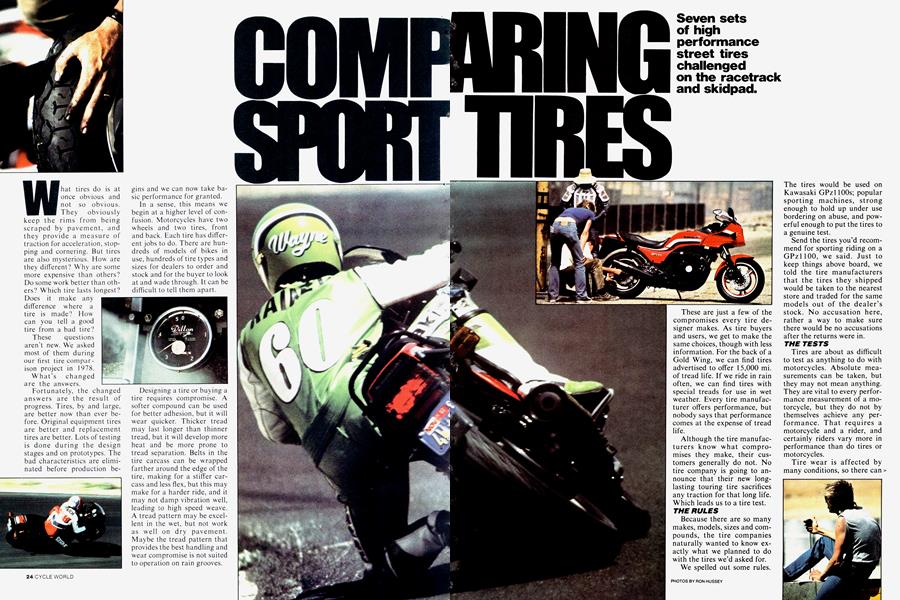
COMPARING SPORT TIRES
What tires do is at once obvious and not so obvious. They obviously keep the rims from being scraped by pavement, and they provide a measure of traction for acceleration, stopping and cornering. But tires are also mysterious. How are they different? Why are some more expensive than others? Do some work better than others? Which tire lasts longest?
Does it make any difference where a tire is made? How can you tell a good tire from a bad tire?
These questions aren't new. We asked most of them during our first tire comparison project in 1978.
What's changed are the answers.
Fortunately, the changed answers are the result of progress. Tires, by and large, are better now than ever before. Original equipment tires are better and replacement tires are better. Lots of testing is done during the design stages and on prototypes. The bad characteristics are eliminated before production begins and we can now take basic performance for granted.
In a sense, this means we begin at a higher level of confusion. Motorcycles have two wheels and two tires, front and back. Each tire has different jobs to do. There are hundreds of models of bikes in use, hundreds of tire types and sizes for dealers to order and stock and for the buyer to look at and wade through. It can be difficult to tell them apart.
Designing a tire or buying a tire requires compromise. A softer compound can be used for better adhesion, but it will wear quicker. Thicker tread may last longer than thinner tread, but it will develop more heat and be more prone to tread separation. Belts in the tire carcass can be wrapped farther around the edge of the tire, making for a stiffer carcass and less flex, but this may make for a harder ride, and it may not damp vibration well, leading to high speed weave. A tread pattern may be excellent in the wet, but not work as well on dry pavement. Maybe the tread pattern that provides the best handling and wear compromise is not suited to operation on rain grooves.
Seven sets of high performance street tires challenged on the racetrack and skidpad.
These are just a few of the compromises every tire designer makes. As tire buyers and users, we get to make the same choices, though with less information. For the back of a Gold Wing, we can find tires advertised to offer 15,000 mi. of tread life. If we ride in rain often, we can find tires with special treads for use in wet weather. Every tire manufacturer offers performance, but nobody says that performance comes at the expense of tread life.
Although the tire manufacturers know what compromises they make, their customers generally do not. No tire company is going to announce that their new longlasting touring tire sacrifices any traction for that long life. Which leads us to a tire test.
THE RULES
Because there are so many makes, models, sizes and compounds, the tire companies naturally wanted to know exactly what we planned to do with the tires we’d asked for.
We spelled out some rules. The tires would be used on Kawasaki GPz 1100s; popular sporting machines, strong enough to hold up under use bordering on abuse, and powerful enough to put the tires to a genuine test.
Send the tires you’d recommend for sporting riding on a GPzllOO, we said. Just to keep things above board, we told the tire manufacturers that the tires they shipped would be taken to the nearest store and traded for the same models out of the dealer’s stock. No accusation here, rather a way to make sure there would be no accusations after the returns were in.
THE TESTS
Tires are about as difficult to test as anything to do with motorcycles. Absolute measurements can be taken, but they may not mean anything. They are vital to every performance measurement of a motorcycle, but they do not by themselves achieve any performance. That requires a motorcycle and a rider, and certainly riders vary more in performance than do tires or motorcycles.
Tire wear is affected by many conditions, so there can
be no absolute measure of tire wear. One rider may get 5000 mi. out of a tire that lasts 10,000 mi. for another rider. Tire wear is not proportional. Some tires might wear quicker when they have the most tread, others might wear quicker when the tread is nearly gone. That makes projections of tread wear risky. We measured tread wear during the test, but it is not a perfect measurement. Tread wear and traction are contradictions. To get one, you sacrifice the other. The soft compound tires in this test will not last as long as harder compound tires. If tread wear is important to you, our best advice is to buy a tire with the hardest compound and stiffest carcass.
Two points emerged from our discussions with tire engineers and producers. One is that riders feel what they expect to feel. A rider who knows he is riding on a Hardstone Neverwear tire-substitute is not going to feel like going fast. He will have already assumed the tire is not good. And maybe a rider will push harder knowing he’s riding on the tire that he sees win at the races. The cure for this is blind testing. No, the rider isn’t blindfolded when he’s riding the bike. But before he gets on the bike, we would cover up the tires and send him on the track without telling him what tires were on the bike.
The second point is variety. Not all riders have the same needs in tires or feel the same things. For this, we wanted the widest range of riders we could find, but people skilled in observation as much as in riding.
To make the most of the tires and riders our tests are both specific and conceptual. The usual test consists of putting a bunch of tires on motorcycles and letting riders ride around a racetrack. The riders come into the pits and explain their observations while guys with stopwatches record lap times. This is simple enough and it’s very good at determining which tire works best for a specific racetrack. And it’s part of our tire test. For this test the riders would be Wayne Rainey, Kawasaki’s hot-shot superbike pilot, and our own John Ulrich, a successful endurance racer and production-class
"Tires Two (Metzeler) and Four (Dunlop) were the best. Number four has good traction but it’s not as stable.
Number two slides too easy.”
roadracer. Wayne is one of the top roadracers in the country, and he has an additional talent left over from his days as a dirt track star. Sliding a motorcycle, even a big heavy motorcycle, does not scare him. He is also particularly articulate, which means a lot when you want someone to explain why a tire feels different from another tire. John
is valuable for this test because he has the opportunity to ride virtually every motorcycle made and use lots of different tires on those motorcycles. He has spent lots of years learning to tell how motorcycles differ.
A racetrack is a busy place. Riders use combinations of every skill they have to go fast, and in so doing, it can be difficult to break down the little skills.
To help us do that we went to the skidpad. If the roadrace track is well removed from normal street riding, the skidpad is other-worldly. It is not part of normal motorcycle testing because it is difficult to fling a motorcycle around a circle at anything approaching its limits. The bigger the motorcycle, the more difficult this is. Still, you can feel things on a skidpad that cannot be felt anywhere on a racetrack, and some of those things are important on the street. On a racetrack the rear tire is easy to slide and spin. On a skidpad the front tire is almost always the limiting factor in cornering, at least when that skidpad is the normal automotive 200 ft. diameter variety. For that, we headed to the Mira Loma test center. The skidpad there is not perfectly smooth pavement. It is a bit bumpy, has occasional patches of weeds growing through cracks in the pavement, and is coated with a little loose gravel. After>
some sweeping it resembled the kind of surface where motorcyclists might fall down, a surface that looked better than it worked. Our riders were Mike Minnig, an expert AMA flat track racer who has raced on pavement and won, and Steve Anderson, CW technical editor and club roadracer. Mike has extraordinary skills when it comes to sliding a motorcycle and living, and Steve is experienced on skidpad riding and describing motorcycle behavior.
While at the skidpad, other tests were made. Motorcycles have to brake and accelerate, and tires are important for this, but normal braking and acceleration tests measure motorcycles more than tires. What we wanted to find out is what actual traction is provided by the tires. Armed with special brackets and strain gauges we measured accelera-
tion and braking forces achieved by front and rear tires just before they began slipping. The acceleration test was run with the strain gauge fastened to a post. The braking test was run with the motorcycle being towed and the front brake gradually applied until the front tire locked. When tires began sliding the peak figure had been reached.
To corroborate these figures we ran normal braking tests, from an indicated 60 mph with a standard tire, and calibrated the speeds so all tests would be run from the same speed. Stops were made using just the front brake to achieve more consistent results. The results were not identical to the braking force numbers, but they are probably a better indication of performance.
A compilation of the performance numbers is shown in the accompanying charts. The times are tire testing times, not racing lap times. The riders were trying for consistency and discovery, not the lap times they are capable of. Here, it's fair to mention what we didn’t test. We don’t have tests of wet weather performance because there was no wet weather during the tests and honest wet-weather tests were simply beyond the testing resources in Southern California. We don’t have tests of these tires with the tread worn. Because tread wear varies so much from rider to rider, there would be no standards for this, though we are interested in possible results. What we have is the best independent tire test we can do.
THE TIRES
Selecting tires was arbitrary but, we hope, fair. We were after high performance tires, any name that is sold as a high quality replacement tire. Our initial list included Avon, Bridgestone, Carlisle, Continental, Dunlop, IRC, Metzeler, Michelin, Pirelli and Yokohama. All these brands have achieved some measure of racing or commercial success and they are the brands that are available in stores and seen on tracks. At least, that’s what we thought when we started out. Letters were sent to all the tire importers asking for tires. Three of the brands invited to participate did not arrive in time for the test and none were available in motorcycle dealers or distributors in Southern California. Those three were Avon, Carlisle and Pirelli. After the tests were complete the Carlisles arrived, but we still haven’t seen the Pirellis or Avons.
A complicating factor in this test is tire size. No longer are sport bikes equipped with
18 in. rear tires and 19 in. front tires. Some have 16 in. fronts, some 18 in. and some
19 in. Rear tires range from 15 in. to 18 in. High performance bikes seem to be concentrating on the 18 in. front tire and the 17 in. rear tire right now, though that may change, too. But not all the companies make all sizes of their best sporting tires. Some of our test tires are smaller than stock size because that’s what was sent. Some of the tires are V-rated, some are Hrated, some S-rated and some carry no ratings. The ratings relate to European speed standards. V-rated tires are designed for sustained speeds up to 150 mph, H-rated tires are designed for speeds up to 130 mph and the S-rating is 112 mph. These ratings are not required on tires, but may indicate some difference in tire models.
THE RESULTS
When all the laps were ridden, the miles piled up, the measurements taken and the notes compiled, the tires stacked up like this, in alphabetical order:
Bridgestone Mag Mopus L303 and G508
Mag Mopus Bridgestones come in all varieties, and these are the top of the line V-rated versions. Good basic tires, these are. Nothing in here is surprising or dangerous. They don’t have the stick of the sport-compound tires and they will probably wear longer
because of it. Braking performance is mid-pack. These tires were the most likely to develop a high speed weave in our 140 mph weave hunt. On the track the Bridgestones weren’t the worst at anything. One rider achieved his third fastest lap times on the Bridgestones, the other rider was fifth fastest. The Bridgestones also came in third and fifth on the skidpad. The only feel that the Bridgestones provided is a feeling of original equipment. If anything, they are distinctive because of their lack of distinction. There's nothing wrong with that. If you like the way your bike handles with stock tires, the Bridgestones will preserve that feeling, and their performance is up to any task short of winning production class road races. The Bridgestone front tire was one of three small front tires sent for the test. It is a 100/90V-18 instead of the standard 1 10/9018. The other two small front tires scored the worst in most of the tests, but the Bridgestone was about average. Tread wear was more pronounced for the Bridgestones than any of the other tires. Front tire wear was .02 in. and rear tire wear was .05 in. Shredded rubber was noticeable on the edges of the front and rear tires.
Continental Super Twins TK22 and TK44
No longer are the Conti Twins the only tires from Continental. Now there are the V-rated Super Twins. These are among the more distinctive tires in this test. An experienced rider could tell he was riding on Continental tires, even though he hadn't seen the tires before he rode on them. What makes these tires so noticeable is limited rear tire traction. The back tire would slide at lower speeds than any of the other tires. Nobody erashed, but it slowed the riders down. The front tire, as the skid pad shows, is above average in stick and cornering control. Continental has announced a soft compound version of these tires. That would likely help for racetrack use, but so far we haven't found any for sale in our area. The marvelous front tire, though, makes the Continentals an excellent choice for all-around use. Metzeler offers tires in hard and soft compounds and a Metzeler representative occasionally recommends using his soft front tire with a hard compound rear for the best street combination with the least cost penalty. That’s what Continental appears to have done. The front tire was the shortest stopping tire in the test and both skidpad riders achieved excellent times with the• Continentals. Only the somewhat slippery rear tire keeps these from being raceready. Tread wear was .01 in. front and .02 in. rear, average for the test. The front tire showed no unusual wear patterns, but the rear tire, which had been sliding during the test, had noticeable wear patterns in the tread blocks.
Dunlop K391 Sport Elites
Dunlop makes a wide variety of replacement tires, but the two Elites, the Sporting and the Touring, are prominent at the top of the line. A new Sporting Elite, the K39l, became available just as we began the test. Dunlop uses the most distinctive tread pattern on the new K39ls. The front tire is an all-new design with a pattern much like that of the rear tire. These are available in the soft compound tested and a harder compound, both with the same tread pattern and carcass. With the softest compound, the Dunlops are a hard-edged sport tire. They have lots of traction and on the roadrace course they work beautifully, one of two outstanding tires on the track. It took our crew some time to get used to the traction available on these tires. Riders used to finding the limits of other tires, particularly other rear tires, found they were approaching the Dunlops too cautiously. The rear Dunlop in particular has extraordinary traction. It didn't go away when it was hot and it didn’t feel unstable, though there was more handlebar wiggling with the Dunlops than the Metzelers. In measures of front tire control the Dunlops are inferior to both the German tires, with longer stopping distances and slower skidpad speeds. But on the track, that marvelous rear tire is the most important thing and the Dunlop rear tire is the best of the bunch. Tread wear was average, .01 in. front and .02 in. rear. Rear tire wear was normal, but the front tire had some tearing of the rubber visible. Like the Metzelers, the Dunlops came with a recommended tire pressure for racetrack use, 32 psi front and 36 psi rear. Both figures are higher than usual motorcycle recommendations and they may have influenced the results.
At the conclusion of the test we again heard from Dunlop. In their testing, some riders had asked for a better compound on the rear tire, one that would work better in the hottest weather. Dunlop, said the spokesman, was consider->
"There’s not a tremendous difference between many of the tires. Itoo are good, one bad, the rest are about the same.”
ing a change in the compound used on the K391. Perhaps our test tire is not an example of what will appear at dealers. As this goes to press, Dunlop has not decided what compound will be used on future production K391s.
Dunlop Gold Seal F11 and K127
Throughout the testing, our riders had a standard by which the tires could be judged. That standard was original equipment. The Kawasakis came equipped with V-rated Dunlop Gold Seal Fl l and K127 tires. While many people might not think of original equipment tires as replacement tires, there can be good reasons for keeping stock tires on a bike. Usually a factory does considerable testing to make sure the stock tires are not prone to high speed weaves. In the Kawasaki's case, the bike didn’t have a problem with the replacement tires. Performance wise, the stock tires are capable but not outstanding. Skidpad times were about the same as the times for the slowest tires. Racetrack times were about average for one rider and next to the slowest for the other rider. Remember that these tires are competing against the best replacement tires money can buy. The Gold Seal Dunlops were not subjected to the full set of performance tests, and they were used when the bikes were ridden to test tracks and for warmup laps, so that mileage on the test tires would be uniform. That means mileage figures for the stock tires aren't available. The stock tires were not exactly part of the test, but they are certainly worth using on the Kawasakis for anything except genuine competition.
IRC Road Winner HS-210
Taken as a whole, the Japanese tires in the test possessed a uniformity of feel. Call it the original equipment feel, if you will. It’s not a bad feel, and if anything, it’s the feel we come to expect from motorcycle tires. On the skidpad the IRC tires work better than some of the other mainstream tires. Times were better than average and the riders had little bad to say. On the track the same kind of comments were made about the IRCs. The front stuck well, the back slid some, bat there was no cause for alarm. Only during the brake tests did the IRCs figuratively fall down. There, the tires locked without warning. All the stopping distances with the IRCs were longer than any of the other tire distances. Some of the trouble may have come after the test rider was surprised by the front tire sliding, but even before he built up an intimidation factor, he couldn’t get good stopping distances from the IRCs. Because these tires achieved good scores in the static tests of traction, there was some conjecture that they make a more sudden transition from static to dynamic coefficients of friction and that the difference is great. Among the characteristics of the IRCs is below-average tread wear (.01 in. front and rear) and an abnormally heavy rear tire. At 19.0 lb., this was by far the heaviest rear tire in the test. Wear pattern was normal, with some shredded rubber and the edges of tread blocks showing noticeable rounding.
Metzeler Perfect ME77 and ME99A Sport
The first time a rider tried a bike equipped with the Metzelers, he knew that there would be measureable differences in the tires, and he knew the Metzelers would be among the best. On the skidpad, the Metzelers tied for the best times and all the riders enjoyed the marvelous front tire’s ease of control at the limit. On the racetrack the Dunlops were a match for the Metzelers, though the fastest time of day came with the Metzelers. Near the end of the test the rear tire was sliding; this could be because of the higher lap speeds, or it could be because the Metzelers fade in the heat. Metzelers are the choice of racers in areas with lower temperatures than Southern California, and are only starting to appear on California tracks. In the braking test the Metzelers were right behind the Continentals with a short 114 ft. stop. Most noticeable of the Metzeler characteristics is a neutrality to steering response. Other tires were prone to turning in or turning out when cornering at low speeds, while the Metzelers enabled the bike to follow rider commands without any correction. The Metzelers were run on the track at higher air pressures, 36 psi front and 42 psi rear, because Metzeler recommends these pressures for track use. Only Dunlop, among the other tire companies, had any track pressure recommendations. Tread wear was about average, .01 in. front and .02 in. rear. The front tire exhibited noticeable chunking on the edges of the tread blocks with some rubber shredding visible.
Michelin A48 and M48
Last time Cycle World conducted a tire test, the Michelin M45 ran off with the prize. Now Michelin has a new top of the line tire combination. For this test Michelin sent the A48 front tire and the M48 rear tire. Perhaps it is an indication of how far things have come, but this time the Michelin tires scored near the back of the pack in almost every test. They were the slowest on both the skidpad and the racetrack for half the test riders, and for the other rider in each event the Michelins were nearly the slowest. Braking distances were respectable, but not out of the ordinary. Even feel was not noticeably different, in that the Michelins fit in a great middle ground with the three Japanese tires. There’s nothing spooky about riding on the Michelins. They don’t let go suddenly or ride harshly. They just don’t have as much traction at the limits as some of the other tires. The only distinction achieved by the Michelins in any tests were slightly greater than average front tire traction numbers in the static test, but this didn’t translate into good braking. Some of the Michelin’s shortcomings could be attributed to a smaller size front tire than Kawasaki recommends, a 100/90-18. Michelin doesn’t have a 1 10/90-18. The Michelins are V-rated. Tread wear was about average, .01 in. front and .03 in. rear. At the end of the test the front tire had noticeable cracks in the center of the tread blocks.
Yokohama Y-992 and Speedline
Here was a noticeable difference between skidpad and racetrack. On the small circle the Yokohamas were in the great middle ground and didn’t scare anybody. Good journeyman tires. But on the racetrack Rainey pulled off the track after two laps. He had slid the front tire going into several turns and just couldn't ride fast on the Yokohamas. At a slightly slower pace Ulrich didn’t notice the same deficiencies and thought there was good traction. It appears the rear Yokohama, part of a new generation of tires, is a good tire. The front is from a previous generation of Yokohamas. It is smaller than the others at 3.50S-18, and it is the lightest front tire at 8.8 lb. The new version is not yet available in an 18 in. front size, which hurt the performance of this brand. It is interesting that Rainey’s lap times on the Yokohamas were much slower than his times on any other tire. His many skills at controlling a motorcycle that wants to fall enable him to ride quickly on a variety of tires, but this brand stumped him. The weakness of the front tire is also shown by the slowest time for the fastest skidpad rider, another indication of the dated front tire. At least it was an average performer in the braking test. There was no measurable tread wear during the test and the tread showed the least scuffing and wear of all the tires at the end of the test.
LESSONS WE HAVE LEARNED
Before the tests began, no one knew how much difference would be noticeable. It turns out there are differences. How big these differences are is difficult to explain. Yes, some tires are better than others. The gaps are enough for normal riders to feel. But these gaps are not so great that any tires are unuseable. Any of the tires in this test are up to normal high performance demands. The differences we found have appeared only at racing speeds.
So. Having now wrung the best tires we could find through every meaningful test we could find, what have we found?
We’ve found that a fast rider rides faster than a slow rider. We’ve found that most of these tires feel very much alike and work very much alike. We've found that a few tires have distinctive features. These features may be universally appreciated, or they may appeal to some riders, or they may offend some riders.
Yes, we’ve heard the boasting and seen the guy at the biker hangout who has the war stories from his canyon racing. If he’s really skilled and really brave, he may be exercising his tires about as hard as these tires were pushed in the warmup laps. Racing speeds are not the same. Racetracks are not the same. On a track a tire can be pushed farther, closer to its limits. For that use, some of these tires work better than others. The Dunlop K391 Sport Elite Soft compound and Metzeler Perfect Sport compound work the best, with the Dunlop having maybe a traction edge and the Metzelers imparting a wonderful you-can-do-no-wrong feel.
It shouldn’t be so surprising that these two tires are the best on the racetrack. They’re the ones with the super-sticky compounds designed just for racetrack work. These tires are available with more normal compounds, which would last longer on the street.
Behind those two are the Continentals with a great front tire and a hard rear tire. While this combination doesn’t work well on the track, it can make a good street combination.
The other tires really defy classification. They do their job. Maybe a few years ago any of the rest of these tires would have been clear winners, but there is progress being made and some tires have progressed more than others.
"I could race on either number two (Metzeler) or four (Dunlop)”
More From This Issue
-
 Up Front
Know Thy Beast
October 1983 -
 Letters
Letters
October 1983 -
 Departments
Summary
October 1983 -
 Roundup
Ducati Quits Bike Business To Build Engines For Cagiva
October 1983 -
Roundup
California Postpones Bike Catalytic Converters
October 1983 -
 Roundup
Feds Give Nod To Barstow-To-Vegas Race
October 1983


