Kawasaki Owner Survey
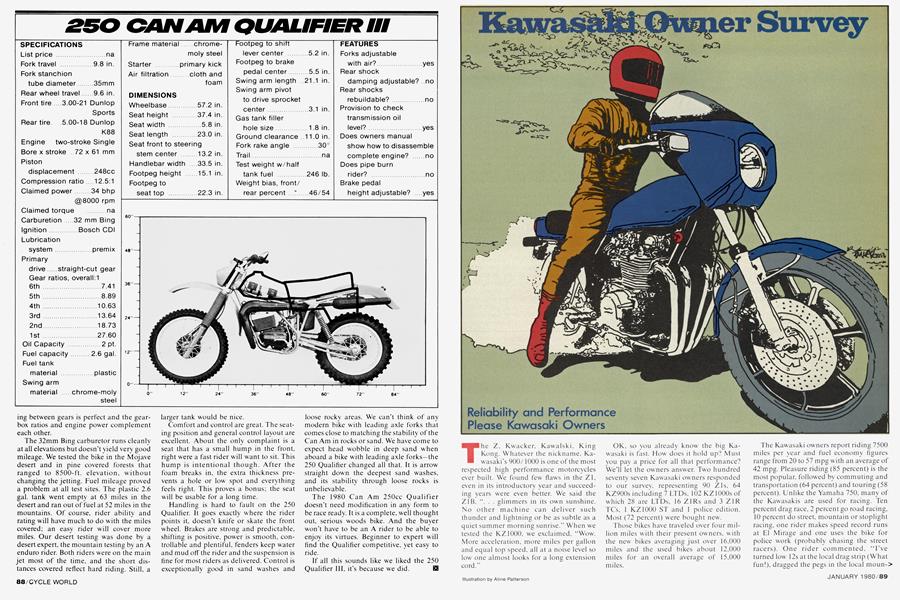
Kawasaki Owner Survey
Reliability and Performance Please Kawasaki Owners
The Z. Kwacker, Kawalski, King Kong. Whatever the nickname. Ka wasaki's 900/1000 is one of the most respected high performance motorcycles ever built. We found few flaws in the Zl. even in its introductory year and succeeding years were even better. We said the ZlB. “. . . glimmers in its own sunshine. No other machine can deliver such thunder and lightning or be as subtle as a quiet summer morning sunrise.” When we tested the KZ1000. we exclaimed, “Wow. More acceleration, more miles per gallon and equal top speed, all at a noise level so low one almost looks for a long extension cord.”
OK, so you already know the big Kawasaki is fast. How does it hold up? Must you pay a price for all that performance? We’ll let the owners answer. Two hundred seventy seven Kawasaki owners responded to our survey, representing 90 Zls, 64 KZ900s including 7 LTDs, 102 KZ 1000s of which 28 are LTDs, 16 ZIRs and 3 Z1R TCs, 1 KZ1000 ST and 1 police edition. Most (72 percent) were bought new.
Those bikes have traveled over four million miles with their present owners, with the new bikes averaging just over 16,000 miles and the used bikes about 12,000 miles for an overall average of 15,000 miles. The Kawasaki owners report riding 7500 miles per year and fuel economy figures range from 20 to 57 mpg with an average of 42 mpg. Pleasure riding (85 percent) is the most popular, followed by commuting and transportation (64 percent) and touring (58 percent). Unlike the Yamaha 750, many of the Kawasakis are used for racing. Ten
percent drag race, 2 percent go road racing, 10 percent do street, mountain or stoplight racing, one rider makes speed record runs at El Mirage and one uses the bike for police work (probably chasing the street racers). One rider commented, “Eve turned low 12s at the local drag strip (What fun!), dragged the pegs in the local moun-> tain roads, commuted to school and work and donned fairing and saddlebags and toured 10 western states. What else could anyone want?”
Kawasaki owners don’t spare their machines. Eighteen percent of them report riding “very hard” and 46 percent ride “moderately hard.” Only 34 percent have an “average” riding syle and almost none (2 percent) ride “gentler than average.” They ride hard but they take care of their bikes. Thirty-five percent always do their own work, 44 percent usually do, 19 percent sometimes work on their bikes and only 2 percent never do.
Thirty-six percent find the work “very easy,” 60 percent call it “average” and only 1 percent say it is difficult to work on.
Parts aren't much of a problem with 40 percent finding parts always available, and 48 percent finding them mostly available. Very few (5 percent) said they are sometimes hard to find and fewer ( 1 percent) said they are always hard to find.
Not only are parts easy to find, they’re not often needed. Only one maintenance problem was mentioned by 5 percent or more of the owners. Ten percent of the respondents told us they dislike the shimtype valve adjustment, citing its cost at the dealer and the need for spare shims in assorted sizes and special tools. Other problems mentioned include miscellaneous oil leaks and carb problems (mostly synchronization), with 4 percent each and chain and sprocket wear, tire wear and difficult battery access listed by 3 percent each.
Most of the service hints are recommendations to do all the lubrication and adjustments frequently to enhance reliability. One owner suggested, “Be compulsive. Do what the ow ner’s manual says when it says to do it.” Other suggestions included setting the dwell to 24°-26° on the eightcylinder scale of a dwell meter and using 125 main jets with the needles in the #4 slot for use with Kerker headers. Which Kerker muffler core was used wasn’t mentioned.
An equal number of owners (31 percent) rated their dealers “very good” or “good,” 20 percent rated their dealer “fair” and the remainder split evenly between “poor” and “very poor.” Praise for the better dealers included comments such as, “Service is great and so are his parts supplies and hints if I do it myself. He also gave me my first issue of Cycle WorldV’ The poor and very poor dealers earned their ratings with high parts prices and small inventories, inexperienced or incompetent mechanics and policies such as a $200 set-up charge for new bikes.
Only 10 percent of the Kawasakis ever broke down or stranded their owners but even that low figure doesn’t convey the sense of indestructibility given by some of the comments made by the owners. One had his battery explode when he used the electric starter but made it home with the kickstarter. Another rider hit a deer at about 50 mph. The impact killed the deer but the bike survived with a few dents and broken lenses.
Fewer Kawasakis than Yamahas (12 vs. 21 percent) were grounded while waiting for parts, but the average wait was about the same (35 vs. 32 days). In the “other than routine maintenance” category the chain and sprockets lead the list with 13 percent reporting problems (premature wear). Eleven percent had to replace the battery, fork seals and clutch cables were replaced by 9 percent each, 8 percent had to replace the swing arm bushings, while voltage regulator problems and rusted exhaust pipes were each reported by 7 percent of the owners.
Modifications are fairly common on the Kawasakis and most of these are performance oriented. Twenty-two percent had carburetor or intake modifications, 14 percent had assorted internal engine mods (welded crankshafts, big bore kits, etc.), 8 percent sported custom paint jobs, while 7 percent each had dual front discs or internal fork modifications. Other changes re-> ported include drilled discs, electronic ignition and stiffened frames and swing arms.
Kawasaki 900/1000 Survey in Brief
The Kawasaki owners have added every kind of accessory from water cushions to wheelie bars, but headers are the most common with 55 percent of the owners opting for 4-into-l or 4-into-2 pipes. Thirty-five percent changed the seat, 34 percent each added fairings or luggage racks and 28 percent each added case guards or aftermarket shocks.
The Vetter Windjammer fairing was the highest rated accessory by our owners, followed closely by Kerker headers. Other fairings (Pacifico, Fulmer. Wixom and Kawasaki) and headers (RC, Winning Performance. Jardine and Denco) got positive ratings, but from far fewer owners. Other well-rated add-ons included K&N air filters, quartz-iodine headlights, Mulholland, Koni and S&W shocks, Lester wheels, LTD, Ez Berg, Corbin Gentry, Fletcher and Hang Two seats, Dunlop, Continental and Michelin tires, Martek, Dyna III, Gerex and Maxi-Dwell ignitions, smooth-bore Mikuni carbs and ATP turbos.
Reliability was mentioned by 48 percent of the owners as a best feature, followed by speed (36 percent), power (35 percent), styling and appearance (32 percent) and handling (21 percent). Handling was also listed as a worst feature by 30 percent of the owners. Sixteen percent called the seat a worst feature: 12 percent listed vibration but 15 percent called smoothness a best feature. The brakes were rated as a best feature and a worst feature by 8 percent of the owners. The worst feature complaints concerned wet braking. Ride quality was called a worst feature by 8 percent, but 5 percent said it was one of the bike’s best features.
What would they change? Frame and swing arm changes got the nod from 19 percent of the owners, 17 percent dislike the shocks, 13 percent want improved forks and 12 percent each want a better seat and shaft drive.
Would they buy another Kawasaki? Eighty-eight percent said they would. One owner commented. “I would buy another and am picking up a second tomorrow . . . I like the simple styling, lack of do-it-foryou gizmos, good gas mileage and faultless reliability.” But another rider told us, “I had my LTD ripped off in the Yamaha parking lot and half an hour later bought an XS1 1 special.” Seventy-five percent said they’d buy another Kawasaki of the same model, making comments like, “Too bad a new' 1000 shaft is so expensive! Fd buy one in a heartbeat.” and “This bike suits me fine—sure beats the old WWII Hogs and Indians I rode then in N. Africa and Italy.” And finally, “If I ever make another purchase as satisfactory as this Z1 has been. I will die a happy man.” Si