Honda's 1980 Range
HONDA'S 1980 RANGE
The Year of the Bolt-on Shaft Drive
John Nutting
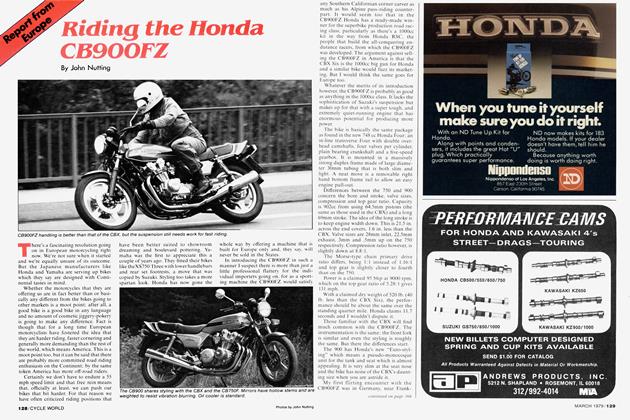
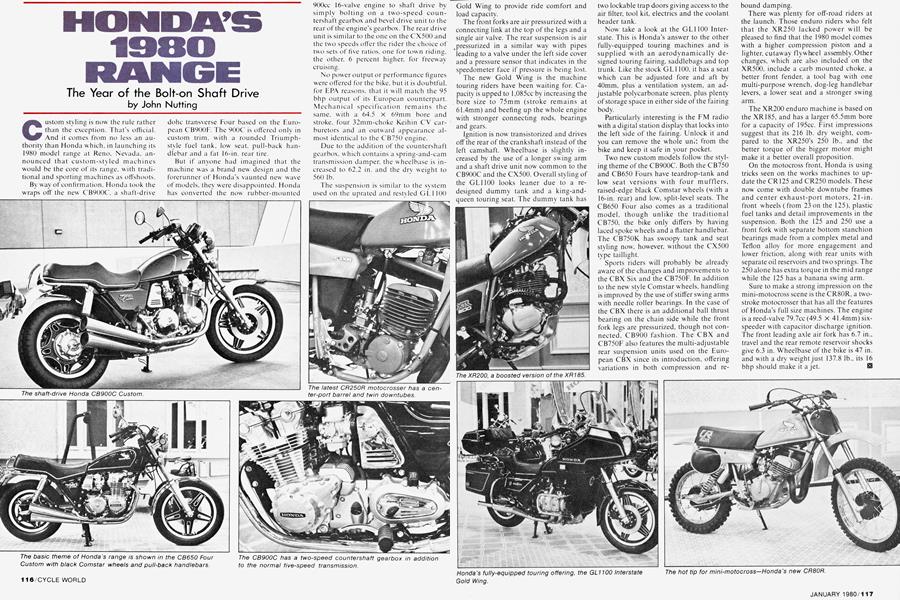
Custom styling is now the rule rather than the exception. That's official. And it comes from no less an authority than Honda which, in launching its 1980 model range at Reno, Nevada, announced that custom-styled machines would be the core of its range. with tradi tional and sporting machines as offshoots. By way of confirmation, Honda took the wraps off the new CB900C, a shaft-drive dohc transverse Four based on the European CB900F. The 900C is offered only in custom trim, with a rounded Triumphstyle fuel tank, low seat, pull-back handlebar and a fat 16-in. rear tire.
But if anyone had imagined that the machine was a brand new design and the forerunner of Honda’s vaunted new wave of models, they were disappointed. Honda has converted the now rubber-mounted 900cc 16-valve engine to shaft drive by simply bolting on a two-speed countershaft gearbox and bevel drive unit to the rear of the engine’s gearbox. The rear drive unit is similar to the one on the CX500 and the two speeds offer the rider the choice of two sets of five ratios, one for tow n riding, the other. 6 percent higher, for freeway cruising.
No power output or performance figures were offered for the bike, but it is doubtful, for EPA reasons, that it will match the 95 bhp output of its European counterpart. Mechanical specification remains the same, with a 64.5 x 69mm bore and stroke, four 32mm-choke Keihin CV carburetors and an outward appearance almost identical to the CB750 engine.
Due to the addition of the countershaft gearbox, w hich contains a spring-and-cam transmission damper, the wheelbase is increased to 62.2 in. and the dry weight to 560 lb.
The suspension is similar to the system used on the uprated and restyled GL1 100 Gold Wing to provide ride comfort and load capacity.
The front forks are air pressurized with a connecting link at the top of the legs and a single air valve. The rear suspension is air ^pressurized in a similar way with pipes leading to a valve under the left side cover and a pressure sensor that indicates in the speedometer face if pressure is being lost.
The new Gold Wing is the machine touring riders have been waiting for. Capacity is upped to 1,085cc by increasing the bore size to 75mm (stroke remains at 61.4mm) and beefing up the whole engine with stronger connecting rods, bearings and gears.
Ignition is now transistorized and drives off the rear of the crankshaft instead of the left camshaft. Wheelbase is slightly increased by the use of a longer swing arm and a shaft drive unit now7 common to the CB900C and the CX500. Overall styling of the GL1100 looks leaner due to a redesigned dummy tank and a king-andqueen touring seat. The dummy tank has two lockable trap doors giving access to the air filter, tool kit, electrics and the coolant header tank.
Now take a look at the GL1100 Interstate. This is Honda’s answer to the other fully-equipped touring machines and is supplied with an aerodynamically designed touring fairing, saddlebags and top trunk. Like the stock GL1100, it has a seat which can be adjusted fore and aft by 40mm. plus a ventilation system, an adjustable polycarbonate screen, plus plenty of storage space in either side of the fairing body.
Particularly interesting is the FM radio with a digital station display that locks into the left side of the fairing. Unlock it and you can remove the whole unit from the bike and keep it safe in your pocket.
Two new custom models follow the styling theme of the CB900C. Both the CB750 and CB650 Fours have teardrop-tank and low seat versions with four mufflers, raised-edge black Comstar wheels (with a 16-in. rear) and low, split-level seats. The CB650 Four also comes as a traditional model, though unlike the traditional CB750, the bike only differs by having laced spoke wheels and a flatter handlebar. The CB750K has swoopy tank and seat styling now, however, without the CX500 type taillight.
Sports riders will probably be already aware of the changes and improvements to the CBX Six and the CB750F. In addition to the new style Comstar wheels, handling is improved by the use of stiffer swing arms with needle roller bearings. In the case of the CBX there is an additional ball thrust bearing on the chain side while the front fork legs are pressurized, though not connected, CB900 fashion. The CBX and CB750F also features the multi-adjustable rear suspension units used on the European CBX since its introduction, offering variations in both compression and rebound damping.
There was plenty for off-road riders at the launch. Those enduro riders who felt that the XR250 lacked power will be pleased to find that the 1980 model comes with a higher compression piston and a lighter, cutaway flywheel assembly.Other changes, which are also included on the XR500. include a carb mounted choke, a better front fender, a tool bag with one multi-purpose wrench, dog-leg handlebar levers, a lower seat and a stronger swing arm.
The XR200 enduro machine is based on the XR185, and has a larger 65.5mm bore for a capacity of 195cc. First impressions suggest that its 216 lb. dry weight, compared to the XR250’s 250 lb., and the better torque of the bigger motor might make it a better overall proposition.
On the motocross front, Honda is using tricks seen on the works machines to update the CR125 and CR250 models. These now’ come with double downtube frames and center exhaust-port motors, 21-in. front wheels (from 23 on the 125), plastic fuel tanks and detail improvements in the suspension. Both the 125 and 250 use a front fork with separate bottom stanchion bearings made from a complex metal and Teflon alloy for more engagement and lower friction, along with rear units with separate oil reservoirs and two springs. The 250 alone has extra torque in the mid range while the 125 has a banana swing arm.
Sure to make a strong impression on the mini-motocross scene is the CR80R, a twostroke motocrosser that has all the features of Honda’s full size machines. The engine is a reed-valve 79.7cc (49.5 X 41.4mm) sixspeeder with capacitor discharge ignition. The front leading axle air fork has 6.7 in., travel and the rear remote reservoir shocks give 6.3 in. Wheelbase of the bike is 47 in. and with a dry weight just 137.8 lb., its 16 bhp should make it a jet.