Suzuki Gs1000
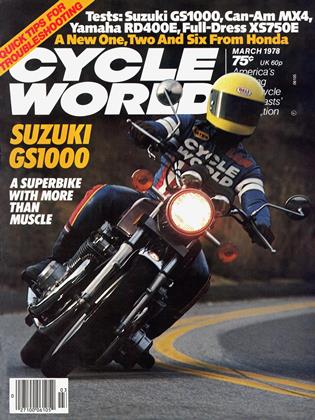
SUZUKI GS1000
CYCLE WORLD TESST
The Superbike With More than Muscle
What’s fast any-
more? The standards are changing. What’s quick? What’s the difference? One bike does the quarter in 11.78 sec., at 114.21 mph. The next one does it in 11.83 at
112.07. Is this an academic distinction? No. It’s just that the current barrage of road missiles is so loaded with eyeball-wideners that the quarter mile has begun to become too short. At the end of a 440-yard run one bike is really starting to come on. The other bike has plenty left, but its power doesn’t have the same elemental May-The-Force-Be-With-You thrust that characterizes the first. Yet both bikes crack the quarter within .05 sec. of each other. And both do it well under 12 sec.
Astonishing. What’s going on here? Suddenly there are production machines so blisteringly rapid that we find ourselves scrutinizing hundredths of seconds in an attempt to make some documentable conclusions about their relative performance.
But there are nevertheless substantial distinctions to be made, and the crop of superbikes we’re seeing this year represents a fascinating variety of approaches to the problem of creating SuperDuperBike. Last month we straddled the Yamaha XSll, turning the tap on the most smoothly awesome source of horsepower we’ve yet experienced on a production bike. Big, muscular and fast.
This month we're communing with the Suzuki GS1000, and a totally different design philosophy. Lightweight, lithe-handling and quick.
The Suzuki GS1000 is rated at 83 bhp, which is the opposite end of the superbike power spectrum from the Yamaha 95. But as the figures show, it more than gets the job done. Consistently. Our man backed his hot time with runs of : 11.85 and : 11.86. (We have also witnessed : 11.75 by another GS1000, but never saw a back-up run under 12 sec. and prefer the duplicability of our times.)
The key to the success of the GS1000 is its relatively light weight. At 536 lb. (with a half-tank of fuel) it is 29 lb. lighter than the Kawasaki Zl-R and 75 lb. lighter than the Yamaha XS1100. The Yamaha’s engine is an incredible thing to experience in a street bike, but the Suzuki out-quicks it. Better than that, it’s substantially quicker on its feet than its competitors. Although all these rockets offer swoop to augment their mind-bending go-power, the Suzuki has a marked edge in all-around maneuverability. Where the Yamaha and Kawasaki must be eased gingerly down those last few' degrees into a hard cornering attitude, the Suzuki can be pitched down directly into position, pow, right now. Although this machine feels as massive as the others at rest, its lighter weight and excellent suspension are discernible almost as soon as the wheels begin to turn. With 75 percent of this year's unparalleled crop of superbikes now in the barn (the Honda Six, previewed elsewhere in this issue, goes up against the stopwatches next month), Suzuki's GS1000 does more things well than anything w'e’ve encountered yet.
The GS1000 project began a couple years back, pre-dating the GS750 by several months. Suzuki had taken considerable interest in the immediate success and acclaim of Kawasaki’s original Z-l and worked up some 960cc prototypes that got as far as the company’s Rvuvo test track — but no farther. Although the 960 showed promise, Suzuki’s product planners chose to make the 750 the flagship of the new line of four-stroke bikes introduced late in 1976. And while the GS750 was selling out completely about midway through the 1977 model year, the slide rule guys were busy applying the lessons of the 750, hands-down winner as best-handling big bike of the year, to the embryo GS1000. The overall design objective was to keep it as light as possible, keep its dimensions, particularly w'idth. generally the same as the 750. and make it handle even better. We’d have to say the engineers scored direct hits on all their targets. The bikes are within 25 lb. and the GS1000 has suspension refinements that make it an even more precise handler than its smaller brother.
The original aim was a lOOOcc bike weighing in under 250 kilograms (550 lb.) dry. Suzuki claims a dry weight that’s just under 500, so it’s clear that the engineers got very serious in their whittling. They started with the engine, and realized their greatest savings there despite an increase in displacement. The kickstarter was the first to go. The rationale is that these items have become almost vestigial anyway, and alternator output has been bumped up 30 percent as a fail-safe against flat batteries and consequent immobility. The starter assembly itself weighs about 4.5 lb., and more w'eight was saved by not having to include a provision for it in the castings. They’ve saved weight inside the cases too, trimming unnecessary metal wherever possible. The outside bearing saddles, for example, aren’t supported in non-stressed areas and the crank, which rides in six plain bearings, has “pork chop” cutaway counterweights where the 750’s were round. Although the GSlOOO’s 997cc engine embodies some of the knowledge gleaned from the 960 protos, it is based much more directly on the 750. The similarity is particularly visible at the bottom end—the bearings for the 750 and the Thousand are interchangeable—and in the heads, w here the valve angles are the same. The twin-overhead cams, which ride directly in the heads, operate on cam followers and valve adjustment is accomplished by the addition or subtraction of shims that fit inside cups at the ends of the followers—just like the GS750, or the big Kawasaki Fours, for that matter. The valves, of course, are bigger—32mm intake, 38mm for the Stellite-treated exhaust. The GS750’s self-adjusting timing chain is a welcome addition to the GSlOOO’s inventory of mechanical goodies. B\ cutting the w idth of the cam chain tunnel,-Suzuki managed to incorporate 20mm worth of additional bore in a package that’s exactly as wide as the 750. The Thousand has proportionally more stroke than the 750, which the engineers say accounts for the new engine’s exceptional smoothness, and is somewhat taller overall—1.5mm from crank center to cam center. But with no kickstarter assembly it’s also somewhat shorter and almost 10 lb. lighter.
The GS1000 design task force was also worried about cooling, but the newr engine hasn't needed much in the way of special items such as oil coolers. The cooling fins are a tiny bit taller than on the GS750. but that's all.
Carburetion —four26mm Mikunis — is conventional, chosen because the Suzuki engineers think this setup gives quicker response on a big Four than constant velocity carbs. However, they admit that on a bike used largely for touring, a set of CV carbs might be a better choice. Ignition is also conventional. The rationale for this choice is that breaker points are more reliable than the various breakerless systems around. More to the point, though, is that they are also considerably cheaper. However, even though this ignition isn't a particularly modern touch in such an advanced bike, it’s quite accessible behind the cover on the right side of the engine. When the bike arrived, it was timed spot on, and we obtained our best drag strip times running it with the factory setting. Attempts to pick up an extra hundredth of a second or so by advancing the timing only made the Suzuki go slower.
As we noted at the top. this engine has a potency all its own. Even though it’s in a fairly mild state of tune, it’s quick, revs freely, and hauls willingly from 1500 rpm on up. Where Yamaha’s 1 lOOcc bomb lets> you know that you’re going fast by giving you a not-too-gentle squeeze in the lower intestines, the Suzuki fools you into thinking you’re out for a Sunday ride—until you look down and see the speedo needle dancing eagerly upward toward 120. It’s a non-viscerah almost cerebral sort of performance that’s as satisfying in its own way as the more obvious punch of some machines of higher power ratings.
CON
Recommended fuel is unleaded, and the GS1000 works very well on this diet. It seems to be no more or less thirsty than the other big Fours. The 41.7 mpg average we show in the data panel represents riding in a variety of traffic conditions—interstates, secondary roads, and boulevards. With the Suzuki’s wick turned up to high, fuel economy goes down, as you might expect.
Power gets from the helical-cut primary drive gears to the easy-shifting 5-speed constant mesh transmission via a wet eight-plate clutch, ala the 750 (although bigger) and most of the other big Fours as well. A super beefy #630 chain transmits drive to the rear wheel, and there’s not much in the way of slop in it.
Although the engine represents a fairly fresh sheet of paper for Suzuki, the truly distinguishing characteristic of this bike is its handling, which is a function of the chassis and suspension. Neither of these is as new as the engine—in fact the double cradle mild steel frame offers a 58.66-in. wheelbase that’s identical to the GS750 (and shorter than both the XS11 and Zl-R)—but each features some interesting updates. The GS1000 swing arm, which rides in needle is slightly longer (30mm) than the GS750’s and is also heftier. Up front, Suzuki has added air forks to the suspension setup, with 8 psi the recommended setting. They work well at this pressurization, chosen no doubt as the apex of some bell-shaped curve of American street riders’ preferences. But the forks also invite tinkering, and do lend stability to the front end with higher pressures. However, with pressurization at almost twice the factory-recommended level, the forks may also be the source of a mysterious rocking-horse motion experienced by a couple of our riders on the freeway (which isn’t particularly surprising) and by one on a smooth, new stretch of tarmac (which is surprising). There were no complaints on this score from the heavier riders on the staff, so it may very well be a function of too much of a good thing with the fork pressures.
The most unique suspension touch, however, is at the rear, where Suzuki and Kayaba have collaborated to offer adjustable rebound damping for the shocks. One of the big problems of shock/spring combinations offering adjustable preload settings is that full preload can often produce handling that’s worse than minimum preload, with the bike’s rear end pogoing all over the place on sharp bumps. Here’s the cure. With the proper combination of spring preload (there are five selections on the GS1000) and rebound damping (four settings), you can get the ride and handling setup for anything you want the bike to do, from touring to racing.
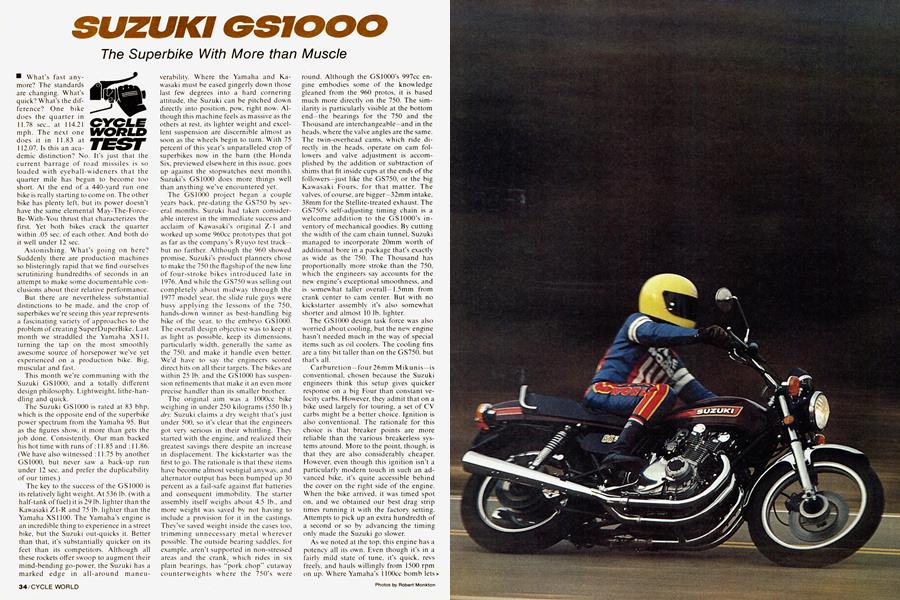
The upshot is superb handling. The Suzuki GS1000 is so quick, so precise, so forgiving and so predictable that it’s hard to understand how we ever survived the neolithic machines of our youth. This bike inspires confidence because you know the machine itself will never give you any nasty surprises. Its cornering clearance is excellent, it works just as well with the pipes on the ground as it does traveling straight up and it is absolutely stable at any speed. It’s as close as you can get to buying a race bike off a showroom floor, and will undoubtedly be heard from on the race tracks this summer.
The GSlOOO’s instrumentation is about average by current Japanese superbike standards, which is to say generally good, although the speedo is one of the most optimistic we’ve seen in a while. The digital gear indicator that distinguishes the GS550 and 750 is absent, and a fuel gauge has been added. The instruments, tilted toward the rider at a 45-deg. angle for easier reading, are illuminated with a reddish light, which is nice for the sake of variety, if nothing else, and the fork lock and ignition lock are combined, even though some other manufacturers have backed away from this handy touch in an effort to cut production costs. The turn signals aren't particularly refined, although self-canceling is part of the deluxe “E” version of the bike. The signals are accompanied by a feeble little warning beeper that's only audible at idle, which suits some of us just fine but makes all of us wonder why it’s there at all. The horn is good and the headlight, which is a rather average stock sealed beam item, interlocks with the ignition.
One of our consistent gripes with the last few Suzuki GS models we’ve tested is the wheelbarrow handlebars. Based on the bars that graced the ill-starred RE5 rotary, they're positioned too high, all of them, and even though this is adjustable, their backswept angle is not. It makes for a seatto-grips relationship that is awkward for some riders and just right for verv few. European editions of these bikes, and other makes as well, usually feature a much more sporting bar configuration, and we would very much like to see Suzuki come up with something between its current American handlebars and the cafestyle numbers employed on the Continent. The bars are topped with mirrors that also have some strange bends in their stalks, but they remain clear at speeds up to about 75 mph thanks to the rubber bushings in their mounts and the general smoothness of the engine.
Suzuki’s hand throttles take a lot of turning to get the wick up all the way. and this can be aw'kward in busy sections of road. This is undoubtedly rooted in concern for product reliability; but we’d rather take our chances with a shorter return spring.
The seat looks as though it might be a> trifle wide for long-distance comfort, but this is not the case; it’s fine. Padding is good fore and aft. and there are no twoplane cosmetics to keep you from sliding back when you feel like exploring the bike’s upper velocities (a feeling that seems to overtake superbike riders quite regularly). The “E” version of the bike sports a somewhat plushier seat, but the stock unit will probably be comfortable to most riders. There’s no storage under the seat. The tool kit stows in the tail section, and the seat covers only the air intake and foam air cleaner.
A useful addition to the basic tool inventory is an air pressure gauge for front fork tuning. This is the same gauge that Suzuki sends out with its RM series dirt bikes, and works very well.
The seat is also part of the bike’s helmet hook system—you flip it up to get at the open part of the hook. The hook is used by sliding your helmet’s D-ring down past an extremely stiff clip. It’s not a particularly inspired system; we like the key-operated Yamaha hooks best.
Speaking of keys, Suzuki will be giving you two of them with this bike, one for the ignition/fork/seat locks, one for the gas cap. We prefer one-key setups, although the tech ed. who has a suspiciously comprehensive knowledge of locks and how to violate them, thinks the tumblers in the gas cap lock might be adapted to the main key. Check with your friendly neighborhood locksmith. The cap. incidentally, is another soft spot in the GS1000 package. It pops out completely, making it very difficult to avoid dripping fuel on the tank, and can't be reinserted without the key. On the plus side, it seals very well; no leakage, even with the tank’s filler neck awash.
A word on cosmetics. We think they're the GSlOOO's weakest point. The bike’s various surface elements don't seem to cooperate with each other very well visually. and some of the pieces at the rear of the bike don’t mate up. The tail section on our bike also vibrated audibly. While it seems likely that the fit of various trim pieces will be better in actual production bikes—ours was a pre-production model bearing serial number 4—the massive tank, the seat line and the tail section will continue to look like separate elements bolted together rather than one integral whole. It’s a packaging job that's not up to the standards of the XS11 or super-slick Z1-R.
However, surfaces are surfaces and when it’s time to get from Turn 1 to Turn 2 faster than the other guy it really doesn’t matter whether your bike’s color coordination is spot on or not. What counts is performance, and that’s what this machine delivers double in spades, more of it for the money—$2749 for the basic Thousand, $2999 for the “E” (which includes dual front discs and cast wfieels, by Enshyu Keigookin. besides the goodies previously mentioned)—than anything in its class.
And when it comes to that, we’re not quite sure that there is anything in this machine’s class; not in terms of all-around performance, at any rate. Certainly not in terms of handling. Last year (January) we concluded our test of the GS750 by observing that it was the “best-handling big production bike on the road.” Let’s update that report. The GS750 is excellent, no question about it. But the GS1000 is super.
SUZUKI
GS1000
$2749