Norton 850 Interstate
NORTON 850 INTERSTATE
Cycle World Road Test
Norton. Nearly a dinosaur by present-day motorcycle definition, an anachronism to many who do not believe a 25-year-old design can exist among throngs of space age technology and modern day influences. Yet it has existed healthily through the superbike era and come out the other end fairly intact, perhaps proof that things learned over two decades about motorcycle design are not to be forgotten amidst other progress.
But tradition and purist logic do not survive an age in which volume and production line blandness couple to produce an everyman’s motorcycle. Throw in overbearing labor problems, and motorcycles like the Norton teeter on the precarious brink of becoming nothing more than fond memories.
And this is precisely what is happening at present. For some time you’ve no doubt read and heard about the many troubles of Norton-Villiers-Triumph (Norton-Triumph in the U.S.);and those troubles are brewing again.
The Meridan factory where Triumph Twins have been produced is presently in operation making parts only for the Twins, which were in very short supply because of the workers’ co-op lock-in of more than a year and a half. The Wolverhampton factory has been placed in receivership and has been closed; and Norton production will move to the Small Heath factory in Birmingham where Triumph Triples are now produced, if everything goes according to NVT plans.
Current problems developed when the British government refused to loan the NVT people any more capital, leaving them behind the eight ball and owing quite a bit of money. This meant a giant cutback in expenses, particularly for NortonTriumph in the U.S., putting many out of work and Norton-Triumph back on the endangered species list. If NVT can get a private loan from a British bank and consolidate all Triumph Triple and Norton Twin production in the Small Heath operation, and if the buying public continues to demand British machinery at the rate it always has, and if the feds don’t regulate the once exciting performers into meek ghosts of what they once were, then the British motorcycle industry will survive. That’s a pile of ifs, and there’re more. But in the meantime, prices of the large displacement machines have been lowered to bargain basement levels. . . meaning there’re a lot of people out there who are going to have to make some big decisions.
Should you buy British now and risk having a motorcycle that might be hard to get parts for in the not-too-distant future? Or will parts be that difficult to come by? The opposite may happen. You might wind up with a motorcycle that will increase in value each year. . .a collector’s item. Afraid that no dealers will be left to service or repair the once famous brand? Shouldn’t be a problem, as today there are specialists all over the country with parts and repair service for Matchless, Royal Entield, Indian, ad infinitum. In other words, if the company should fail, and if you love British machinery to any degree at all, it’ll be worth the e'xtra bother to possess a motorcycle that is rare and different, particularly at the price you will have paid. And if the company goes on into the> future of motorcycling successfully, you’ve still got your British bike, and you got it for a song compared to the rest of today’s values.
Wolverhampton's Latest Hosts Several Important Changes, But Goes Back On The Endangered Species List
We looked at the modern-day Triumph Triple two issues back (Sept. ’75), now let’s take a healthy gander at the latest from Norton, all other considerations aside.
Hard to believe, but this motorcycle has a heart a couple of generations old. As a baby the big Twin started life as a 500, growing to 600, 650 and then to its most famous stage as a 750. Performance-oriented motorcyclists remember the 750 fondly, as do we; the 1972 model was our all-time favorite. But one can reasonably wonder how a performing, but nevertheless antiquated pushrod Twin could carry on into the ’70s against the multitudes of Japanese computer printouts that produced overhead camshafts, five-speed gearboxes and multi-cylindered, multi-carburetored engineering exercises that for the most part worked better than fine for the average rider.
What saved the quaking, shaking and vibrating vertical Twin from demise was a brilliant improvisation. . .Isolastic suspension they called it and still do. . .which isolated the engine/ transmission/swinging arm sub-assembly from the rest of the motorcycle. . .and the rider. A super rigid chassis and proper geometry made Norton handling an example for others to follow, and its all-around exceptional performance kept it well up there on the highly desirable list for many people.
Come 1973 and the bore was increased 4mm, which, of course, made the 750 an 828, or, to better fit people’s desire for even numbers, an 850. The new engine was generally beefed up throughout, though power-wise no real increase came about where it counted. . .on the Chrondek timers at the drag strip. A host of improvements popped up in 1974 (April ’74 CW), but the 850 Interstate remained a long-distance sporting machine not to be confused with a true tourer.
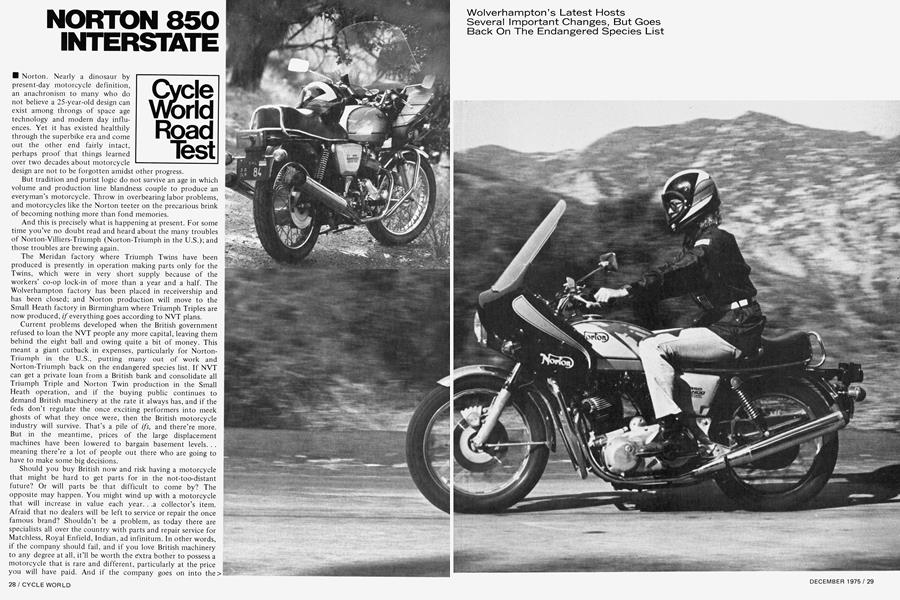
Perhaps in an effort to better the Interstate’s touring image, Norton-Triumph in the U.S. was about to market a complete tour package for the latest 1975 model, the subject of this test. But the bottom fell out in Duarte, and abandonment of the idea followed. So the equipment you see on our test model (seat, crash bars and windshield/fairing), may or may not be available when you read this. Saddlebags were supposed to be a part of our package, but they too went by the wayside in the NVT shuffle.
The big news with the latest model is, of course, electric starting, left-side shifting and a new rear disc brake. And if one is at all familiar with Nortons, there is nothing weirder than throwing a leg over the latest version and discovering the brake on the right and the shift on the left! This, of course, is now a federal regulation. No doubt if the government continues at its present rate, standardization will follow on everything we say or do in the future, including our methods of making babies!
Breaking from traditional black with gold striping, our test machine was finished in silver and black; not quite as rich looking perhaps, but pleasing just the same. The fairing and safety bar struck us as strange, but only because they were fitted to the Norton. We just don’t see that many touringequipped Commandos. More so than the options, were other new items that hit the eye.
Highly welcomed, maybe even prayed for by many, are new handlebar switches and ignition key location. Abandoning the old Lucas razor blade devices, Norton has gone to a perfectly positioned horn button, beam changer and direction indicator on the left, all within easy and comfortable reach of the thumb. On the right is a thumb-operated button for the new electric starter motor, an engine stop switch and a rocker switch that isn’t hooked up on U.S. models.
If you were like us and had bad dreams about Norton’s old ignition key location—it was cleverly concealed under the left side of the seat—fret no more! Moved to a central position between the speedometer and tachometer in a small console, the key operates the taillight for parking in full left position, is off and locked in the central position. Ignition only turns on with one click to the right; two clicks to the right gives you ignition and lights both. Warning lights include ignition on, high beam, turn indication and neutral; the neutral light does not necessarily mean the transmission is in neutral, however. . . at least not on our machine. A separate key operates a steering lock that proved difficult to use for us, despite repeated dousings with WD-40 and the like.
Fuel petcocks are now easier to understand and operate; one side operates the reserve system and the other side is simply an on/off arrangement. The tank is one of the largest you’ll come across on a stock motorcycle, holding roughly 6.3 gallons. Our fuel consumption average of 46 mpg was under a variety of conditions, equaling our last Norton 850 figure despite more restrictive silencing all the way around.
This, Norton calls the Mark 2A intake-exhaust system; it’s far more quiet to meet today’s very strict noise level requirements. The airbox is molded plastic and all new, containing oil-wetted foam filters and a method of collecting oil mist residue from the engine breather tubes and redirecting it into the cylinders where it is burned off rather than deposited in the air. The pipes are now pronounced upswept, with those funny little end caps that make it appear as though someone plugged the tips when the rider wasn’t looking. Very> quiet, with a most unNortonlike sound. So much for tradition.
And tradition goes all to hell with the addition of that electric starter, to be sure, but especially when one considers where the starter motor is manufactured. . .in the U.S. Sure enough, Prestolite makes it, but it was a bit more than a bolt-it-on operation. A new die casting was made to accommodate the motor, which sits behind the cylinders and connects to the primary chain. The chain case is new, as well.
Nortons have always required a fairly hefty kick and a certain starting sequence for best results. Stall the machine at a traffic signal and you once had your hands full with the horn honkers. Now that’s all changed. Simply push the button and things start turning. Once in awhile the starter motor labors a bit, but remembering the force of the kick required on earlier Nortons to get the crankshaft rolling, it’s not hard to understand why the motor struggles.
PARTS PRICING
Of course, the Amals still require the messy tickling before the engine is started; a choke lever need only be used in very cold weather.
They’ve also beefed up the crankshaft and the crankcases have thicker walls; inlet ports have been enlarged from 30 to 32mm, helping out midand top-end performance. The timing cover is new and a hydraulic chain tensioner is fitted to keep primary chain tension right at all times. New seals are used throughout to help prevent oil leaks, threaded adjusters are now used in the Isolastic system for easier maintenance.
To further improve the already good handling characteristics, the swinging arm is enlarged and stiffer and the rear axle is a larger-diameter piece with new rear-wheel adjusters. The relocation of shift and brake pedals necessitated a slight change in footpeg locations. . .about three-quarters of an inch rearward, but still not enough to keep them from fouling the rider’s leg when stopped at a light or standing still.
The footpegs will also touch ground fairly readily in hard cornering, and their non-folding attributes can cause a moment of thrills. If they folded they also wouldn’t be nearly as annoying to the rider’s legs when he’s stopped and holding the machine upright.
The new rear disc brake mounts on the right with the front unit being switched to the left for supposedly better braking balance, but the caliper has gone from the back of the fork leg to the front, meaning an increase in steering mass and a loss in the fine touch department. Brakes on our machine were disappointing, particularly the rear unit, which only worked to a sufficient degree when it got very hot. When cold. . .forget it, the front would have to be the savior. Master cylinders are positioned in conventional locations, the front on the handlebars and the rear just behind the gearbox.
The 1975 models also sport a new cush-drive rear hub assembly with a pre-loaded vane damper. The rear wheel can be removed without touching the chain or rear sprocket, ISDT-style, but it’s more difficult in practice than it is on paper. The front, however, comes off and goes on with little> bother, helped by an adequate centerstand that holds the bike securely in position when either wheel is taken off. The sidestand, however, is long and awkward to use.
NORTON 850 INTERSTATE
SPECIFICATIONS
$1995
TEST CONDITIONS
PERFORMANCE
SUSPENSION DYNO TEST
FRONT FORKS
Description: Norton front fork with HD 315 oil Fork travel, in.: 4.5 Spring rate, lb./in.: 38 Compression damping force, lb.: 1 1 Rebound damping force, lb.: 32 Static seal friction, Lb.: 6 REMARKS: Damping is ideal in both compression and rebound. Ride is firm, especially for riders weighing 150 lb. or so. Heavier riders will find the spring weight more to their liking. Travel is limited at 4.5 in. For the commuter or Sunday rider this is no problem, but touring types who favor secondary roads would benefit from an additional inch of wheel movement.
REAR SHOCKS
Description: Girling shock, non-rebuildable Shock travel, in.: 3.0 Wheel travel, in.: 4.05 Spring rate, lb./in.: 123 Compression damping force, lb.: 0 Rebound damping force, lb.: 156 REMARKS: With 0 compression damping, a heavier spring than normal is required to keep the rear end from bottoming through dips in the road surface, etc. When riding solo, this yelds a firm, but not objectionable, ride. When riding double, bottoming occurs when anything out of the ordinary is encountered (such as a dip you didn't see or a driveway that has a more severe transition with the road than you expected). Rebound damping should be around 105 lb. instead of 156. Too much rebound damping causes the rear of the machine to settle on rough secondary roads because the wheel is prevented from responding quickly enough to bumps. This effectively reduces the amount of wheel travel at a time when you are likely to need the maximum available for good control. Tests performed at Number One Products
In the workmanship and quality departments Norton has slipped a notch since we last gave one a going-over in 1974. Thank goodness the seat on our test model will not see production, for it was of far too soft a density, allowing even lightweight riders to bottom out on the seat base, and movement was restricted by the “hump” separating rider and passenger. The engine remained fairly oil-tight, with the exception of the tach drive mechanism emanating from the engine case.
None of our testers liked the padded “falsie” handgrips or the odd rear view mirror shape, and the touring package seemed out of place on such a sporty machine. Too, four-speed gearboxes are rare on large-bore Streeters these days, but the 850’s rhino-like torque more than makes up for the lack of an extra transmission ratio. Clutch pull was medium-hard, but full engagement was obtained very close to the bottom of the lever squeeze. At times neutral was easy to find, rolling or stopped. Then, inexplicably, it became as elusive as Howard Hughes, though shifting action usually remained positive. But long throws are the rule rather than the exception.
For touring work, suspension compliance was unsatisfactory up front; the forks are harsh and stiff and could give a hoot about giving rider or riders an easy time of it. And the rear shocks acted only slightly better, for the most part ignoring the small bumps and yielding a tad to the big stuff. But away from the straight touring aspects and into the sporting realm, where the Norton belongs, the suspension is much more fun, and contributes much to twisty-turny handling. We’d like more ground clearance on both sides, but particularly on the left. Other than that, the Norton’s easy, light and positive steering was a welcomed blessing. . .though expected. Hell, it’s British.
Around-town, low-speed handling is clumsy and imprecise; mechanical noise from the engine also becomes apparent. Low-rpm vibration or, rather, earthquaking, rattles and shakes everything but the neighbors’ windows; traffic around you is apt to wonder if the machine is going to wiggle itself into a pile of warm scrap iron before the light turns green. But it doesn’t, and an occasional blip of the throttle will assure people that it’s a motorcycle and not a Vic Tanny reducing machine. It will also keep the engine running, because Amal carbs and slow idling don’t always make a predictable combination, meaning the engine likes to stall a lot. Tinker with the carbs all you want, and just when you think they’re adjusted perfectly, a mere blip of the throttle will throw things out of kilter once again. Yeah, Harry, Mikunis do a lot of fixin’, and they’ll cure the Norton of a few ills.
Performance is a far cry from that of the famed Commandos of 1972, but we showed our readers how to make present-day Nortons run like the wind in our May 1974 issue. Those same techniques still apply today. In the course of refinement, Norton has lost some of its personality, but will no doubt appeal to a new group of riders.
So the modern-day Norton has a few minor aggravations to contend with, most of which are easily solved. Riders who formerly balked at kickstarting the big, healthy Twin need not worry with the latest from England, which makes it far more desirable for the masses. Serious touring is a bit out of its realm, which is really purely sport and purely pleasure. It’s a motorcycle that entertains. . .and we all know that it takes a real motorcycle to entertain. Norton still makes a real motorcycle. . .ain’t that just dandy! ES