Grand Prix Wrap-Up
GRAND PRIX WRAP-UP
DECOSTER BEGAN HIS DOMINATION OF 500cc WORLD MOTOCROSS IN 1971. THREE YEARS AND COUNTLESS G.P.s LATER, MIKKOLA HAS ENDED IT.
Terry Pratt
LATE IN SUMMER, when the days are full and ripe, the 500cc motocross Grand Prix season matures, excitement mounts, and finally, there is the crowning of a new World Champion.
This year the champagne flowed for Heikki Mikkola, the 29-year-old Husqvarna factory rider from Finland, who has invested 10 arduous years into becoming Number One. You see, for a motocross rider it’s a long uphill climb from Junior races, to professionalism, to that first Grand Prix, to the factory ride and finally to those few precious seasons when a man’s athletic ability and his racing experience combine to put him in contention for the World Championship.
ON THE GRAND PRIX TRAIL
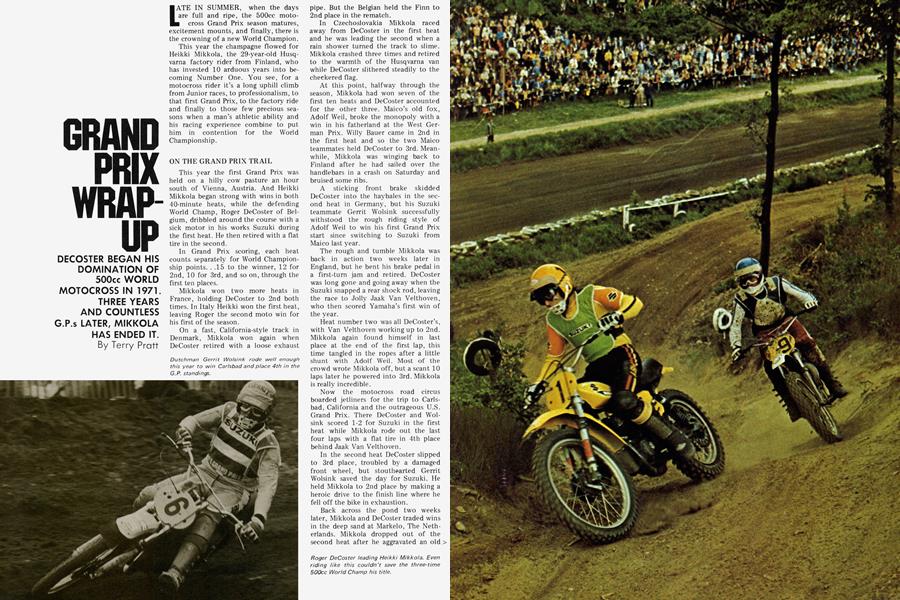
This year the first Grand Prix was held on a hilly cow pasture an hour south of Vienna, Austria. And Heikki Mikkola began strong with wins in both 40-minute heats, while the defending World Champ, Roger DeCoster of Belgium, dribbled around the course with a sick motor in his works Suzuki during the first heat. He then retired with a flat tire in the second.
In Grand Prix scoring, each heat counts separately for World Championship points. . .15 to the winner, 12 for 2nd, 10 for 3rd, and so on, through the first ten places.
Mikkola won two more heats in France, holding DeCoster to 2nd both times. In Italy Heikki won the first heat, leaving Roger the second moto win for his first of the season.
On a fast, California-style track in Denmark, Mikkola won again when DeCoster retired with a loose exhaust
pipe. But the Belgian held the Finn to 2nd place in the rematch.
In Czechoslovakia Mikkola raced away from DeCoster in the first heat and he was leading the second when a rain shower turned the track to slime. Mikkola crashed three times and retired to the warmth of the Husqvarna van while DeCoster slithered steadily to the checkered flag.
At this point, halfway through the season, Mikkola had won seven of the first ten heats and DeCoster accounted for the other three. Maico’s old fox, Adolf Weil, broke the monopoly with a win in his fatherland at the West German Prix. Willy Bauer came in 2nd in the first heat and so the two Maico teammates held DeCoster to 3rd. Meanwhile, Mikkola was winging back to Finland after he had sailed over the handlebars in a crash on Saturday and bruised some ribs.
A sticking front brake skidded DeCoster into the haybales in the second heat in Germany, but his Suzuki teammate Gerrit Wolsink successfully withstood the rough riding style of Adolf Weil to win his first Grand Prix start since switching to Suzuki from Maico last year.
The rough and tumble Mikkola was back in action two weeks later in England, but he bent his brake pedal in a first-turn jam and retired. DeCoster was long gone and going away when the Suzuki snapped a rear shock rod, leaving the race to Jolly Jaak Van Velthoven, who then scored Yamaha’s first win of the year.
Heat number two was all DeCoster’s, with Van Velthoven working up to 2nd. Mikkola again found himself in last place at the end of the first lap, this time tangled in the ropes after a little shunt with Adolf Weil. Most of the crowd wrote Mikkola off, but a scant 10 laps later he powered into 3rd. Mikkola is really incredible.
Now the motocross road circus boarded jetliners for the trip to Carlsbad, California and the outrageous U.S. Grand Prix. There DeCoster and Wolsink scored 1-2 for Suzuki in the first heat while Mikkola rode out the last four laps with a flat tire in 4th place behind Jaak Van Velthoven.
In the second heat DeCoster slipped to 3rd place, troubled by a damaged front wheel, but stouthearted Gerrit Wolsink saved the day for Suzuki. He held Mikkola to 2nd place by making a heroic drive to the finish line where he fell off the bike in exhaustion.
Back across the pond two weeks later, Mikkola and DeCoster traded wins in the deep sand at Markelo, The Netherlands. Mikkola dropped out of the second heat after he aggravated an old foot injury by catching it in a deep rut carved in the sandy track. But a visit to Dr. Der Weduwen, the motocross specialist, put Heikki back in form for the battle coming up.
Going into the two final rounds in Belgium and Luxembourg, Mikkola held a clear-cut points advantage of 166 to DeCoster’s 156. But the FIM World Championship scoring system is based on the best results in half plus one of the total number of heats. That is, of the 22 heats in 11 Grands Prix, only the best 12 scores count. Mikkola had eight wins, three 2nds and a 3rd. DeCoster was holding six wins, three 2nds and three 3rds.
Now the team managers, journalists and other odds-makers put new batteries in their pocket calculators to size up the situation. DeCoster had a shadow of a chance if he could win three of the remaining four heats—but if Heikki Mikkola won any two of them he would be declared World Champion on the spot.
THE BELGIAN MOTOCROSS CLASSIC
The Belgian Grand Prix is more than just a race, it is a tradition. This year marked the 25th consecutive running of the event and a list of its winners is a mini-history of the sport of motocross. Names like Victor Leloup, Bill Nilsson, Jeff Smith, Rolf Tibblin, Paul Friedrichs and Bengt Aberg fill the roster all the way back to 1949. But no rider has won the Belgian Grand Prix more times than Roger DeCoster’s four. And this year he needed his fifth win to stay alive in the race for the World Championship.
The setting for an event so steeped in history is a fitting one. The race is held in a large park surrounding an ancient stone fortress overlooking the picturesque city of Namur. During most of the year it is a place where tourists come in buses to go strolling past the museums and to sip beer in the cafes. But on Grand Prix day the citadel is jammed with 30,000 motocross-wise spectators and the cars and vans of racing teams from a dozen nations.
On the start the tightly bunched racers make one pass around a rocky oval track in front of a huge stonework grandstand and then dive into the dark woods on a narrow trail that zig-zags down the mountainside in a series of blind corners and drop-offs closely bordered by solid, moss-covered trees,
some too big to reach around with both arms.
Along the bottom of the hill the racers rocket down a cobblestone street past an outdoor cafe packed with hundreds of enthusiastic Belgian fans who are within sight of a soaring fifth-gear jump.
The ride back up the mountain is a series of difficult stair-step climbs past a never-ending gallery of trees and spectators and at one place the trail parallels a sheer 40-foot drop-off, a stone-walled moat that must have been part of the citadel’s defense system.
As it often happens when there is a close battle for the World Championship, the race, in fact each heat, was a personal duel between the point leaders, Mikkola and DeCoster. But Gerrit Wolsink got another hole shot and led the opening laps of the first heat, while
Adolf Weil, Willy Bauer and Jaak Van Velthoven got only about 100 yards from the starting gate before they tangled up and went down in a heap. Jaak unhooked his Yamaha and kept going, but Bauer and Weil both retired with two frazzled Maicos.
Mikkola battled past several tough riders in the first two laps and when Wolsink seized his engine solid, Mikkola was there in 2nd place ready and wait ing to take over the lead.
DeCoster came around in 6th place on the first lap but after a few minutes of broadsliding through the trees on the rain-slick course, Roger was 2nd just 30 seconds behind Mikkola and carrying the roar of the partisan Belgian crowd around the track with him.
Brad Lackey had gotten his Husqvarna off to a medium good start and was running about 5th when a little get-off put him back to the bottom half of the field. A little later Brad was catching up and he had the crowd gasping with his stepladder-high jumps and ground shaking landings. But just as Brad worked up to 10th place and back in the points again, his chain derailed as> the Husky slammed to the ground, and Brad coasted to a stop.
Meanwhile, Jaak Van Velthoven was trying to catch up by broadsliding around the oval in his best flat-track style when the bike in front of him spit back a rock about the size of a tea cup and knocked his inside leg out from under him. Jaak got off like an Indian in a John Wayne movie and put another cut in his already abused nose.
DeCoster charged after Mikkola but the gap remained consistent at 30 seconds, and after 40 minutes the clock ran out. Mikkola had won his 9th heat of the season. Now the standings said that if anyone but DeCoster won the next heat, Mikkola would become World Champion no matter where he finished.
In the second heat Wolsink again pulled the trigger ahead of everyone else and the Dutchman showed DeCoster and Mikkola the way around on the first lap. But on the second lap Gerrit drifted to the right of his usual line just as he made the jump from the oval track down into the woods and crashed heavily with the bike bouncing on top of him a time or two before they slid to a halt.
Meanwhile, DeCoster was buzzing along on an open track and pulling away from Mikkola. Heikki’s mechanic, PerOlaf Persson, a Swedish motocross racer from the days of the Husqvarna fourstroke, signaled to Mikkola with the chalkboard, “6 sek”, showing him the time deficit. Two laps later it was eight seconds, and then 12.
With the consistency of a chronometer, DeCoster was widening the gap over Mikkola by one second per lap. Pele chalked in “18 sek” and ran out on the track waving at Mikkola as he roared by. Now it was 20 seconds and Pele was running farther out on the track and waving harder with every lap. Mikkola powered past the frantic Pele with the throttle twisted back to the stop, violently nodding his head as he went by, “Yes, yes, I know!”
Husqvarna team rider Arne Kring held 3rd place until the last few laps when he said he tired out from tensing up every time he narrowly missed sliding off the slippery bumps into a tree. With Kring dropping off the pace, Adolf Weil and Van Velthoven slipped by in the closing laps. Brad Lackey was dueling in 7th place with Belgian Husqvarna rider Gilbert DeRoover before he gave him the slip.
Just before the final flag the cops came and chased Pele off the track and DeCoster took the checkers an easy 30 seconds ahead of Mikkola, who was trailed by Weil, Van Velthoven, Kring and Lackey.
DeCoster came through in the clutch with a win on the difficult course that he alone knows so well. But if Roger could pull away from Heikki in the second heat, why couldn’t he catch up when he trailed Mikkola in the first heat?
“We were having trouble with the carburetor or something during practice,” DeCoster explained after the race, “and there was just no punch in the engine. The mechanics told me they had it fixed before the first heat but the edge wasn’t there. So we changed engines for the second heat and the new engine was much more fun to ride over the bumps and it would pull right from the bottom.”
Now here’s a guy who is fighting in every lap to save the World Championship that is slipping through his hands and he is talking about how much fun his bike is to ride. . .when they have it running right.
As the sun was going down and everyone was cleaning up for dinner, Heikki asked Roger jokingly, “Why were you going so fast? We could have ended the season today but now we must go to next week also.” Heikki was smiling and Roger was trying to. “But we must end it next week, Heikki said, because then we run out of races.”
LUXEMBOURG: THE FINALE
Of course, Mikkola’s dry remark was true. The following Sunday was the Grand Prix of the Grand-Duche of Luxembourg, the final G.P. of the season and the race that would decide the 1974 World Champion.
That week the motocross teams traveled south, past Bastogne where the Yanks battled the Nazis in W.W. II, and then across the Ardenne mountains to the town of Ettelbruck, where the folks speak an odd mixture of French and German and where they have held a Grand Prix every year since 1949.
Mikkola’s mechanic Per-Olaf Persson was 3rd here in 1963 behind Sten Lundin of Sweden and John Burton of England. This year Pele parked the big Husqvarna diesel van in that familiar meadow next to the race track and Heikki moved in next door in his caravan trailer with his wife Kaija and their six-year-old daughter. Brad Lackey, Arne Kring and the rest of the Husqvarna team slept in a hotel in town, but Pele chose to sleep in the van with the bike. Or, at least, try to sleep.
Under Pele’s experienced wrench, Mikkola’s 360 Husqvarna had not stopped once in 20 grueling 40-minute Grand Prix heats. The closest thing to machine trouble Mikkola had was a flat tire at Carlsbad when he insisted on using a two-ply tire against Pele’s advice. Heikki later apologized humbly.
On the other hand, DeCoster’s Suzuki had actually quit a total of five times and twice more finished with reduced performance. A number of those breakdowns happened when the Champion was leading a Grand Prix. Roger spent the week at home in Belgium watching the Suzuki mechanics prepare the bikes in his garage.
(Continued on page 86)
Continued from page 50
The end of the week was rainy in the Benelux and the grassy hillsides of the Ettelbruck course were left wet and soggy. Sunday morning was spotty, with rain strangely interspersed with sunshine. During practice the grass was churned up with the mud below and the spinning knobbies lofted great plops of adobe, arcing high in the air behind each bike accelerating out of the turns. The mud was everywhere. Mechanics dug through their vans for parts to make extra large front fenders and the riders wore coveralls over their leathers during practice.
Finally it was time. The rain had stopped and the track was drying out, leaving a fluffy cushion of mulched mud and grass. The clearing sky encouraged a crowd of about 15,000 to gather before the steel starting barrier dropped open and the first heat began with a roar and a cloud of blue exhaust smoke. Swedish Kawasaki rider Christer Hammargren won the drag race to the first turn, but DeCoster pinched by him just 100 yards later and quickly pulled the Suzuki several seconds ahead of the field.
Mikkola came around the first time in 5th place behind Hammargren, Bengt Aberg and Adolf Weil. On the next lap Heikki was in 2nd place, some seconds behind DeCoster, but one 2nd-place finish was all the Finn needed to seize the Championship he had worked for so long. As DeCoster paced Mikkola around the long, hilly course, the crowd watched in breathless suspense, almost ignoring the close racing going on be-
hind the two Championship contenders. Bengt Aberg, feeling in the mood and really pouring on the coal today, passed Hammargren while Weil and Jaak Van Velthoven were battling over 5th place, throwing twin roostertails of mud and debris high in the air.
Then on lap number eight DeCoster rocketed past the officials and journalists in the reviewing stand, leading the race by a steady 15 seconds. With the Suzuki at full cry and subtly drifting across the long, top-gear sweeper, the connecting rod snapped in two and internally sawed the engine in half.
DeCoster clutched it, coasted over to the circle of Japanese mechanics standing beside the track and then the exChamp walked slowly back to the pits, followed by a long-faced cortege of supporters and Belgian journalists. Everyone knew how the morning papers would read:
Husquarna factory rider Heikki Mik kola of Finland won the first heat at the final 500cc Grand Prix of the season in Ettelbruck, Luxembourg here today, and clinched the 1974 World Champ ion ship, ending the reign of Belgium `s Roger DeCoster who had held the title since 1971.
Now Mikkola circulated around the track in the lead against a backdrop of grins and handshakes and the words "Roger Stop" written on Pele's chalk board. The new Champ was followed across the line by Van Veithoven (who later won the Grand Prix overall), Weil, Hammargren and England's John Banks, who had made the most of his CCM's four-stroke traction on the slippery track.
When Heikki made his way through the mob that stopped him at the finish line, he went directly to his caravan, which was surrounded by the pandemonium in the Husqvarna pits. Inside the caravan his wife Kaija and DeCoster were already celebrating with iced champagne that Roger had brought over from the Suzuki pits in a big cooler. [ô
FINAL WORLD CHAMPIONSHIP POINTS STANDINGS