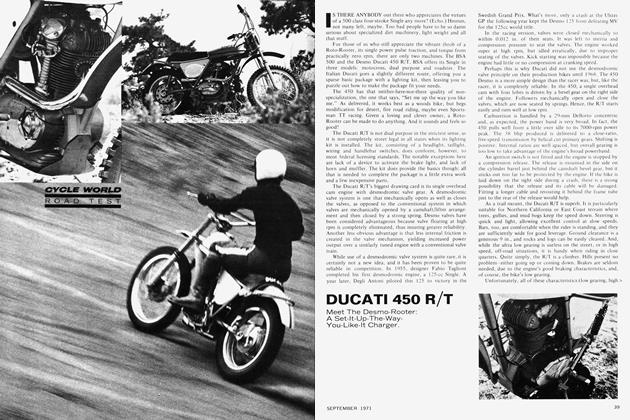
Yamaha Ty250a Trials
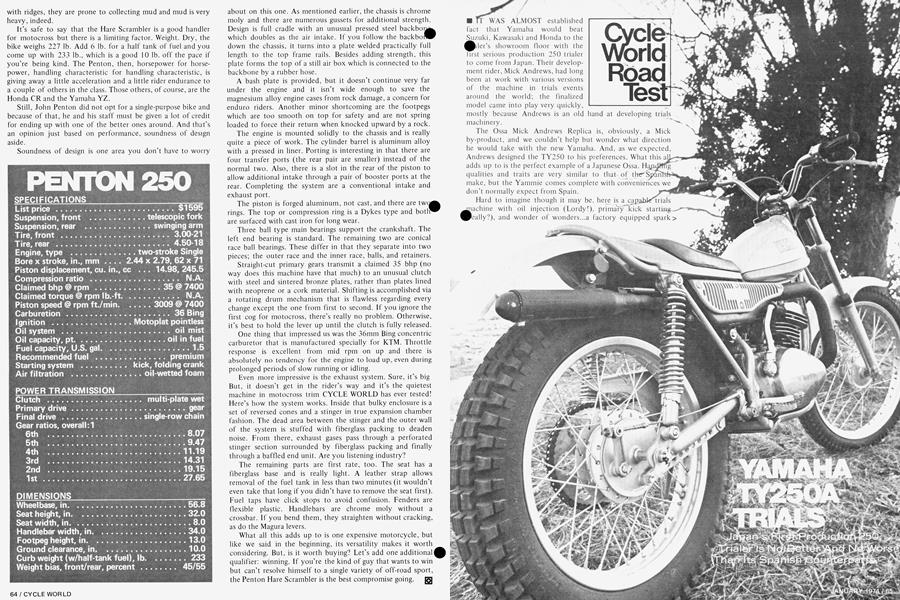
YAMAHA TY250A TRAILS
Japan's First production 250 Trailer Is No Better And No Worse Than Its Spanish Counterparts
Cycle World Road Test
IT WAS ALMOST established fact that Yamaha would beat Suzuki, Kawasaki and Honda to the Aler’s showroom floor with the first serious production 250 trialer to come from Japan. Their development rider, Mick Andrews, had long been at work with various versions of the machine in trials events around the world; the finalized model came into play very quickly, mostly because Andrews is an old hand at developing trials machinery.
The Ossa Mick Andrews Replica is, obviously, a Mick by-product, and we couldn’t help but wonder what direction he would take with the new Yamaha. And, as we expected, Andrews designed the TY250 to his preferences. What this a adds up to is the perfect example of a Japanese Ossa, qualities and traits are very similar to that of t make, but the Yammie comes complete with conveniences we don’t normally expect from Spain.
Hard to imagine though it may be. here is a ca ^machine with oil injection (Lordy!), primary ^Peally?), and wonder of wonders...a factory equipped spark > arrester! From that point on, most of the features and design follow traditional trials patterns.
Frame design is very close to the Ossa; twijutawntubes éxit the steering head and continue only to the front engine mount bolts without wrapping under the engine, while a single toptube hide¿ below the fuel tank and joins with the triangulation of tubing at the rear of the machine. Footpeg placement is about 1 in. behind and 2 in. below the swAgping arm mounting point and footpeg width is a narrow 16 in. Although steering head angle, fork rake and trail are different from the Ossa, they are close enough to effect the same type of steering characteristics. *. J
With a short wheelbase and steep fork angle, the Ossa is a “quick” steerer. At the same time, for the same reason, the MAR is a bit scary to ride over a dropoff; it wants to throw the rider over the bars. Fortunately, these traite^^Md as severe with the TY250, but on the other handf^in^^Rep Cota and Bultaco Sherpa T are better in this respect. Our main complaint concerning the frame was the quahty oT*elds—very shoddy with poor penetration. Lucky there are lots of gusset plates or there would be trouble. *
The swinging arm is conventional tubing and utilizes those neat snail-type chain adjusters, but thosé^fellows i^ejike to add a' few links to their chain and move the wheel back4§§ increased wheelbase will be in for a problem. The slots in the ends of each arm simply aren’t long enough*fÜMril off such a trick. Mandatory on a trflSRMtee and included is a cflmf tensioner; they’ve even gone ahead and made the left side of the swinging arm an oil réservoir for a drip-type chain oifcr, a feature we’re not that keen on. The problem with filis one occurs when the rider is moving around on the machine. It’s too easy for the heel of a boot to knock out the filler plug, and we lost ours in'fast-five minutes of riding.
We had heard that Yamaha’s trialer was a heavyweight, but that’s just . not the case at all. Much time and effort has been devoted to slicing off unnecessary pounds, so the TY25Q comes into-the ring weighing a competitive 212, including a couple of pounds of lighting and wiring.
Non-clogging D.I.D. rims are standard front and rear; not the lightest in weight, but substantially strong and attractive. Small, cast aluminum hubs are used, and the brake backing plates are magnesium. Braking action and feel is truly super’ the best we have sampled on any trailer. In addition, the units are highly resistant to water, an important feature in view of te Act that many trials sections are run through streams and the like. Both front and rear brake actuation is via cable.
Most of the top trials riders use Dunlop trials tires, and that’s what you get with the TY250. The only catch is that these are Japanese Dunlops, which, even though they are in actuality a two-ply tire, are rated at four ply. This is due to the stiffness of the Nylon material. They’ll be just fine for most competitors, but the really fussy may still want to switch to the more flexible versions made in England.
Styling wise, we have a new personality added to the motorcycle field. With the exception of its little brother, the TY80, Yamaha’s new model has a truly unique look about it. Even the engine unit blends with the package and flows in with the concept. The flexible plastic fenders and the 1.5-gal. steel fuel tank are finished in a pearlescent white, with the tank!3 lower portion, seat base, exhaust guard and left side cover a bright yellow. The frame is silver.
Trials bikes do not need lighting for the type of off-roac usage they receive, but Yamaha, in an effort to make the TY250 more appealing to the trail hike crowd, has included a standard installed headlight and taillight. These are not street legal, but work well enough around the campsite or similar spots to make them pretty handy. The only shame is that trials competitors have to pay for them, and most will yank the equipment off and store it away to rot. In addition, that nice rear fender will have three big, ugly holes where the taillight went. Why not have a lighting kit that can be ordered separately? That way everyone can be happy, except maybe the production line planners at Yamaha.
Our resident trials rider entered the new Yamaha in the second round of the California State Trials Championships at Indian Dunes. What could be a better method of testing the new model? One thing for sure, it pointed out many things about the machine that may have not shown up otherwise.
The classic “stand-up” trials riding position works well on the TY; peg position is about right, handlebars have the right rise and width, everything is nicely tucked in and well out of the rider’s way. The brake pedal is easy to use, but the shift lever is sort of vulnerable in the “as delivered” position and is quite flimsy. Many trials riders like to rotate the lever into a high position to keep it from snagging on rocks and such, but on the Yamaha it’s not possible, due to the shape of the engine side cover.
In fact, the engine unit is 12 in. wide, or about Wi to 2 in. wider than the Spanish machines, so expect to see those attractive, polished side cases looking the worse for wear in short order. A full width fiberglass skid pan helps protect, but its longevity will be short-lived in the rocks. Aluminum would have been a better way to go.
Starting is as easy as any Yamaha; there’s none of that carb tickling mess necessary with the Spanish machines. And don’t forget, this one has the convenience of oil injection, so the rider can forget about mixing fuel. It’s wise, however, to check the oil tank level each time the fuel tank is filled, since the oil tank’s capacity is minimal and won’t last much past a tankful of gas.
Probably the best feature is primary kick starting. How we hate hunting for neutral in inconvenient places, such, as the side of a hill and the like. Too, there are times when a rider falls in a trials section and holds up the line of riders waiting at that section while he fishes for neutral. Now one can right the bike, pull in the clutch and kick, and get the hell out of there fast!
Gear shifting is smooth and precise, but we felt the TY was ared just a tad on the high side. Changing the countershaft sprocket one or two teeth cures the ailment.
In keeping with recent Yamaha two-stroke tradition, the newly designed Single features reed-valve induction, and shares a few internal pieces with other engines in the line. But most of the unit is all new, even down to the cylinder and head assemblies. It’s a smooth runner and chugs merrily at low trials speeds, but it became apparent in some of the tougher sections at Indian Dunes that something was lacking in the power department. CYCLE WORLD has four staff owned trialers of different makes, and we ride them regularly. Maybe that’s why the Yamaha’s lack of low end “snap” and midrange “oomph” was so readily apparent to us. The Yamaha isn’t bad, but it could be stronger. Some sections are simply a bit rough on the TY’s ego.
In nit-picking we could complain about the miserable handgrips, the vulnerable sidestand, the lighting dilemma and a few other non-serious incidentals. We can applaude the fine suspension, the brakes and the niceties such as the ease of fueling and kick starting. Casual trail and trials riders will love it, but for the truly serious trials competitor, Spain is still the way to go, unless he doesn’t mind doing some “development work” on his own. If Yamaha can improve the power characteristics, they’ll really have something.
YAMAHA
TRAILS
$1053