Racing Review
RACING REVIEW
UTE CUP TRIAL
TOM STRONGMAN
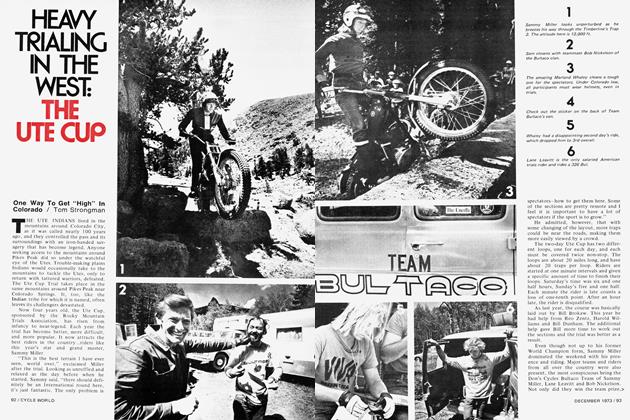
Thick fog and chilling rain...what a day. Winding through the gloom of Cheyenne Canyon I can detect the lights of a pickup camper pulling a trailer loaded with bikes. Unmistakably trials iron. They must be headed for the Ute Cup.
Leaving Cheyenne Canyon and winding along the front range the fog begins to thin. At 8000 feet the sun is bright. The air is crisp. Rugged mountains are jutting through the blanket of clouds filling the valleys. It’s Labor Day weekend and the weather is capricious. It looks like the Ute Cup will be run in good weather.
It’s not surprising that Colorado has some of the finest trials events in the country, for it has not only an outstanding group of trials enthusiasts but also some of the most challenging terrain in the nation.
In three years the Ute Cup has become the nation’s outstanding observed trials event. Patterned after the International Championship, the Ute has a number of traps linked by a specific trail, over which an average speed must be maintained. This year’s running was in the Pike National Forest around the base of Pikes Peak. Each of the events’ two days had separate courses, Saturday’s being two laps of a 17.5-mile loop, and Sunday two laps of a 20-mile loop.
Elapsed time Saturday was 4 hr., 35 min., while Sunday’s longer course was to be finished in 5 hr., 30 min. There was an 11.5 mph average, with an additional 3 min. per trap. Altitude varied from the nearly 10,000 feet at Wye Campground starting point to a high of 12,000 along the Mount Baldy road; location of Sunday’s Grand View series of traps.
Bill Brokaw, president of the sponsoring Rocky Mountain Trials Association, laid out the routes with a special U.S. Forest Service use permit. This is the first time such a permit had been used for an RMTA event. The result was the opening of areas not normally used by bikes, which Brokaw used for some spectacular traps. He explained that Forest Service Rangers had visited previous trials events and were anxious to give the group a permit. This, in effect, was an endorsement of observed trials by the Forest Service, and that should be beneficial in the future.
The day after the event was spent by Brokaw removing all markings, picking up debris, and restoring and rebuilding trails that needed attention. One particular trail needed two switchbacks completely rebuilt, as they had been chewed up on a steep descent between two sections of Sunday’s course. Such responsible treatment of the land promotes respect and cooperation with the U.S. Forest Service, which affords the RMTA the reputation it owns.
In laying out the two-day event Brokaw drew heavily upon experience gained in competing in the French and Spanish rounds of the World Championship last spring. The sections were challenging without being impossible, and the connecting trail was interesting in its own right. While in Europe, Brokaw said, the average speed between traps was on the order of 20 to 24 mph. In addition, there was only 2-min. allowed per trap. After waiting in line to get through the traps, the only way to stay on time was to go as fast as possible. The time here was increased to 3-min. for each trap, and the average speed lessened to take into account the tightness of the trails.
Since the regular monthly RMTA events are not run on a time schedule the majority of the field was behind time on Saturday and lost points accordingly. On Sunday, by being mindful of the time and riding faster, nearly all of the riders finished in the allotted time.
Approximately 50 riders started the Ute Cup, with some coming from as far as Missouri, Kansas, New York, Oklahoma and California. After the very first section, one rider was heard to grumble, “We sure don’t have traps like this in Oklahoma.” The win was captured by a recently displaced Californian, Bob Nickelsen, on a Bultaco 325. Nickelsen only recently moved to Colorado Springs from California, where he was one of the top riders.
Second place Lane Leavitt, the first factory-paid trials rider in the country, hails from California. He too was on a Bultaco 325. Californian Kevin Walker was 3rd, riding an Ossa.
One of the lighter sides of the Ute Cup is the Montesa factory’s perpetual Bog Trophy, reserved for the worst ride in a bog. The trophy occurred as a result of a spectacular crash in a bog by Montesa employee Xavier Jordi in a previous year’s event. This year, however, no one did poorly enough in trap number nine, “Xavier’s Bog,” to warrant the trophy.
The success of the Ute Cup is indicative of the excellent trials organization, the RMTA, which has grown to prominence in a relatively short period of time. When Brokaw moved to Colorado Springs from California in 1965, there was very little serious trials activity in the state. Having been involved in trials for a long time in California, in fact he was the regional champion in 1951, he naturally began riding here.
The small group of riders gained interest, and size, rapidly. Brokaw credits Jon Callahan and Wiltz Wagner with giving observed trials a strong boost with their enthusiasm and work. Callahan, Brokaw relates, was a terrific idea man who could make challenging traps out of a plain piece of ground. Wagner had the ability to generate ideas and follow them through methodically. These two were responsible for 75 percent of the original concept of the | RMTA.
Wagner’s ingenuity was the motivation behind many of the club’s awards. One of the most treasured accomplishments is for a rider to be granted the rank of master, for finishing in the top three in points. The award to a master is a hand carved Ram, a 32nd-scale Big Horn Sheep. Wagner found one man to carve all of the Rams, and as a work of art are valued at nearly $ 1000.
Secretary Ed Crouch, says Brokaw, has a set a new level for that office by comparing the scores of traps after each event. Utilizing this comparison and the average point loss per trap a rider can get an indication of his weak points and practice to improve. This accounts, at least in part, for the rapid improvement in the caliber of riders during the past couple years.
Originally, the RMTA was formed around one idea—to hold a nationally prominent high altitude trial, unequaled in the United States. This was the Ute Cup. Though the RMTA is over 2-1/2 years old as a group, the idea goes back a couple of years prior to that. However, with the monthly trials being quite popular, the Ute Cup has lost some of its beginning importance. It still is the high point of the year, and has rapidly grown into the premier trials event in the nation. Many of the local riders do not attempt the Ute, however, as they do not feel they have either the time, two days, or the necessary ability. The RMTA has over 200 members.
Monthly competition provides the biggest outlet for the members, as most meet to ride in novice, semi-expert, expert and masters classes. The novice class rides traps that are not quite as difficult as the others, which allows a beginner to learn without being discouraged.
I asked Brokaw whether he thought the Ute Cup could ever gain International importance. He replied that lack of a purse would not make it attractive for a part of the World Championship. However, he thought it was highly possible that some factory representatives—world caliber riders— would be here to ride in exhibition. Most of the factories sponsor goodwill tours by a factory rider, and Brokaw feels they may be able to take part in the Ute Cup in the future. The European trials schedule is over by late summer, the traditional time for the Ute.
The original goal of a first-class trial has easily been reached, for the third Annual Ute Cup was held in some of the most enjoyable scenery in Colorado, perhaps the nation. Interest in the Ute Cup has soared through the cliquish world of observed trials. Two days after the event, news had traveled across the country by the grapevine or long distance telephone.
Perhaps the best comment on this year’s event came from Lane Leavitt, who said in complimenting Brokaw that the course took the right number of points. It was a proper contest, he said. Riding trials demands a certain amount of gentlemanly behavior, and the camaraderie is astounding as both good and bad riders are cheered for their efforts and abilities. These are genuine people. Perhaps all branches of the sport could profit from such brotherhood.
UTE CUP TRIAL RESULTS 1. Bob Nickelsen, Gold medal ...... Bui 2. Lane Leavitt, Silver ............ Bui 3. Kevin Walker, Silver ............Ossa 4. Jim Walt, Silver ...............Ossa 5. Wiltz Wagner, Silver ............ Bui 6. Gary Baughman, Silver.......... Bui 7. Mike Stokes, Bronze............ Bui 8. Doyne Bruner, Bronze .......... Bui 9. Kirk Mayfield, Bronze ..........Ossa 10. Bill Schaaf, Bronze............. Bui TEAMS 1. Sports City Ltd. Kevin Walker ................Ossa Jim Walt....................Ossa Dick Hedwall ................Ossa 2. Don’s Cycles Bob Nickelsen ............... Bui Lane Leavitt................. Bui Ed Crouch .................. Bui Best expert ..................Jim Walt Best semi-expert ............Jerry Lucas
NEW NO. 1
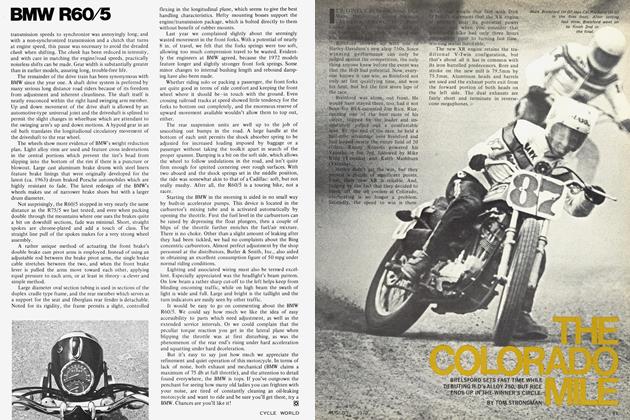
Mark Brelsford competed in the Champion Spark Plug Classic road race which wound up the current American Motorcycle Association National Championship Series with the knowledge that the biggest prize of all-the 1972 Grand National Championship—was already his.
As a result of his performance throughout the current AMA National Championship Series, Brelsford has made it mathematically impossible for any other racer to outpoint him for the No. 1 plates.
In retrospect, the Motor Sports Press Association could not have been more correct when, in 1968, they awarded the title of “Motorcycle Rider of the Year” to the then amateur/junior-classed racer.
Since his initial recognition in 1968, Brelsford has continued to grow in professional stature. In 1969, he was classed as an AMA expert, gained a position as a first stringer on the Harley-Davidson factory team, won a 50-lap TT National Championship at Gardena, Calif., and was ranked as the 8th best racer in the nation.
The San Bruno, Californian moved up to a 7th place finish in the 1970 National race. While he had scored well in most of the season’s competition, bad breaks kept him from an even better year end finish. His only win was notched at the Oklahoma City Mile, the final event of the year.
Again, 1971 found Brelsford in 7th place at the end of the circuit. His first win of the season took place at the 100-mile Loudon road race, when, to the delight of 30,000 racing fans, he scored a dramatic last lap, come-frombehind victory over road race veteran Kel Carruthers. He also scored first at the Gardena (Calif.) TT.
But 1972 was the year for the 23-year-old racer. His riding was so consistently good that, with two Nationals remaining, it was mathematically impossible for any other expert to take the Grand National Championship away from him.
At the 25-lap TT National Championship at Ascot Park, Brelsford and his Harley grabbed an early lead and held it through the finish of the race. His second 1st place trophy was collected at the Louisville Half-Mile National and he clinched the title when he was victorious in the Yamaha Gold Cup National in Salem, Ore.
LIFETIME FIRST PLACE FINISHES 1969 ......... 50-Lap TT, Gardena, Calif. 1970 . . 10-Mile Dirt Track, Okla. City, Okla. 1971 . . 100-Mile Road Race, Loudon, N.H. ..............50-Lap TT, Gardena, Calif. 1972 ......Yamaha Gold Cup, Salem, Ore. ................25-Lap TT, Ascot, Calif. ................Half Mile, Louisville, Ky.
BAILEY WINS FINAL 250 MX
More than 10,000 motorcycle race fans were on hand at Talladega, Ala., to view the country’s top professional motocrossers in action at the American Motorcycle Association’s final 250cc National Championship event.
Sweeping the 250cc class was Gary Bailey, a Bultaco rider from Torrence, Calif. Bailey put together a 2nd place finish and a pair of lsts in the event’s three hotly contested motos.
Richard Jordan of Littlerock, Ark., won the first moto on a CZ and finished 2nd and 3rd respectively in the remaining motos to finish 2nd overall.
The open class action featured daylong duels between Brad Lackey of Pinole, Calif. (Kawasaki) and Wyman Priddy of Fort Worth, Texas (CZ). The overall victory went to Brad Lackey with a 3rd place finish and a pair of lsts. Priddy finished 2nd overall by capturing close 2nds in each moto.
250cc CLASS 1. Gary Bailey ................... Bui 2. Richard Jordan .................CZ 3. Gary Semics ..................Hus 4. Steven Thorton ................ Bui 5. Fred Hanna ...................Hus 6. Francis Daley ................ Yam 7. Scott Jordan .................. Bui 8. James Yarbrough................CZ 9. John Borders.................. Bui 10. James Weinert ................ Yam OPEN CLASS 1. Brad Lackey ..................Kaw 2. Wyman Priddy..................CZ 3. Gary Chaplin .................. Mai 4. Herbert Miller ................. Mai 5. David Doerschuk................CZ (Continued on page 93)
Continued from page 81
JONES NAMED 250 MX CHAMPION
The American Motorcycle Association has crowned Gary Jones, a Yamaha rider from Hacienda Heights, Calif., as 250cc Grand National Motocross Champion.
The announcement followed the conclusion of the final event of the 25 0cc National Championship series which was held at Talladega, Ala., Sept. 2.
The final point standings for the 1972 National Championship Motocross series in the 250cc class is as follows:
1. Gary Jones .......... Yam, 995 2. Jim Weinert ......... Yam, 781 3. Gunnar Lindstrom .....Hus, 775 4. Peter Lamppu.........Mon, 489 5. Bob Grossi ...........Hus, 430 6. Mike Runyard ........Mon, 428 7. Bill Cook ............ Mai, 376 8. Robert Harris ..........Oss, 373 9. Sal Defeo .............CZ, 310 10. Tony Wynn ...........CZ, 304
BONNEVILLE CONTINGENCIES
Dr. Felix A. Kalinski, president of The Birmingham Small Arms Company Inc., recently announced that recordbreaking contingency awards have been posted by the company for the 1973 American Motorcycle Association Speed Trials at Utah’s Bonneville Salt Flats.
The top award posted for Bonneville’s Motorcycle Speed Week— $25,000—is offered for a new official AMA/FIM world record set by a full streamliner powered by a Triumph engine.
Triumph motorcycles presently hold 40 AMA speed records, and to lend incentive to Triumph salt racers to strive for more and faster records, The Birmingham Small Arms Company Incorporated has posted these awards for new AMA speed records established during Speed Week and officially standing on December 31, 1973:
For non-faired or partial streamliner records: Any record over 160
mph—$1000; for fastest speed record over 200 mph—$5000.
For full streamliner records: Any record over 230 mph—$5000; World Speed Record (AMA/FIM)—$25,000.
All record-breaking motorcycles must be powered with Triumph engines to be eligible for one of these awards.
ST. PETERS TRANS-AMA
Ideal track conditions paved the way for a day-long battle for 1st place in the third event of the 1972 Trans-AMA Motocross series held in St. Peters, Mo. Swede Ake Jonsson grabbed the winner’s spot in the 500cc International
Class aboard a Maico after competing fiercely with Finland’s Heikki Mikkola and West Germany’s Hans Maisch through all three motos.
Over 12,000 enthusiastic fans watched as Jonsson took two lsts and a 2nd in the motos, while Mikkola (Husqvarna) placed with two 2nds and a 1st. Maisch ran a consistant 3rd in all three motos on his Husqvarna.
Brad Lackey was 6th and highest placing American in the International Class. Lackey, of Pinole, Calif., was riding a Kawasaki.
Jonsson claimed the $10,000 race purse in addition to the contingencies offered by Cycle News, Champion, Bell, Pro-Am Products and Bell/Ray.
In the 250cc Support Class, Bob Grossi of Brookdale, Calif., took top honors on a Husqvarna. Grossi crossed the line first in both of the motos. Pasadena, California’s Jim West came in 2nd, also on a Husky, while 3rd place was filled by Sal DeFeo, a CZ rider from Port Washington, N.Y.
MOTOCROSS RESULTS 1. Ake Jonsson, Sweden ........... Mai 2. Heikki Mikkola, Finland .........Hus 3. Hans Maisch, West Germany ...... Mai 4. Arne Kring, Sweden ............Hus 5. Pierre Karsmakers, Holland .......Hus 6. Brad Lackey, Pinole, Calif........Kaw 7. Gary Jones, Hacienda Heights, Calif. Yam 8. Richard Thorwaldson, Cerritos, Calif. Suz 9. Dave Bickers, England ............CZ 10. Wyman Priddy, Fort Worth, Texas . . CZ 250cc CLASS RE SUL TS 1. Bob Grossi, Brookdale, Calif......Hus 2. Jim West, Pasadena, Calif.........Hus 3. Sal DeFeo, Port Washington, N.Y. . . . CZ 4. D. Jones, Hacienda Heights, Calif. . . Yam 5. Bill Cook, Carlton, Oreg.......... Mai
$1000 CONTINGENCY FROM BELL
The coveted No. 1 was worth another $1000 to Mark Brelsford for winning the 1972 AMA Grand National Championship. Bell-Toptex, manufacturer of the Bell Safety Helmet made the award at the Champion Spark Plug Motorcycle Classic at Ontario Motor Speedway. Brelsford picked up another $500, from Bell, for accumulating the most points in National Flat Track racing over the 1972 AMA season.
Bell has also posted a $500 contingency for the rider accumulating the most points in National Road Race competition. Bell Helmet equipped Gene Romero, Yvon du Hamel, Cal Rayborn and Gary Fisher will all be trying for the posting, with the winner receiving a check, following the conclusion of the Champion Spark Plug Motorcycle Classic.
These awards are part of Bell’s $50,000 contingency posting in 1972. Harley-D avid son-mounted Brelsford wore a Bell Star or Super Magnum during the season. |5]