Yamaha Lt2-Mx
YAMAHA LT2-MX
CYCLE WORLD IMPRESSION
A New 100-cc Motocrosser/Tracker Featuring Reed-Valve Induction, Five-Speed Gearbox, Responsive Handling.
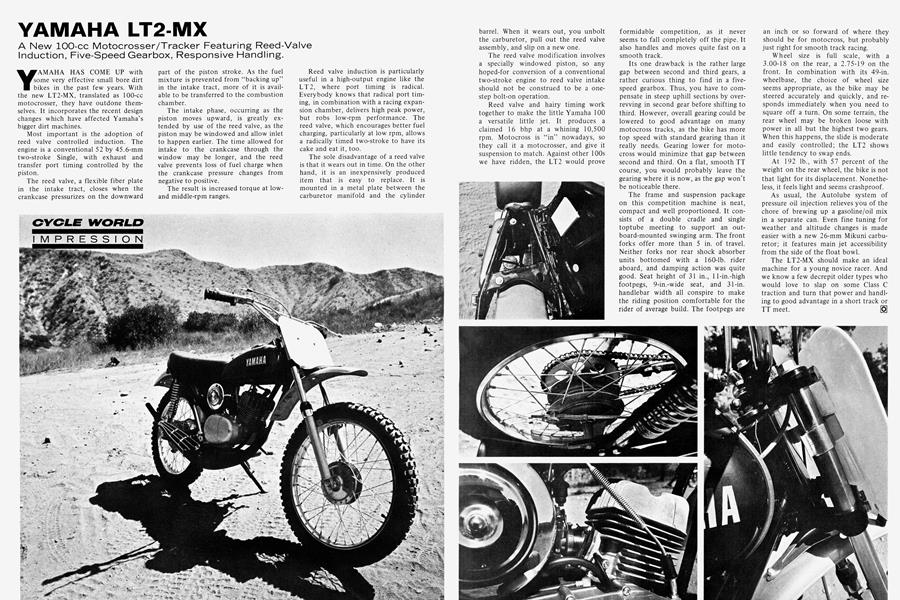
YAMAHA HAS COME UP with some very effective small bore dirt bikes in the past few years. With the new LT2-MX, translated as 100-cc motocrosser, they have outdone themselves. It incorporates the recent design changes which have affected Yamaha's bigger dirt machines.
Most important is the adoption of reed valve controlled induction. The engine is a conventional 52 by 45.6-mm two-stroke Single, with exhaust and transfer port timing controlled by the piston.
The reed valve, a flexible fiber plate in the intake tract, closes when the crankcase pressurizes on the downward part of the piston stroke. As the fuel mixture is prevented from "backing up" in the intake tract, more of it is available to be transferred to the combustion chamber.
The intake phase, occurring as the piston moves upward, is greatly extended by use of the reed valve, as the piston may be windowed and allow inlet to happen earlier. The time allowed for intake to the crankcase through the window may be longer, and the reed valve prevents loss of fuel charge when the crankcase pressure changes from negative to positive.
The result is increased torque at lowand middle-rpm ranges.
Reed valve induction is particularly useful in a high-output engine like the LT2, where port timing is radical. Everybody knows that radical port timing, in combination with a racing expansion chamber, delivers high peak power, but robs low-rpm performance. The reed valve, which encourages better fuel charging, particularly at low rpm, allows a radically timed two-stroke to have its cake and eat it, too.
The sole disadvantage of a reed valve is that it wears out in time. On the other hand, it is an inexpensively produced item that is easy to replace. It is mounted in a metal plate between the carburetor manifold and the cylinder barrel. When it wears out, you unbolt the carburetor, pull out the reed valve assembly, and slip on a new one.
The reed valve modification involves a specially windowed piston, so any hoped-for conversion of a conventional two-stroke engine to reed valve intake should not be construed to be a onestep bolt-on operation.
Reed valve and hairy timing work together to make the little Yamaha 100 a versatile little jet. It produces a claimed 16 bhp at a whining 10,500 rpm. Motocross is "in" nowadays, so they call it a motocrosser, and give it suspension to match. Against other 100s we have ridden, the LT2 would prove formidable competition, as it never seems to fall completely off the pipe. It also handles and moves quite fast on a smooth track.
Its one drawback is the rather large gap between second and third gears, a rather curious thing to find in a fivespeed gearbox. Thus, you have to compensate in steep uphill sections by overrevving in second gear before shifting to third. However, overall gearing could be lowered to good advantage on many motocross tracks, as the bike has more top speed with standard gearing than it really needs. Gearing lower for motocross would minimize that gap between second and third. On a flat, smooth TT course, you would probably leave the gearing where it is now, as the gap won't be noticeable there.
The frame and suspension package on this competition machine is neat, compact and well proportioned. It consists of a double cradle and single toptube meeting to support an outboard-mounted swinging arm. The front forks offer more than 5 in. of travel. Neither forks nor rear shock absorber units bottomed with a 160-lb. rider aboard, and damping action was quite good. Seat height of 31 in., 11-in.-high footpegs, 9-in.-wide seat, and 31-in. handlebar width all conspire to make the riding position comfortable for the rider of average build. The footpegs are an inch or so forward of where they should be for motocross, but probably just right for smooth track racing.
Wheel size is full scale, with a 3.00-18 on the rear, a 2.75-19 on the front. In combination with its 49-in. wheelbase, the choice of wheel size seems appropriate, as the bike may be steered accurately and quickly, and responds immediately when you need to square off a turn. On some terrain, the rear wheel may be broken loose with power in all but the highest two gears. When this happens, the slide is moderate and easily controlled; the LT2 shows little tendency to swap ends.
At 192 lb., with 57 percent of the weight on the rear wheel, the bike is not that light for its displacement. Nonetheless, it feels light and seems crashproof.
As usual, the Autolube system of pressure oil injection relieves you of the chore of brewing up a gasoline/oil mix in a separate can. Even fine tuning for weather and altitude changes is made easier with a new 26-mm Mikuni carburetor; it features main jet accessibility from the side of the float bowl.
The LT2-MX should make an ideal machine for a young novice racer. And we know a few decrepit older types who would love to slap on some Class C traction and turn that power and handling to good advantage in a short track or TT meet. [Ö]