"Then Came Bronson"
"THEN CAME BRONSON"
Harley-Davidson's Hottest Salesman
CLYDE EARL
ONE OF THE BEST new shows in the current TV season is the MGM-TV weekly series, "Then Came Bronson." Last spring, a two-hour pilot feature was released. From this, the series evolved.
The star of the show, Jim Bronson (played by Michael Parks), is a free spirit who travels the country on his motorcycle. His interaction with the many types of people he meets makes for some of the best TV stories since early shows like "Playhouse 90" and "Studio One."
The lead-off episode was a beautiful piece of work, starring English child actor Mark Lester. This was followed by Hollywood’s long-time motorcyclist Keenan Wynn in an appropriate story called “The Old Motorcycle Fiasco,” which featured a 1937 Rudge Ulster. Keenan’s wife in the story hated motorcycles, but fade-out time found her riding on the bike, her purse slung on her shoulder and her inhibitions thrown to the wind.
The show is being filmed all over the country. Filming on location presents many technical problems, but provides an enjoyable contrast with back-lot studio sets.
The Bronson show utilizes a 35-ft. vehicle called the Cinemobile Mark IV, a compact mobile unit which houses the hundreds of pieces of equipment required for filming.
As Bronson, the Hemingway of the
Harley, the producers cast Michael Parks—a good choice. He is not given much to say in his role, but he is a sensitive actor and viewers are responsive to his portrayal.
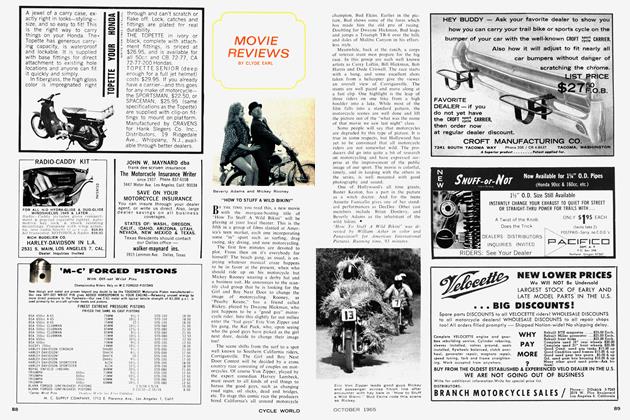
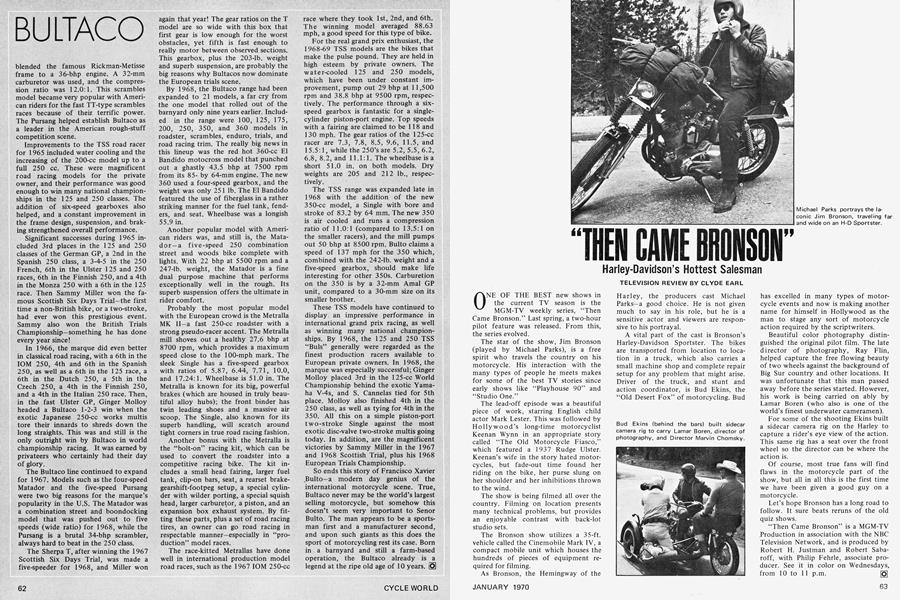
A vital part of the cast is Bronson’s Harley-Davidson Sportster. The bikes are transported from location to location in a truck, which also carries a small machine shop and complete repair setup for any problem that might arise. Driver of the truck, and stunt and action coordinator, is Bud Ekins, the “Old Desert Fox” of motorcycling. Bud
has excelled in many types of motorcycle events and now is making another name for himself in Hollywood as the man to stage any sort of motorcycle action required by the scriptwriters.
Beautiful color photography distinguished the original pilot film. The late director of photography, Ray Flin, helped capture the free flowing beauty of two wheels against the background of Big Sur country and other locations. It was unfortunate that this man passed away before the series started. However, his work is being carried on ably by Lamar Boren (who also is one of the world’s finest underwater cameramen).
For some of the shooting Ekins built a sidecar camera rig on the Harley to capture a rider’s eye view of the action. This same rig has a seat over the front wheel so the director can be where the action is.
Of course, most true fans will find flaws in the motorcycle part of the show, but all in all this is the first time we have been given a good guy on a motorcycle.
Let’s hope Bronson has a long road to follow. It sure beats reruns of the old quiz shows.
“Then Came Bronson” is a MGM-TV Production in association with the NBC Television Network, and is produced by Robert H. Justman and Robert Sabaroff, with Philip Fehrle, associate producer. See it in color on Wednesdays, from 10 to 11 p.m. [Ô]