When America's Milne Brothers Beat the World's Best
When America's Milne Brothers Beat the World's Best
THE BROADSLIDERS
'We Had to Win. It Was a Long Swim Home. When We Saw a Hole During a Race, We Went Through. All We Had to Lose Was Our Lives'— Jack Milne, 1937 World Speedway Champion
NORM HARTFORD
THOSE LEGENDARY Milne brothers of Pasadena, Calif., Jack and Cordy, are at it again. This time they're building a bike with a JAP engine for the revival of speedway racing in California. "This JAP weighs only 165 lb.—they used to scale around 250 when we rode 'em in England," said Jack, as we chatted at his plant.
He reminded me that three tracks in Los Angeles County, Calif., were holding races on fifthand sixth-mile ovals. He predicts that by next summer the thrill-hungry public again will go wild over the night broadsliding sport.
When Jack and Cordy make a forecast and back it up with American money and sagacity inherited from their Scottish ancestry, no one is inclined to argue. I’ve known them for more than 35 years and remember how they rose from jobs as Union messenger boys to become national and world champion speedway stars. And, their canny minds transformed a small bike shop and a three-figure bank account into a million-dollar motorcycle and automobile center in their home town.
“You remember Gene Rhyne, the hillclimber,” said Jack. “Gene and Dave Hynes, who is over here from New Zealand, designed the frame of this JAP, and Gene is assembling the units. Their frame saves weight by using the backbone tube as a fuel tank and the rear downtube for oil. The engines burn methanol—the speedway boys were burning this fuel years before it was used in dragsters.
“The JAP engine is named after the British manufacturer, J. A. Prest wich, and it’s a marvelous piece of machinery,” he continued. “It hasn’t changed much since 1932. This one produces 50 bhp, and the bike will do 70 mph on a short track straightaway, and will hit 1 30 mph on an open run.”
We were inspecting the bike when Gene Rhyne walked in. Gene was a national hillclimb champion and competed against Joe Petrali and Windy Lindstrom. Later, it was Rhyne who
teamed up as mechanic and manager to make another Pasadenan, “Lammy” Lamoreaux, famous as the “Flying Frenchman” of the short tracks.
The talk revived memories and took me back to a small ballpark in the south central district of Los Angeles in 1931, when the golden era of speedway racing in California began.
I was then a young Los Angeles sports broadcaster, but also worked with the late Paul Bigsby as promoter of the speedway racing. It was during the depression. We had a bankroll of a few hundred dollars, but to complicate matters, we not only didn’t know what we were doing, we weren’t even sure what we were trying to do.
Bigsby, a sidecar racer, had heard that in Australia and England, racing on small, flat tracks, from a sixthto a quarter-mile in length, was drawing huge crowds. He had tried to promote a couple of these meets at the fashionable Breakfast Club near Glendale, but the track was too small. It was merely an oval for horse shows, and measured about an eighth-mile around. The snooty club members decided they didn’t need the noise, anyhow.
So we persuaded Joe Pirrone, owner of the ballpark in the Central Avenue section, to lease us the place one night a week. The park had a good lighting system, a luxury which was rare in those days, and Pirrone closed his eyes while we plowed up his lush baseball turf—we were in business.
We held a couple of night races and everything ran smoothly, except that lads such as Ray Grant, Ted Morrow, “Mutt” Kelly, “Slim” Meyers, Dick Tweedy, Miny Wain, “Shorty” Campbell and George Lannum didn’t know exactly how they were supposed to ride the track, and their equipment consisted of Indians, Harleys and Excelsiors geared for larger speedways. The boys also ran old Cyclones and anything else available.
Cordy Milne, then an “amateur,” rode an Indian against another hot
youngster, Burton Albrecht, on a Harley. At this time, Lammy Lamoreaux and Jack Milne were only interested spectators standing in the pits.
Then, one night, tall, dark and handsome Lloyd “Sprouts” Elder, who lived in Fresno, showed up at the track with a Douglas. Elder had ridden in Australia, where the sport started in 1924, and later became a hero in England. Sprouts climbed aboard the bike in his street clothes, asked the boys to give him a push, and proceeded to burn up the track. The crowd leaped to its feet and went wild as the old master broadslided the turns, sprayed dirt 20-feet high, then rocketed down the straightaways.
In the pits our riders stared popeyed. Now they understood! That was how those tracks had to be ridden.
From then on Sprouts was the star and headliner, his sensational style attracting big crowds and Hollywood movie stars, among them Clark Gable and Hoot Gibson, both of whom owned road machines. Elder commanded a guarantee and often made a clean sweep of the prize money. A shrewd businessman, Sprouts unloaded his Rudges and Douglases in sales to other riders, then showed up with faster JAPs.
Winter set in, the rains came, and night racing was postponed until spring. We tried a couple of Sunday afternoon races at a Culver City ballpark, but the thrills were lacking. Speedway was strictly a night sport.
The next year we interested Floyd Clymer, a newcomer from Denver, Colo., in the White Sox location. Clymer, a former Rocky Mountain hillclimber, speedway champion and promoter, had established an Indian agency in Los Angeles. His additional ideas on promotion helped, and with the public going daffy over the sensational new sport, we started packing ’em in. Admission was only 50 and 75 cents, or 35 cents with a part-pay pass. These prices may seem paltry now, but in those days hard dollars were scarce, and the WPA workers among our fans weren’t exactly flush.
We bought time on a local radio station and broadcast the races with Bob Steele, a rider, describing the action. Steele later became a top announcer on New England stations.
Nothing succeeds like a packed house, and soon there was a track in San Diego operated by Bob Sarkijian and the Seward brothers, one in Long Beach built by Jack Crane, and tracks in Sacramento, Emeryville, Fresno, Bakersfield, Santa Ana and San Francisco. Old time motorcycle champions and dealers saw the possibilities and started building and leasing tracks. New promoters included Dud Perkins, Hap Alzina, Frank Murray and Harry Wilson.
The boys were riding at a different track each night, and the sport was booming. Crowds and prize money increased, and the lads were fattening their bank accounts and buying faster equipment. A rider could make $75 or $100 a night. Another track opened in Los Angeles at Loyola Stadium. An ex-newsboy, Domonick Distarce, saw the races, got a bright idea and rounded up a dozen “miniature car” drivers. Thus was born midget auto racing.
Later, Earl Gilmore, owner of an oil company, built a quarter-million-dollar stadium on the west side of Los Angeles, where the motorcycles and midgets drew huge crowds until the local residents complained of the noise. They caused so much pressure that the races were discontinued. Paul Bigsby and his brother, Carl, built the Atlantic Speedway on the east side of the city, where races were held for years.
Meanwhile, along the circuit, the
youngsters who were winning the prize money included the Milne brothers, Ray Grant, Lammy Lamoreaux, Bob Lisman, Jimmy Gibb, Pete Colman, Earl Farrand, Byrd McKinney, “Peewee” Cullum, “Rusty” Roberts, Garland Johnson, Miny Wain, Ed Jones, Dick Springston, Mark Porter, Kenny Schofield, Del Morrison, Jim Young, Leonard Andres—now the sponsor of Cal Rayborn’s Harley-Davidsons—Al Chasteen, Cliff Self and “Slim” Meyers. Tracks had sprung up in the eastern part of the country, with races being held at several cities in New York, Illinois, Wisconsin, New Jersey and Connecticut.
(Continued on next page)
Racing also started in Mexico City and some of the boys, including Cordy Milne and Shorty Campbell, competed there under the partido betting system. Mexican fans were wildly enthusiastic, but not numerous enough, and the riders were glad to get home with their equipment intact.
After a couple of seasons, the other riders started passing Sprouts Elder. The tall campaigner, whom the Australian, English and South American sports writers had dubbed the “greatest showman of them all,” found himself consistently finishing behind the fiery new kids. He gracefully retired from competition, joining the California Highway Patrol at Fresno.
Both handicap and scratch races were held, the latter from a flying start. Fans usually were on their feet by the time the JAPs hit the starting line, with throttles wide open and engines blasting. One night, early in the game, an eight-lap race had been tried at White Sox Park, but the riders were exhausted before the finish. Four laps was the best distance.
In Los Angeles, the sport was brought to the height of public attention in 1933, when Captain Cannon and the California Highway Patrol leased the Los Angeles Coliseum, site of the Olympic Games, and held the National Short Track Championships. The winner was little Cordy Milne, who was only 5 ft., 7 in. tall, and weighed 130 lb., but who was a bundle of fire on wheels. Cordy won the national AMA title again in 1935 and later in 1947.
Fans often have discussed how the Milne brothers found that extra something that made them U.S. and world champions.
They are of Scottish ancestry, but were born in New York state and reared in Pasadena, a city then known for its millionaires, parades and Rose Bowl football games, rather than motorcycle racing. Nobody has been able to explain why Pasadena not only produced the Milnes, but also Lamoreaux, Pete Colman, Shorty Campbell, Byrd McKinney, Garland Johnson and so many others.
For years the Milnes insisted their name was pronounced “Mile-an” in the old Scottish manner, but they finally gave up on this and now accept the public’s desire to pronounce the word “Mill-nee.” The Milnes always were careful about keeping their racing equipment in tip-top shape, were smart about finding the short way around the tracks, and had the tenacity of a pair of bulldogs. So did their little fellow Pasadenan, Lamoreaux.
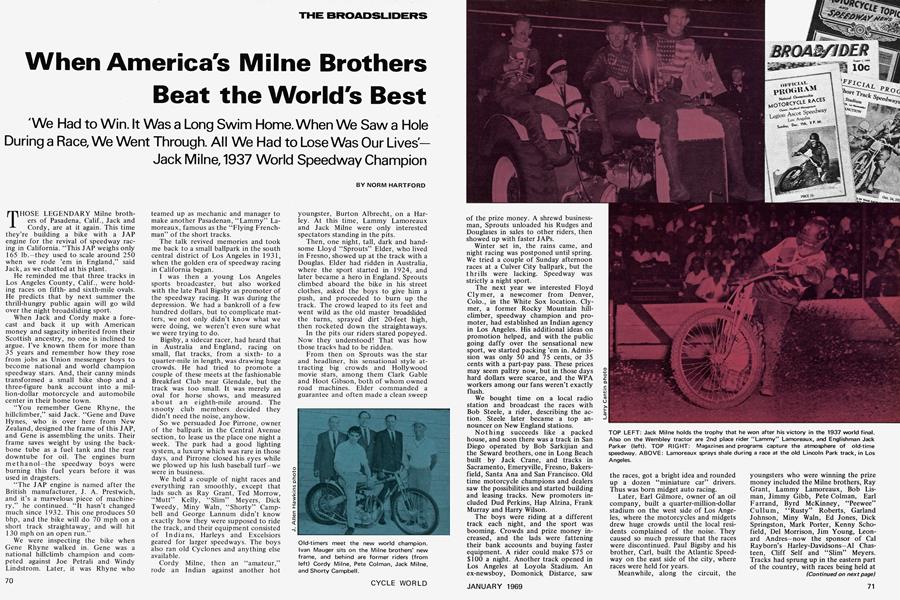
Jack, who from hundreds of riders from the Continent, Britain, Australia and America, became world champion in London, said, “Gosh, I don’t know why we got to the top. Maybe we won through desperation. When we got to Australia in 1935, we had spent about our last cent on the boat trip. We had to win. It was a long swim home. When we saw a hole during a race, we went through. All we had to lose was our lives.”
Critics, however, say the Milnes and Lamoreaux developed a winning style of holding the left foot forward and hugging the rail, thus beating the likes of Elder, Grant and others who rode with the left leg tucked back and dragging, oversliding and covering too much ground. Time has proven them right, for today no one uses the old “legtrailing” style.
The Milnes had been urged to go to Australia by some riders from “Down Under,” who had visited southern California. Later, the Australians probably wished they had withheld the invitation, because as soon as the boys landed in Australia, they began winning everything in sight. Jack took the Aussie title in 1936, and Cordy won it in 1940. One night, in Sidney, after the Milnes had swept the program, Frank Arthur, the promoter who had raced against Sprouts Elder when the sport was in its infancy, told the brothers he was taking them to Britain.
On arrival in England, they found 40 stadiums operating on a vast scale. Team racing was established, and riders were bought, sold and traded like big league ball players in America. Over four million fans crowded the stadiums annually, and the World Championship final at Wembley Stadium in London attracted some 100,000 spectators, and visits from the Royal Family.
“We were both signed by the New Cross club in London,” said Jack. “But the organization that ran speedway decided not to let Cordy and me race for the same team. They let me stay with New Cross, but assigned Cordy to Hackney Wick, another London track.”
The reason for the split was obvious. The Milne reputation had preceded them from Australia, and officials considered that both brothers in one team would make it too powerful.
Stenner’s Motorcycle Speedway Annual reported: “What a commotion the advent of the Milnes caused. Some of the unlucky clubs talked wildly of asking the Ministry of Labour to kick the Milnes out of the country because they would be depriving British riders of their bread and butter. What a lot of eyewash this contention turned out to be. Jack and Cordy sent attendances rocketing at their respective tracks. The profit made enabled both Hackney and New Cross to go in wholeheartedly for the finding and training of young riders.”
(Continued on page 82)
Continued from page 72
In their first season, Cordy finished in a 4th-place tie in point standing, while Jack was 7th. That was in 1936, the first year an official world championship was held. Lionel Van Praag, of Australia, won, Englishman Eric Langton was 2nd, and another Australian, “Bluey” Wilkinson, finished 3rd.
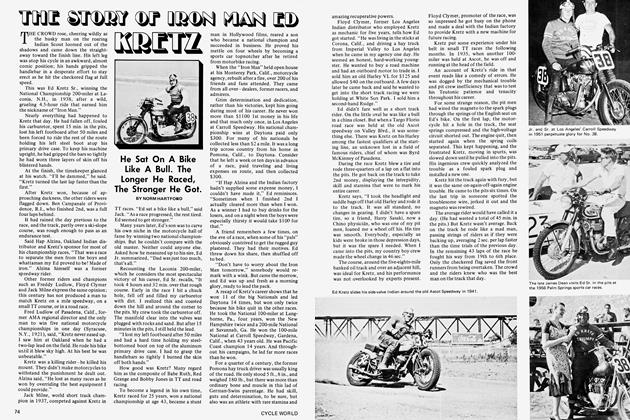
The next year, Jack became the first American to win the world crown, with Lammy Lamoreaux 2nd and Cordy 3rd. This trio claimed a clean sweep for America, a shutout that was hard for the Europeans and Australians to swallow. In the final day of the season, Jack won every event he entered.
In 1938, Bluey Wilkinson, of Australia, took the championship with Jack 2nd and Lammy 3rd.
Again, in ’39, it looked like a Pasadena triumph. Cordy was leading in points when, three days before the big race in September, war was declared. The boys returned home.
The next year the Milnes, Lammy, and Jimmy Gibb promoted and rode in races at a ballpark at Slauson and Western in Los Angeles. This stadium, like so many others, was to give way to the California real estate boom, which made land too valuable and highly taxed to be used for sports. The park was torn down to make way for industry.
In 1946, the riders built and opened Lincoln Park Stadium in Los Angeles and appointed Floyd Clymer manager. Successful races were held until 1949, when this location also gave way to rising real estate values and was vacated. Also, the advent of television in the 1950s hurt all sports, as people stayed home and enjoyed the new medium. Riders and drivers were retiring, and both short track and midget racing faded from the scene.
“The big problem now is to find a central location for a track outside a residential area where the rent isn’t prohibitive,” said Jack. “Close to houses, there’s always the noise to worry about. But if short track racing was a big success in the ’30s and ’40s, think how many more potential fans we have, now that the motorcycle has become a dozen times as popular.”
The Milne JAP sells for about $1100, Jack said. He was at his desk scribbling some notes when he became self-conscious of a thumb missing from one of his hands. “Lost that in ’36, my first season in England,” he smiled. “Went over the top of a fellow into a wire fence. I didn’t even know the thumb was gone until I went over to pick up my bike. The thumb was in my glove, cut off clean. I was back riding in three weeks.”
Some years previously, in San Diego, Jack suffered another bad accident, when he spilled and was struck by a machine ridden by “Putt” Mossman. Jack was out for some time with a cracked-up back.
“What became of Putt Mossman?” I asked.
“He’s over in Arizona, still giving trick bike riding exhibitions,” said Jack. “And he’s still pitching horseshoes. Putt must be over 60. You remember, Putt was the darndest combination, used to entertain crowds between races with jumps, blindfold stunts and other shenanigans on a bike. Then he’d perform on a vaudeville stage doing trick horseshoe pitching. Putt was a fair short track racer, too.”
Rhyne wheeled in one of the new race machines and sat down. “That JAP engine is simple in design, but nobody ever matched it,” said Gene. “When short tracks started in California, AÍ Crocker, the Los Angeles Indian dealer, built a bike but it couldn’t quite compete. So did the Harley factory—and Harley didn’t have any luck, either.”
Cordy, who, like Jack, toils a full shift and feels more at home in jeans and work shirt than in a business suit, tossed some tools aside and joined the conversation. The talk resolved itself into a, “Whatever happened to so-andso?” gabfest. Before we finished, it was generally agreed that most of the old timers had done well, and some had become downright rich.
Miny Wain, for many years a boss of hydraulics at Lockheed Aircraft, invested in 90 acres of apricots at Hemet, Calif. When the town boomed, he sold out for a fortune.
Eldon “Shorty” Campbell long has been one of the top recording directors in Hollywood television circles. He is in charge at Desilu Productions.
George Lannom was a captain when he retired from the Los Angeles Fire Department.
Mutt Kelly owned a trucking company which he sold for a sizable profit some time ago.
Floyd Clymer publishes magazines and books, and is behind the manufacture of certain brands of motorcycles.
Pete Colman quit racing to become an aircraft engineer during World War II, and for three years was in charge of a U.S. Army Air Corps maintenance depot at McDill Field, Tampa, Fla., which employed 750 technicians. Pete now is vice president and general manager of the Triumph and BSA distributing plants at Duarte, Calif., which gross $25 million annually. The organization distributes bikes to 19 western states, including Alaska and Hawaii.
Paul Bigsby was wealthy when he passed away in 1968. A pattern maker by trade, Paul patented and manufactured a guitar amplifier at Downey, Calif., and with the advent of the Beatles and the soaring popularity of the guitar, he made considerable profits.
Tragedy befell the true father of American short track racing, Sprouts Elder. After quitting the game, Sprouts became a Highway Patrolman at Fresno. He was critically injured in an accident and was later retired because of disability. His friends say Sprouts never seemed right after that. Later, he was struck by a car while walking, and was hospitalized. When his wife died, Sprouts took his own life.
Lammy Lamoreaux, the daring little guy who seldom spoke, but was all guts and skill on a track, was a successful Triumph dealer in Glendale when he died a few years ago. Lammy’s widow, Margaret, is a secretary on Pete Colman’s staff at Duarte. Also working for Colman is little Andy Anderson, who started the first races at the Breakfast Club and White Sox Park, and sent so many kids on their way to fame and fortune.
Perhaps the enthusiasm of the new wave of speedway enthusiasts—people like Los Angeles promoter Dude Criswell, or riders such as recently crowned U.S. champion Rick Woods, teenager John Hately, and “Wild Man” Jimmy Nicholson—will win the U.S. more world championship honors in coming years.