Baja
BAJA
The Land of Disenchantment
JOE PARKHURST
WHAT STARTED out as a lot of pure fun, grew into an obsession for some, a sport for others, has now become a hot-blooded contest of record setting. Motorcycles proved beyond question which vehicle is fastest in the rough, as they have been doing in the other dune buggy/fourwheel-drive/motorcycle cross-country races, the Mint 400 and Stardust 711, both run in the wilds of Nevada, and the classic event, the Baja 1000.
The Mexican 1000 has grown into an event important enough for ABC television’s “Wide World Of Sports’ ” attention. Their trucks, helicopters, airplanes, cars, and buggies, were everywhere. Funniest sight at such dirty, dusty checks as Rancho Santa Ynez was the ABC interviewer, dressed to the teeth in slacks, pale blue shirt, tie and the familiar black blazer with the ABC emblem on the pocket. Most frightening sight of all was one of the two ABC helicopters carrying the gyro-mounted motion picture camera, blasting over the sage brush and rock just a few feet off the deck, and 10 or 15 ft. to the side of a motorcycle or car. Several drivers complained of the dust whipped up by the whirling blades, and Larry Berquist said he almost fell off in surprise when he glanced sideways at about 80 mph to
find himself staring into a camera lens.
Promoted by the National Off-Road Racing Association, the Mexican race to the tip of the wild, barren Baja peninsula has grown from its first event with an entry of only 68 to an all-out effort on the part of dozens of buggy makers and enthusiasts, jeeps, broncos, trucks, and motorcycles numbering 254 vehicles. This appears to be a lot of machinery, but the vastness of Baja swallows them at once. Of the starting total 112 finished, 16 of them motorcycles.
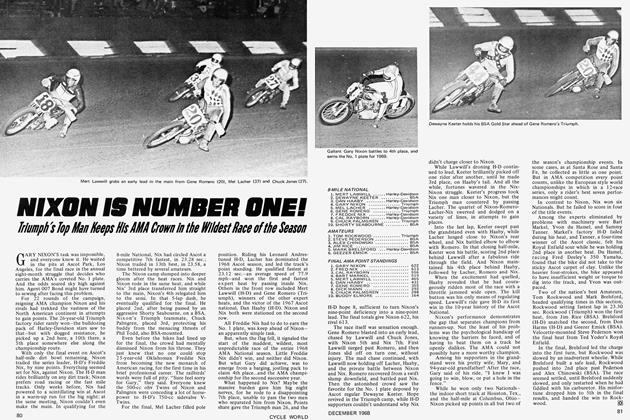
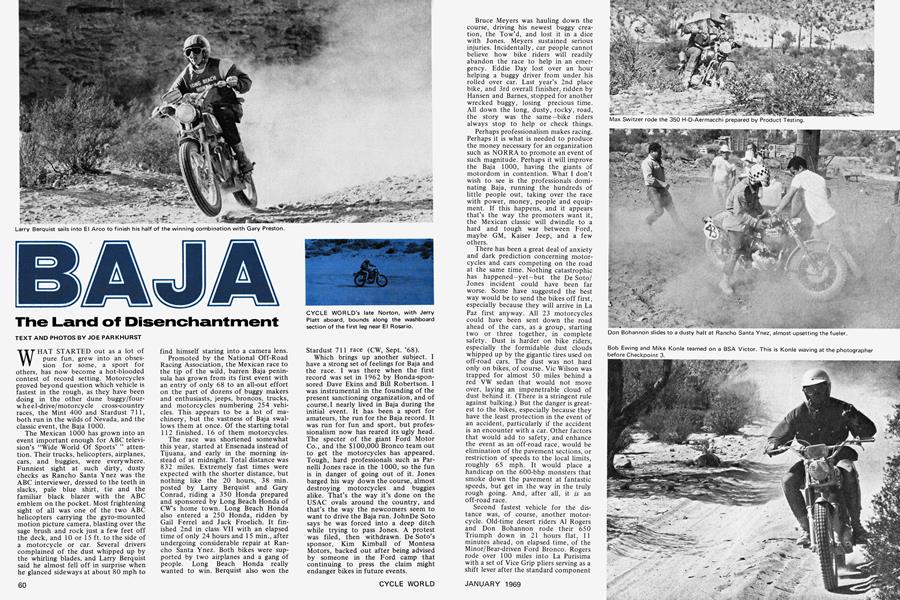
The race was shortened somewhat this year, started at Ensenada instead of Tijuana, and early in the morning instead of at midnight. Total distance was 832 miles. Extremely fast times were expected with the shorter distance, but nothing like the 20 hours, 38 min. posted by Larry Berquist and Gary Conrad, riding a 350 Honda prepared and sponsored by Long Beach Honda of CWs home town. Long Beach Honda also entered a 250 Honda, ridden by Gail Ferrei and Jack Froelich. It finished 2nd in class VII with an elapsed time of only 24 hours and 15 min., after undergoing considerable repair at Rancho Santa Ynez. Both bikes were supported by two airplanes and a gang of people. Long Beach Honda really wanted to win. Berquist also won the
Stardust 711 race (CW, Sept. ’68).
Which brings up another subject. I have a strong set of feelings for Baja and the race. I was there when the first record was set in 1962 by Honda-sponsored Dave Ekins and Bill Robertson. I was instrumental in the founding of the present sanctioning organization, and of course, I nearly lived in Baja during the initial event. It has been a sport for amateurs, the run for the Baja record. It was run for fun and sport, but professionalism now has reared its ugly head. The specter of the giant Ford Motor Co., and the $100,000 Bronco team out to get the motorcycles has appeared. Tough, hard professionals such as Parnelli Jones race in the 1000, so the fun is in danger of going out of it. Jones barged his way down the course, almost destroying motorcycles and buggies alike. That’s the way it’s done on the US AC ovals around the country, and that’s the way the newcomers seem to want to drive the Baja run. JohnDe Soto says he was forced into a deep ditch while trying to pass Jones. A protest was filed, then withdrawn. De Soto’s sponsor, Kim Kimball of Montesa Motors, backed out after being advised by someone in the Ford camp that continuing to press the claim might endanger bikes in future events.
Bruce Meyers was hauling down the course, driving his newest buggy creation, the Tow’d, and lost it in a dice with Jones. Meyers sustained serious injuries. Incidentally, car people cannot believe how bike riders will readily abandon the race to help in an emergency. Eddie Day lost over an hour helping a buggy driver from under his rolled over car. Last year’s 2nd place bike, and 3rd overall finisher, ridden by Hansen and Barnes, stopped for another wrecked buggy, losing precious time. All down the long, dusty, rocky, road, the story was the same—bike riders always stop to help or check things.
Perhaps professionalism makes racing. Perhaps it is what is needed to produce the money necessary for an organization such as NORRA to promote an event of such magnitude. Perhaps it will improve the Baja 1000, having the giants of motordom in contention. What I don’t wish to see is the professionals dominating Baja, running the hundreds of little people out, taking over the race with power, money, people and equipment. If this happens, and it appears that’s the way the promoters want it, the Mexican classic will dwindle to a hard and tough war between Ford, maybe GM, Kaiser Jeep, and a few others.
There has been a great deal of anxiety and dark prediction concerning motorcycles and cars competing on the road at the same time. Nothing catastrophic has happened-yet-but the De Soto/ Jones incident could have been far worse. Some have suggested the best way would be to send the bikes off first, especially because they will arrive in La Paz first anyway. All 23 motorcycles could have been sent down the road ahead of the cars, as a group, starting two or three together, in complete safety. Dust is harder on bike riders, especially the formidable dust clouds whipped up by the gigantic tires used on off-road cars. The dust was not hard only on bikes, of course. Vic Wilson was trapped for almost 50 miles behind a red VW sedan that would not move over, laying an impenetrable cloud of dust behind it. (There is a stringent rule against balking.) But the danger is greatest to the bikes, especially because they have the least protection in the event of an accident, particularly if the accident is an encounter with a car. Other factors that would add to safety, and enhance the event as an off-road race, would be elimination of the pavement sections, or restriction of speeds to the local limits, roughly 65 mph. It would place a handicap on the 600-bhp monsters that smoke down the pavement at fantastic speeds, but get in the way in the truly rough going. And, after all, it is an off-road race.
Second fastest vehicle for the distance was, of course, another motorcycle. Old-time desert riders AÍ Rogers and Don Bohannon rode their 650 Triumph down in 21 hours flat, 11 minutes ahead, on elapsed time, of the Minor/Bear-driven Ford Bronco. Rogers rode over 100 miles into La Purisima with a set of Vice Grip pliers serving as a shift lever after the standard component
broke off while the transmission was in third gear. Motorcycles held six of the first twelve places in the end, and would have had all of them were it not for a few problems. Lars Larsson was entered on a Husqvarna with an eight-speed gearbox, but, with Gary Conrad riding, it was forced to drop out shortly after the start. A 420-cc Husky, ridden by John Coots, seized just a mile down the road.
Two of the best prepared bikes in the race were the 350 H-D-Aermacchis entered by Jack Krizman’s Product Testing Co., maker of the Filtron air filters for off-road vehicles. Max Switzer, often winner of rough desert events, and motocross rider Paul Hunt shared the riding of one Krizman bike. Hunt rode the first half, experienced a flat tire, the front wheel spokes almost fell out, and a minor electrical problem destroyed the lights. Regardless, they finished 4th in class, going the distance in 24 hours flat, well under the old record. Motorcyclist John Steen switched to cars. He drove a giant Oldsmobile Toronado set up for the dirt. Dub Smith and Al Hillan rode a 125-cc Sachs to La Paz faster than the Olds, but, considering the machine, it’s a wonder Steen and his Pikes Peak driver Frank Peterson got there at all.
Bud Ekins traveled down in another unfamiliar machine, one of Hickey’s remarkable Olds-powered Baja Boots. He didn’t finish, but another “Boot” finally lumbered across the finish line. Bob Ewing and Mike Konle finished in 23 hours, 1 min. on their BSA Victor. Konle rode the first half in daylight, singing and generally enjoying himself most of the way. Ewing left the halfway point at El Arco, developed an oil leak and lost time finding oil to replace the leaking vital fluid. During the night a small fall cost him his headlight. He finished on a weak fog light only. The BSA is another machine that could have beaten the Broncos and finished higher in the money.
Two more desert rats, long on the California scene, Eddie Day and Buck Smith, entered a Triumph TR-6. Day rode the first half, making it to the halfway mark almost 500 miles away in 10 hours, 59 min. This was good time, but it would have been better had he not stopped for a serious buggy crash, then ridden to the next check at El Rosario to get help for the injured driver. Smith, on the second half at night, lost the bike near San Ignacio, nearly 600 miles from the start. His injuries were so severe that he was unable to continue for six hours. He finished the race later in the morning, arriving at La Paz after noon.
TCW’s entry, a Norton P-11, again was ridden by CW^s Jerry Platt and Vern Hancock, but the worst luck possible befell Platt on the first half, when he was taken out of the race by failure of two inner tubes. He abandoned the bike 15 miles north of remote Punta Prieta, walked into the settlement and tried to radio for yet another tube. Unable to find one, or communicate with the other members of the team, camped at El Arco about 80 miles away, he spent a frustrating night. Next morning he hitched a ride with one of the many Ford support crew trucks back to where he had abandoned the bike, but it had been stolen and carted north. Riding on to Rancho Santa Ynez, the nearest checkpoint back up the road, he finally managed to reach a radio that could get through. Jerry was picked up later.
Road racing’s Dan Gurney was entered with Montesa partner Kim Kimball on a 250 Scorpion, but apparently Ford, to whom Gurney is somewhat obligated, said “No.” It was likewise for ex-motorcyclist and now Gurney-sponsored car racer Swede Savage.
Dick Hansen and John Barnes also rode for Montesa. Hansen took the bike into El Arco in only 11 hours, 1 min., including the time required for the previously mentioned stop to help the buggy driver. Steaming for La Paz, Barnes had a flat on the rear, crashed while trying to ride with the flat, and suffered a broken collarbone. It ended a superb try, one that could have brought the team in well up in the field.
George Zuber and Ron Bishop ran a 250 Yamaha to 3rd place in class VII in 26 hours, 47 min. Doug Douglas and Bill Ydiando took a 350 Ducati down in 26 hours and 30 min. for 5th in class VII. Class VIII, for bikes 250 and over, was won by Baja veterans “Whitey” Martino and Steve Holladay, on a Husqvarna, in only 23 hours, 17 min. Expert Steve Scott entered a Bultaco, finished 5th in class VII after losing precious time when a rag jammed in his rear chain. Thinking the engine had seized, he left the bike, but returned later to discover the rag and continued. Later he lost his lights, but rode by the glow of the full moon. He also lost his gas line, and had to ride from gas supply to gas supply as best he could.
Gary Leupold and Warren Seigfred rode their Triumph beautifully, but the engine blew on the second half and Leupold pushed it across the line after nursing it for hours. They finished 4th in class VIII regardless. Trouble was not confined to any group, everyone had a taste. Another Montesa entry, ridden by Steve Kirk, sat at one check for 12 hours after being one of the leaders on the first half, waiting for a new front tire. Montesa’s Mexican plane pilots did not understand the directions given them and went the wrong way.
It was a smashing victory for motorcycles over our four-wheeled opponents. It could have been even more overwhelming. Even Berquist ran out of gas, losing an estimated 10 min. Baja will continue as the man and machine breaker, and one of the most expensive events in which to compete in motorcycling. Entry fee is $250, but the prize money is about $1200 for 1st in class.
Additional prize money was offered by several accessory and petroleum products makers, but nothing like the thousands of dollars offered the car drivers. It is a shame more of the motorcycle industry has not taken up the Mexican 1000 as a promotion. The only way a motorcycle can continue to win the event is through continued support of the few individuals and firms that have made it what it is so far. Montesa and Husqvarna are the only two distributors which enter. Long Beach Honda is a large but local dealership. The remaining bikes are private and dealer entries. These people spend a great deal of money.
The nearly 250 vehicles, 23 of them motorcycles, leaving Ensenada at 1-min. intervals, was a fabulous show. Spectators lined the road for over 70 miles from the start. Part of the course is still on almost 200 miles of pavement, giving the faster cars an edge. The Ford Broncos were touching over 120 mph at times on these stretches, while Berquist, on the Honda, was forced to be content with 90 mph.
Race organization was much better this year; the logistical problems of the event are so huge nobody expects miracles. Radio communication could be better, and NORRA is all too willing to simply abandon competitors where they lie. Team CYCLE WORLD received no help trying to locate the Norton. NORRA’s “sweep crew” was often hard to find and gave up early, leaving many competitors to find their own way out. The best advice for anyone who plans to run next year is: “Don’t leave your machine if forced to stop. Hide it. Make your own preparations for getting out broken down equipment.”
CYCLE WORLD will be back, and at good old El Arco we’ll have something set up to compete with the lavish El Arco Hilton for bike riders. CYCLE WORLD again will see Montesa guys working on Bultacos, and vice versa, and BSA riders working on Nortons and Triumphs. Bike riders pitch in and help each other with a camaraderie the car folk never will understand. Maybe that’s the reason motorcyclists are so enthusiastic about racing the Baja torture test. Few events better promote good will for motorcycling. I can’t think of one that spreads the good word farther and better.