Racing Review
RACING REVIEW
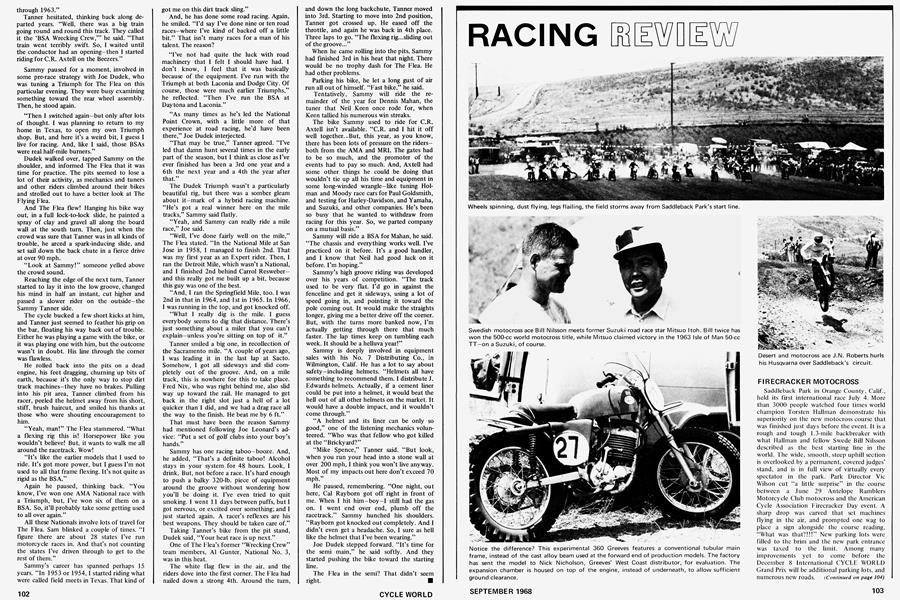
FIRECRACKER MOTOCROSS
Saddleback Park in Orange County, Calif., held its first international race July 4. More than 3000 people watched four times world champion Torsten Hallman demonstrate his superiority on the new motocross course that was finished just days before the event. It is a rough and tough 1.3-mile backbreaker with what Hallman and fellow Swede Bill Nilsson described as the best starting line in the world. The wide, smooth, steep uphill section is overlooked by a permanent, covered judges’ stand, and is in full view of virtually every spectator in the park. Park Director Vic Wilson cut “a little surprise” in the course between a June 29 Antelope Ramblers Motorcycle Club motocross and the American Cycle Association Firecracker Day event. A sharp drop was carved that set machines flying in the air, and prompted one wag to place a sign alongside the course reading, “What was that?!!!” New parking lots were filled to the brim and the new park entrance was taxed to the limit. Among many improvements yet to come before the December 8 International CYCLE WORLD Grand Prix will be additional parking lots, and numerous new roads.
(Continued on page 104)
NORTH AMERICAN GP
French Canadian Yvon du Hamel won the 250-cc race at the Grand Prix of North America, though he completed the final nine laps with the left handlebar of his Yamaha dangling uselessly, attached to the machine only by the control cables. The incredible du Hamel also achieved an impressive double, winning the combined 500-cc and unlimited event by more than a lap from Mike Duff.
The event was the first of its kind, and the sanctioning Canadian Motorcycle Association hopes it will prompt the start of an international series similar to the Can-Am automobile events. Mosport, measuring 2.459 miles to the lap, is one of the finest circuits in North America. Its twisting nature and average speed of nearly 85 mph demand equal proportions of rider ability and machine performance.
CYCLE WORLD Associate Editor Mike Duff, racing a seven-speed RD56 Yamaha Twin provided by Vancouver dealer Fred Deeley, won the 250-cc heat. In the final, du Hamel sped into the lead while Duff, with an overrich engine, required four laps to work into 2nd place. But, with 15 laps remaining, a plug oiled up and he was forced to pit, and replace the wet plug. Meanwhile, Dave Bloom, from Michigan, had occupied 2nd place behind du Hamel. Duff eventually reached 3rd place, with Suzuki factory rider Ron Grant 4th. Walt Fulton (Kawasaki) retired with a slowing engine, after holding 2nd place.
The combination of du Hamel and the 351-cc Yamaha, which he also had ridden at Daytona, proved unbeatable in the 500-cc and unlimited event. He lapped the entire field, and circulated at within 0.5 sec of Mike Hailwood’s 500-cc record, set on a Honda Four in last year’s damp Canadian GP.
Walt Fulton held 2nd place on his factory Harley-Davidson, but he was slowed by carburetion troubles. Mike Duff, who had started slowly on his G50 Matchless, passed the unlucky Fulton to claim 2nd place.
Sidecar racing has increased rapidly in popularity in Canada in the last two years, and eight outfits entered the sidecar event at Mosport. K. Zans and passenger J. Sauer piloted their 650 Triumph to victory by almost a minute over BMW-mounted H. Wolters and H. Baumgartel. Sidecar heat winners Lou Herrmann and Klaus Grundier (650 Triumph) finished 8th. The 125-cc race was the only event in which du Hamel was beaten. Dave McDaniels of Milford, Mich., headed Yvon by only 0.1 sec. Both rode Yamaha 100s.
LOUISVILLE NATIONAL
More than 7000 fans, 51 Amateur competitors, 52 hard riding Experts, and $6000 in prize money made up the 15-mile National at Louisville, Ky. Although this was the event’s 10th birthday, it was only the second time that the race had been run on the fabulous Louisville Downs track.
Ted Heil set fastest Expert time around the limestone half-mile, with Bob Maiers of Lansing, Mich., quickest of the Amateurs. Maiers led the field in the first Amateur heat, and other heat winners were Larry Darr and Jerry Stokes. More than 19 states were represented in the Amateur class! Heil, Bart Markel, and Fred Nix-all on Harley-Davidsons-claimed 1st places in the Expert heats.
After the track had been conditioned, top finishers in the Amateur heats were introduced, and then sent headlong into the first turn. Going into the back straight on Lap 1, last year’s top Novice, Dave Atherton, hit the outside fence and was struck by two other riders. Jack Forrester plowed into Atherton’s machine, and Jack and his bike performed a spectacular end-over-end flip. Atherton suffered a leg injury, and Forrester received a broken hand.
Men and machines blocked the track, and the race was stopped. In the rerun, Larry Darr, who had been running 2nd at the time of the accident, jumped into the lead and held it throughout the 14-lap race, although he was challenged several times by Maiers and his BSA Single. Larry Evener of Columbus, Ohio, moved his H-D into 3rd spot on Lap 4, to finish behind the two front runners.
The 15-mile National started with Dan Haaby moving his immaculate H-D into the lead, to pick up the first $10 lap prize. Bart Markel passed Haaby on Lap 2, with Fred Nix holding 3rd place and Cal Raybom moving into 4th sport. Then, on Lap 10, Haaby repassed Markel, and it seemed the three-time Grand National champion would have to settle for second best. But on Lap 19, Markel squeezed his super-tuned H-D past Haaby to stay in front for the remaining race distance. Haaby never gave up, and at the finish only a machine’s length separated the two, after they had closed up while lapping some of the slower traffic.
Dick Mann moved into 4th place, as Gene Romero passed Nix into 3rd place. With less than three laps to go, Mann’s engine faltered, and he was passed by Chuck Palmgren. However, Markel again stole the limelight, for Louisville was his 3rd National win in four weeks. The missing week? That was when he only made 2nd.
LOUISVILLE NATIONAL
U.S. MOTOCROSS TOUR
World champions Paul Friedrichs and Torsten Hallman are among the dozen European motocross stars who are expected to contest an eight-round series of races in America this fall, starting Oct. 20. A ninth round will be staged in Guadalajara, Mexico.
This year’s tour by the Europeans should be the greatest yet, with additional meetings, and a greater number of riders than ever before in the U.S. Spectators also will be provided with a spectacle usually denied European spectators—competition between the leading men in the 250and 500-cc world series. Conflicting dates among world championship rounds invariably keep 250 and 500 riders apart. Thus, the American series becomes almost an unofficial “champion of the champions” event.
Organizers of the series hope to contract East German Friedrichs, reigning king of the 500 class, and Russian star Viktor Arbekov. Edison Dye, head of the organizing body, said the East German Motorcycling Federation already has promised that Friedrichs will appear—for the first time in the U.S. Both he and Arbekov are factory CZ riders. Other CZ team men who will ride are fiery Belgians Joel Robert, Roger de Coster and Sylvain Geboers, Englishman Dave Bickers, and Czechoslovakian Vlastimil Valek.
Husqvarna is the other European factory to enter an official team. Its riders are reigning 250-cc world champion Torsten Hallman, fellow Swedes Ake Jonsson and Bengt Aberg, Englishman Vic Eastwood, and Jef Teuwissen, from Belgium.
Fast-rising star Hakan Andersson and Suzuki factory rider Olle Pettersson were to have ridden, but injuries have prevented them from making the tour.
Both CZ and Husqvarna factories are sending machines and teams of mechanics specially for the series. Last year, only CZ provided factory bikes, while the Husqvarna men rode bikes supplied by U.S. distributors.
Increased factory participation is a sign of America’s fast growing interest in motocross. Last year, only half as many European riders made the tours, and there were only six events, watched by 100,000 people. Dye hopes that spectator attendance may be doubled this year.
The Europeans will be paid attractive appearance money—approximately $500 per event, said Dye. An additional $100 will be forwarded from each meeting, to provide a $900 purse for the overall winner of the series. One of the meetings—in Dallas, Tex.will be a two-day event.
Dates and locations for the series are: Oct. 20, Pepperell, Mass.; Oct. 27, Mid-Ohio Racetrack, Ohio; Nov. 3, Wichita, Kan.; Nov. 9-10, Dallas, Tex.; Nov. 17, Los Angeles, Calif.; Nov. 24, San Francisco, Calif.; Dec. 1, San Diego, Calif.; Dec. 8, Saddleback Park, Calif.; and Dec. 15, Guadalajara, Mexico.
THE DUTCH GRAND PRIX
Heinz Schneider
Sidecars and 50-cc machines replaced the large displacement solo bikes as thrillmakers at the Dutch GP, contested over the twisting and demanding Assen Circuit. In the absence of Mike Hailwood, Giacomo Agostini scored easy victories in the 350and 500-cc classes, while Yamaha team men Bill Ivy and Phil Read buzzed their Fours to clear wins in the 250and 125-cc races.
(Continued on page 106)
But battles for the lead in the two remaining events brought the 150,000 spectators to their feet. Paul Lodewijkx was their hero for the day, for he took the diminutive Dutch-built Jamathi machine to a photo finish victory over the predicted winner of the 50-cc event, Hans-Georg Anscheidt, on a Suzuki Twin.
Anscheidt lacked the assistance of factory mechanics, now that Suzuki has pulled out of FIM road racing, and his best practice time was 2 sec. down on the Jamathi. Undeterred, he swept into the lead on Lap 2, followed by Lodewijkx, who stayed in the Suzuki’s slipstream through the many Assen curves. Two laps from the end he was on Anscheidt’s tail, and everyone expected him to take 2nd place—a fine achievement for the Jamathi. With its single-cylinder engine and six-speed gearbox, it fully conforms with probable future FIM restrictions on 50s. All through the final lap, Anscheidt could not shake off the Dutchman, and when he had to lap a tailender only yards from the flag, Lodewijkx squeezed through a tiny gap to win, after using all the road, and a stretch of grass, on the final corner.
Johann Attenberger, a lesser known German sidecar driver, competing in only his second season of world championship racing, provided a similar shock in the three-wheeler race by defeating reigning champion Klaus Enders.
Enders led by the end of Lap 2, while Attenberger was trapped in a lowly 7th place. By Lap 4 of 14 laps, Attenberger’s pale green BMW was only 1 sec. behind Enders’ similar machine. Attenberger claimed the lead, but was repassed with six laps to go. On the penultimate lap, he was back in front, riding with a stiff right leg stretched out horizontally, and throwing up clouds of dust with his comer-cutting style. In a daring effort, Enders tried to snatch 1st place on the last comer of the race, but Attenberger spotted the move, let his outfit drift wide, and forced Enders to roll off his throttle. It was Attenberger’s first GP win.
Siegfried Schauzu, known as “Sideways Sid” by English-speaking riders, was 3rd, and Georg Auerbacher 4th. Both rode BMWs. Helmut Fath, troubled by brake fade and a loose battery terminal on his homebuilt Four, trailed in 5 th.
Italian rivals Agostini and Renzo Pasolini led the 350 race, until the spectacular Pasolini dropped his Benelli. He remounted, but lagged as his fairing disintegrated, and eventually retired with a misfiring engine. Aided by retirements, Ginger Molloy claimed an excellent 2nd place on his big Bultaco Single, beating H-D Aermacchi factory rider Gilberto Milani. After a determined ride from a midfield placing, Czechoslovakian Bohumil Stasa finished 4th, on his CZ Single. Derek Woodman (AJS Métissé) and Dave Simmonds (Kawasaki) were next to finish.
After six laps of playing with the Singles and the Twins, Agostini hurled his MV Three to an undisputed win in the 500 event. A quartet comprised of Jack Findlay (McIntyre Matchless), John Cooper (Seeley), Billie Nelson (Paton) and Silvio Grassetti (Bianchi) disputed 2nd place, until Grassetti retired and Nelson’s engine seized, throwing him off.
The struggle continued between Cooper and Findlay, who were joined by Peter Williams (Arter Matchless). At the finish, Findlay claimed 2nd, from Cooper and Williams. Only 0.1 sec. separated each of them. Australian Kel Carruthers (Norton) rode in 5 th, ahead of Londoner Ron Chandler (Matchless),
With no serious opposition from other factories, Bill Ivy and Phil Read expected no problems in the 125 and 250 races. However, Ivy retired on Lap 2 of the 125 event. For five laps, Read held his Yamaha just ahead of Heinz Rosner (MZ) and Dave Simmonds (Kawasaki), until Rosner retired and Phil tired of the waiting game. He promptly pulled out a lead of 7 sec. on the following lap! Read won by a great distance, but unlucky Simmonds stopped with a broken machine on the last lap, when holding a seemingly certain 2nd place. This allowed Ginger Molloy to gain his second 2nd place of the day. His Bultaco headed Jan Huberts’ MZ.
The 250 event was a complete Yamaha benefit, with Read and Ivy teamriding. On the last lap Read allowed Ivy, who heads the 250-cc world championship, to take a slight lead. Another Four, heavier and less powerful than the Yamahas, raced into 3rd place. It was the Benelli, piloted by Pasolini, who led Rosner’s MZ.
Rod Gould’s Yamataco refused to start quickly, and on Lap 1 he trailed in 14th position. But by Lap 3 his Yamaha Twin engine had screamed into the midst of a battle for 5th position, and he held this place to the finish. Gould was the first privateer home, chased by Spaniard Santiago Herrero, fast making an impression on the grand prix scene, with his factory Ossa Single.
LAS SEIS HORAS
John Blanton
Endurance road racing is not a new idea in motorcycle competition, but, for the past two years I have been unable to resist riding in a unique 6-hour endurance event organized by the Moto Club Laguna in Torreon, Coahuila, Mexico. Titled La Seis Horas de la Laguna, the race is open to any machine up to 175 cc in piston displacement, and which conforms to the rules of the FIM-the world organizing body of motorcycle sport. The entry fee is $8 per machine. Prizes are tantalizing. First award is a new 175-cc Moto Islo (worth about $500), with less valuable machines for 2nd and 3rd place finishers. Cash awards start at $160 for 4th, and end at $40 for the 7th place team. Trophies are presented to the succeeding three finishers.
Last year the course was located in a residential area of Torreon, and twisted through narrow streets, between trees, houses, and public buildings. This year the organizers laid out a 1.75-mile course in the industrial district of Gomez Palacio, across the Rio Nazas. The new location is really in the state of Durango, because the Rio Nazas marks the border between Coahuila and Durango. The circuit was devoid of houses and trees, but lamp posts and curbs were still present, as were the hordes of spectators, who edged farther and farther onto the track as the race progressed.
I shared a ride with Dave Carpenter on his new 175-cc Honda. Race day began with the Mexican National Championship Road Races, with events for machines from 50 cc upward. The American contingent was pleasantly surprised when John Miller, from San Antonio, Tex., won one of the events, on his HarleyDavidson.
Then, shortly before noon, riders in the 6-hour race were fitted with numbered steel bracelets, fastened with a metal seal to the wrist. A similar bracelet was attached to the frame of each bike. Finally, 50 riders lined up on one side of the street, with machines on the opposite side, ready for the Le Mans start. The following 6 hours were filled alternately with jubilation and maddening frustration, as fortunes shifted under the hot Mexican sun. A Bultaco, entered and co-ridden by Jaime Requenes, president of the Laguna Club, held the lead for much of the race. But on my second time out, as I was attempting to gain a “tow” from the Bultaco, I suddenly shot past it, and looked back to see it stop beside the road. The eventual winner was the Bultaco of Enrique Benitez and Jose Castillo, of the Club Independiente of Saltillo, who completed 148 laps. Saltillo is the home of the Moto Islo concern, which helps sponsor the race. That night, at the awards banquet, the winning bike was listed as an Islo. Riders greeted this announcement with cries of “Bultaco!”
With four well prepared Hondas, Stark’s Cycle Center, of El Paso, Tex., was unlucky. Mechanical failures stopped two of the bikes, and a spill eliminated a third. However, the Honda of Ken Leighty and Willy Stokes finished 4th, and was the first of the American entries. Richard Long and James Gardner, from Austin, Tex., set a blistering pace with times close to the 2 min., 24 sec. per lap, set by the leading Bultacos. True to form, Jim Gardner, following in the footsteps of his mentor, the late Ramon Torras, ran the Honda into a curb on the third lap of his first session. After pitting for 30 min., the pair finished 17 th.
The Honda Dave Carpenter and I shared made an eventful start when I dropped it on Richard Long’s bike during the Le Mans riot. Our position worsened when Dave made an unscheduled pit stop, and later pushed the bike into the pits after a collision with another bike. Finally, on my last session, an exhaust pipe broke off, and I wasted valuable time retrieving the worthless pipe and carrying it back to the pits. Dave finished the race in 10th place by running the bike with only one exhaust pipe, taking 2 min., 45 sec. per lap.
That night at the awards banquet, after we had eaten the promoter’s free chicken, rice, and salad, and drunk quantities of free cerveza (the banquet is served at the Cerveza Modelo brewery near Torreon), we received a 2-ft. high trophy mounted on two decks of white marble. We were impressed!
(Continued on page 108)
Las Seis Horas de la Laguna is no big deal. But it offers more fun for the money than any other race meet I have attended in the U.S. Torreon is a pleasant, modern town with a population of 200,000. The people are friendly and anxious to help, the promoters treat riders royally, and the Moto Club Laguna is eager to accept race entries-no special license is required.
If, like I do, you race for fun, then you, too, can catch the fever of Las Seis Horas. Your cure is located at: Moto Club Laguna, Calle Gonzalea Ortega No. 182 Nte., Torreon, Coahuila, Mexico. See you next year!
LAS SEIS HORAS DE LA LAGUNA 1. Enrique Benitez/Jose Castillo . . . .Bultaco 2. Baltazar Aguero/Mario Ramos . . . Honda 3. Pedro Garcia/Pedro Gonzalez . . Carabella 4. Ken Leighty/Willy Stokes.......Honda 5. Rodolfo Muniz/lgnacio Morfin . Carabella 6. Atila Vecchi/Fernando Alfaro . Carabella Placings of Other U.S. Teams: 10. David Carpenter/John Blanton . . . Honda 15. Tommy Waller/Frank Butcher . . . Honda 17. James Gardner/Richard Long .... Honda
WIDOWMAKER WIPEOUT
Only 48 in. of Utah soil prevented hillclimber Mel Kimball from being the first to conquer famous Widowmaker Hill, in the Bees Motorcycle Club’s annual two-weekend event at Point-of-the-Mountain, south of Salt Lake City. Mel urged his 650 Triumph up 576 ft. of the 580-ft. escarpment, until the bike reared up and quit. However, his effort makes him absolute record holder for the hill, and placed him 1st in the Unlimited Class during the second weekend’s action.
Widowmaker Hill has a vertical height of approximately 400 ft., and a gradient of 88 to 90 percent. Many thousands of attempts have been made to better the climb, but local experts still claim it will never be beaten. However, this year’s action saw some tremendous efforts. Previous record holder was Byron Keller, who managed 521 ft., 6 in., on a 650-cc Triumph fueler in 1967. This mark was topped by three other riders, in addition to Kimball. And, like Kimball, each rode a 650 Triumph. They were Open A Class riders Joe Cash (523 ft.), and Norm Parcell (529 ft.), and Exhibition Class contestant Bud Chambers (548 ft.). Parcell went even better when he entered the Exhibition section, with a climb of 566 ft.
Chambers, of Ogden, Utah, made the best climb during the first weekend. Bud is no musclebound youngster, but a 54-year-old veteran who runs a music vending business when he is not working on his 18-year-old Triumph. Bud has won more than 100 trophies in motorcycle competition, and his enthusiasm has extended to his two sons. Allen, Bud’s 15-year-old boy, and Lowell, his other son, twice won their classes at the Widowmaker climb.
After the 75 riders had loaded up machines and equipment and left for home, the dreaded climb was closed, and will not be open again until next year—no one is given an opportunity to make secret practice sessions. But if newcomers think they can force a motorcycle 4 ft. farther than Mel Kimball, Bees’ vice president J.D. Thurgood will be glad to hear from them. His address is: 4446 West 4630 South, Kearns, UT 84118.
Jubilant Mel Kimball, new absolute record holder on Widowmaker Hill, waits for officials to measure the 4 ft. that separate his machine from the peak of the climb.
WIDOWMAKER HILLCLIMB
GREENHORN ENDURO
The 22nd annual Greenhorn Enduro proved that motocross speed is not necessarily an advantage over 435 miles of Mojave Desert trails. More than 450 hopefuls started the two-day event, but by evening of the first day all but 100 had been eliminated by heat, fatigue, meehanical failures, and the 24-mph average speed schedule. The 100 included tough, 68-year-old Lloyd Larson, 15-year-old Bob Steffan, Jr., and Kris Cox and his wife Ann Marie-riding double. This couple was among the few to clean the day’s toughest sand hill, a feat they accomplished with all four feet on the pegs!
(Continued on page 110)
A number of Sunday-only entrants swelled the starting line for the second day. At the finish, 65 of the starters still were running, while 29 of the one-day entrants completed the course. Larson, a grandfather, teenager Steffan, and the two Coxes were among the finishers. Young Dick Chase, who was “on the ropes” the previous afternoon, rode his 750 Norton to an overall win for the second time. Pasadena MC members organized the event with no more mishaps than a couple of misplaced checks.
Rosemary Martino was one of two women solo riders to tackle the Greenhorn Enduro. She and the other girl, Jan Ditson, were disqualified after 160 miles, when they were an hour behind schedule.
GREENHORN ENDURO
PHOTO CONTEST
The Triumph Corp. is accepting entries for the 1968 Triumph Photo Contest. Amateur and professional photographers are invited to submit black and white, and color, photographs which feature Triumph motorcycles.
Professionals and amateurs will compete in two separate contests. Each carries 1st, 2nd, and 3rd prizes of $50, $35, and $25. Several honorable mention awards of $10 each also will be made. Entries become the property of the Triumph Corp., and cannot be returned. The contest will close Sept. 15. Entries should be sent to: Photo Contest, The Triumph
Corp., Towson, Baltimore, MD 21204.