Epic Rides of the Fabulous Hepburn
Epic Rides of the Fabulous Hepburn
J. L. BEARDSLEY
IF A MOTORCYCLE RACING Hall of Fame ever is built, one of the first to be honored should be Ralph Hepburn, whose 35 years of record-breaking speed triumphs won him two outstanding careers.
The amazing Hepburn had few rivals as a racing pro on the fabulous Harley-Davidson factory team after World War I.
He held every 61-cu. in. record on the dirt from 1 to 300 miles — and, in some books, still does.
Riding the fastest eight-valve twins ever built, he defeated the nation's best on the board auto tracks and, one day, he thundered around the Indianapolis Speedway in the 450-bhp Novi Special for the swiftest 10 miles ever seen on the historic bricks up to 1946.
Born in Somerville, Mass., April 11, 1896, he, at age 10, moved to Los Angeles with his family. After leaving high school, Ralph became a merchandise delivery boy, but pedaling a bicycle loaded with packages convinced him there must be an easier way.
The answer was a light Harley-Davidson (Continued on following page)
single with 26-in. wheels. He bought the machine in 1910, and became the happiest teen-ager in Los Angeles County.
The excitement of racing fascinated young Hepburn even more than the average youngster. In 1912, he courted financial disaster to buy a fast little Thor machine.
Soon he appeared at Fiesta Park for the Sunday novice races, for which the hat was passed to pay the riders. It was a start. Hepburn soon outclassed the amateurs, and graduated to a bicycle velodrome, where he picked up some modest purses.
He struck up a friendship with Don Johns, another Los Angeles boy with a bright future. Early in 1914, Hepburn went with Johns to a dirt track meet at Bakersfield, Calif. Hepburn lent his machine to another rider when his was disabled, but experienced a real thrill in a ride on Don John's ported Excelsior. With no pipes, the Ex's exhaust blast was terrific, and nearly scared young Hepburn to death.
Hepburn progressed as he gained experience in track riding, and made friends among local riders and dealers. The day came when he set out for Detroit, where a new motordrome was looking for riders. In his pocket were letters of recommendation from the Los Angeles racing fraternity.
While changing trains at Kansas City, Hepburn bought a paper and read that the Detroit drome had been closed as unsafe after a rash of accidents. Fortunately, the same paper carried a notice that a carnival to open at St. Joe needed a rider for its motordrome show. Hepburn at once changed his Detroit ticket for one to St. Joseph, Mo., and was soon a carny drome rider, though he never had seen a portable "tub" before.
It didn't take him long to master the daredevil wall-riding stunts, and he liked the life on the midway so well he remained for the season, and returned for the entire 1915 Midwest Tour.
When playing fair dates, promoters often allowed the drome riders to enter "outlaw" motorcycle races on horse-tracks. Hepburn owned a yellow Flying Merkel that won him considerable cash in this way.
With determination to get into legitimate racing, Hepburn worked all the 1915-16 winter rebuilding a ported single for halfmile track use.
In his first year as a free-lancer at the Kansas and Colorado half-mile meets, Hepburn experienced moderate success, until the races at McPherson, Kans., where Ray Weishaar on a Harley and Paul "Speck" Warner on an Indian ran off with the purses.
"Speck" Warner, one of the best in the Southwest, was sorry for the youngster who tried hard, but didn't have the horses. He lent Hepburn a four-valve Indian single racing machine. After that, things improved, and Hepburn learned a lot from those great riders from the Southwest, where many of the early greats were born.
On the four-valve Indian, Hepburn did well in Kansas, Texas and Colorado in 1916. At Ellsworth, Kans., "Speck" Warner's hometown, he set a world 2-mile record for half-mile tracks.
In 1917, Ray Weishaar, the Harley star professional rider, lent him a four-valve
Harley single, which made the two good friends. The company soon cancelled this arrangement, however, and Hep returned to Indians and ported Excelsiors.
World War I found Hepburn one of the early volunteers for the U. S. Air Corps in November, 1917, but he was still in flight training at March Field a year later when the war ended. He received an honorable discharge in December, 1918.
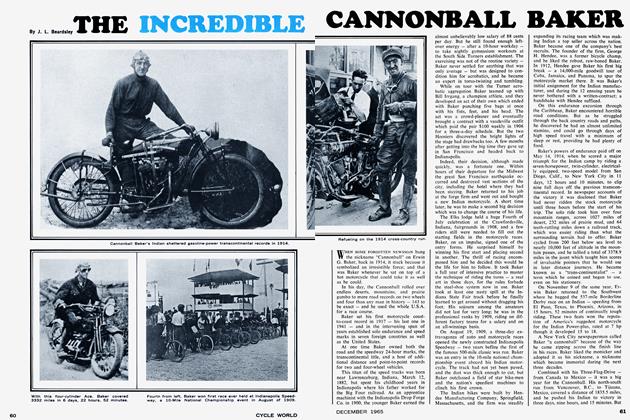
Harley-Davidson was assembling the famous "Wrecking Crew" in June, 1919, making ready for the racing wars, and Hepburn lost no time in signing on as a professional rider on the usual salary-pluspurses contract.
From the carnival midway he had climbed to the big time. On June 22, 1919, he was determined to show everyone he belonged. This was the day the 200-mile National Track Championship was to be decided at Ascot Park, in Los Angeles. Hepburn was to ride before a hometown crowd of 10,000, with Harley greats "Red" Parkhurst, AÍ "Shrimp" Burns, Ray Weishaar, and Earl Roylance.
The Indian team of Bob Newman, Bill Church, Ralph Sullivan and Dave Kinney, and the Excelsior crew of Roy Artley, Wells Bennett, and M. Tice, comprised the classiest field Hepburn ever had met.
Weishaar streaked out ahead at the start, but Hepburn, with his whole future at stake, rode right with the furious pace. A big cheer swelled through the stands as he took the lead at 30 miles. After holding it for 50 laps, Weishaar was on top again, but couldn't shake Hepburn.
Good pit work was a help to the Harley crew (a rear wheel was changed and gas and oil refills made in a record 32 sec.), but Hepburn's hard fight to stay ahead was the big thrill. At 150 miles he led at 72.32 mph for a track record for both autos and motorcycles. Fighting off challenges by veteran racing stars, Hepburn sped on to a brilliant victory to win the towering Firestone Trophy, the Harley-Davidson Cup, and $650 cash. Parkhurst, Weishaar, Burns, and Roylance roared in behind Hepburn for a smashing Harley team triumph.
On July 5, the Grand Island, Neb., meet was run on a rough 1.8-mile track. Hepburn, Parkhurst, and Weishaar were matched against Indian aces Gene Walker, Roy Artley, and Waldo Korn. Hepburn won one 25-mile event and was third in another.
Ten days later, the Driving Park mile at Columbus, Ohio, saw Harley and Indian teams collide head-on as Hepburn and Indian torpedoes Jim Davis and Gene Walker fought a hectic duel in the 50-mile feature, until Davis retired with engine trouble and Hepburn nosed out Walker to win.
AÍ Burns, on a Harley, collected the 5and 10-mile professional heats.
Labor Day, Sept. 1, 1919, brought the International Road Race Championship on an improved course at Marion, Indiana. The circuit distance was 912 ft. over 5 miles, making the race a total of 206.9 miles.
Eighteen of the nation's best started this rugged grind, but the ever-reliable "Red" Parkhurst pounded out a win at 66.6 mph with Hepburn and Otto Walker in the money for another Harley triumph.
Over 25,000 packed the Ascot stands to
see the Harley, Indian and Excelsior giants go in the 100-mile Ascot Championship, Jan. 4, 1920. This three-sided battle-royal forced Otto Walker (CW, Jan. '68) to a new record of 77 min., 42 sec., to stay ahead of Hepburn and Parkhurst.
AÍ "Shrimp" Burns switched to an eightvalve Indian in 1920. At the Overland Park mile in Denver, Colo., on July 25, Hepburn had been running second to his old teammate all day, and the 25-mile feature wasn't going any better. Late in the race, Hepburn went in for a wheel change and Burns, thinking his lead was long enough, eased off. Hepburn came out of the pits in 51 sec., poured on the coal in a mad dash to catch Burns, then battled wheel-to-wheel to the wire. Hepburn won by a scant few feet.
He had another 25-mile feature in the bag at Cleveland, Ohio, Sept. 19, when his rear wheel locked in the final lap, and it was all over for him.
Hepburn always shot for the big events. He took top purse money at Readville, Mass., on Oct. 23, 1920, when 10,000 fans turned out to see him win the 25-mile Massachusetts Motorcycle Club Championship, and the 10-mile National title race.
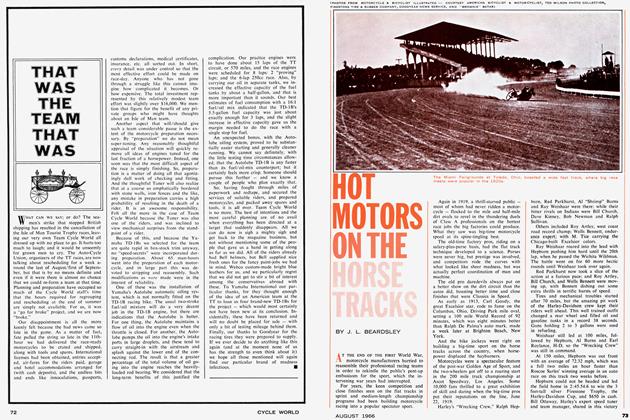
Annually, the 300-mile National Championship on the 2-mile dirt track near Dodge City, Kansas, where all the factory teams converged each Independence Day, attracted thousands of fans — but no one expected the 1921 extravaganza would end as it did.
Hepburn was to ride the only ohv eightvalve Harley twin, with Jim Davis, Otto Walker, Ray Weishaar, Fred Ludlow and Walt Higley on pocket-valve two-cam engines.
The Indian team of Curley Fredericks, Shrimp Burns, Johnny Seymour, Don Pope, "Speck" Warner, Floyd Dreyer, and Hammond Springs also rode pocket-valve machines.
The lap record, set in 1920 by Hepburn, soon was wiped out by Shrimp Burns at 93 mph, and equaled by Waldo Korn on his ohc Excelsior. Obviously, a display of fireworks was to explode on July 4th.
This race, the last of the 300 milers run at Dodge, was one to remember. Hepburn shot out in front at the start and left the field behind at such a terrific pace that rival pit crews shook their heads and said it couldn't last. At 100 miles, the entire Harley team had failed to catch him, and no one else was even close as he cracked the 100-mile record wide open at 1 hour, 7 min., 5.4 sec.
Hepburn then pitted for gas and oil, and Otto Walker held the lead for three laps until the flying Hepburn caught up with him.
The long stretches on this 2-mile oval heated engines nearly red hot, but Hepburn's never missed. He put the 200-mile record behind him in 2 hours, 7 min., 54 sec.
Never in motorcycle history had one man so completely mastered a field of top professionals. It was more startling as one after another dropped out with engine failure; but Hepburn's Harley sang ever more sweetly as he piled up the miles. Even his final lap was very fast, at 1 min., 17 sec., when 1 min., 28 sec., was fast for the course.
As the checkered flag fell, the amazing Hepburn had broken all competition rec-
ords to 300 miles, even trimming 17 sec. from Carl Goudy's mark on the Chicago board track, with a smashing 85.7-mph average.
Johnny Seymour came in second on an Indian, but was 12 miles behind! Ludlow, Weishaar, and Walker followed for the Harley camp.
A swing through the Midwest, and then out to the coast, found Hepburn at the Portland, Ore., mile on Aug. 6 and 7. There he crushed the opposition again, winning 5and 10-mile solo and 5-mile sidecar events on opening day. He was victor in six of seven events the final day.
The big California Speedway circuit next beckoned the new champion. On Aug. 28, he rode the 1.25-mile Cotati, Calif., board bowl for a new lap record of 42.4 sec., won the "Miss-and-Out" race, and the 25-mile feature in 16 min., 29.7 sec.
The Fresno, Calif., mile saucer was advertised as "The Fastest Motorcycle Track in America," and Hepburn aimed to discover the truth of the matter on Nov. 24, 1921. After winning the Missand-Out event; the 10-mile "Scramble" in a fraction over 6 min.; the 15-mile Sweepstakes in 9 min., 5.4 sec.; with Jim Davis tops in a 10-mile sprint; and with Fred Ludlow capturing the 25-miler the H-D Wrecking Crew agreed with the publicity.
After Harley abandoned its factorysponsored racing team in 1922, both Hepburn and Jim Davis were soon riding Indian eight-valve machines. One of the colorful movie colony throngs that filled the stands at beautiful Beverly Hills Speedway saw these two in their first record-breaking spree on these new mounts.
On April 25, 1922, Jim Davis flattened his treads against the Beverly boards as he rocketed for the mile in 32.53 sec. for a world record of 110.75 mph.
Hepburn then sailed out on his eightvalve Indian and shot the course in what appeared another record run — until the time was announced at 32.64 sec.
It wasn't long before Hepburn had his greatest day on the boards. This was on May 14, at the San Carlos 1.25-mile speedway, at Redwood City, Calif.
Here he was pitted against four of the greatest of the old pros — Otto Walker, Ray Weishaar and Fred Ludlow on Harleys; and Jim Davis on his recordbreaking Indian. This race was all that 6500 fans expected. The motorcycle demons rode the rims, and every race was won at over a 100-mph average.
But it was Hepburn's day, as he won the Miss-and-Out race, then rode a magnificent race to win the 50-mile feature — for which he was awarded the Barney Oldfield Diamond Medal, inscribed "To the Master Rider of the World."
He again proved he was master of the 300-mile dirt championship when he went to the new course at Wichita, Kans., and defeated 14 starters to retain his title July 4, 1922, though no records were broken.
Sidecars never greatly interested Hepburn, but he could handle them very well, which he proved at Milwaukee, Wis., by beating the best in the business for the 25-mile National Aug. 13, and repeating in this event Aug. 10, 1924.
(Continued on following page)
In demand by promoters everywhere, Hepburn went east for the New York State Fair meet at Syracuse, and on Sept. 16 won the state sidecar 10-mile championship.
He always ended his season near home. Thus, the finale of his banner year, 1922, was at the fine mile dirt oval at San Luis Obispo, Calif., Nov. 5, where Hepburn rocketed through one lap at a world record of 39.6 sec. He continued for sensational marks at 5, 6, 10, and 25 miles. These are still carried as 61-cu. in. records in All Sports Record Book, by Frank G. Menke, noted sports authority. His 200- and 300-mile records also are listed.
The auto racing game started to interest Hepburn. In 1923 he was a pit crewman for Tommy Milton, who won the Indianapolis 500 in an HCS.
On Labor Day, 1923, the Kansas City Speedway staged the richest motorcycle meet of that era with $12,000 in purses for a 100-mile race. Hepburn finished in third place at 92.40 mph to collect $3000. Johnny Branson, a local Indian rider, was the surprise winner. Dave Kinney, also Indian mounted, finished second.
Hepburn rode in the bi-weekly races at Ascot through much of 1924, but had adapted his skill to the benzine buggies so well that he drove a Miller Special on opening day at the Fulford, Fla., Speedway to a world lap record of 141.1 mph.
On May 30, 1925, he had qualified for the Indianapolis 500, then led the classic race for a time. This was the first of his 14 starts in the great speed spectacle.
A popular driver, many good cars came Hepburn's way He finished in the money eight times, but his best was in 1937 when only 2.16 sec. separated Hepburn and Wilbur Shaw, the winner. This remains the closest finish in Indianapolis Motor Speedway history.
Hepburn had been near collapse from the heat, and a relief driver took over while he recovered, which might have made the difference that lost him the world's greatest auto race.
Hepburn became one of the few men who could handle the massive front-drive Novi Special. In 1946, he broke all qualifying records in the white monster — at 133.944 mph for 10 miles, and 134.288 for one lap. He was then 50 years of age, the eldest driver ever to complete at Indianapolis.
As the fastest car in Speedway history, Hepburn believed the Novi would win some day. After two years of retirement, he returned in 1948 for one more try for racing's greatest prize — the 500 race.
He was then 52, but still handled the tricky Novi with all his skill. The Hepburn luck, that had cloaked him for 35 years in the violent world of racing, suddenly ran out as the big white car careened into the concrete outer wall on a curve during a practice run. Hepburn's neck was broken by the impact.
Trying to make a dream come true had cost Hepburn his life. Death ended the second career of a great motorcycle sportsman, who was one of the five greats of all-time, one who helped build the motorcycle industry by his feats on the nation's race tracks. Those thousands who saw him, or knew him, never will forget him. ■