Snowmobiles
Snowmobiles
NOW AND AGAIN, CYCLE WORLD goes off on a tangent. This particular tangent runs on rubberized caterpillar treads and skiis, instead of the sacrosanct two wheels. This tangential product report-snow test is about snowmobiles. Of course with that revelation, it might be charged that CYCLE WORLD has gone too far, has completely escaped the sphere of motorcycles.
Wait! CW once regarded snowmobiles as northland curiosities for individuals disinclined to pull toboggans up hills, preferring medium-sized two-stroke engines to human leg power. Now, one of the world's major manufacturers of motorcycles has decided to build snowmobiles, primarily for the U. S. market, which appears to be currently dominated by machinery of Canadian marque. Furthermore, as there are now somewhere between 200,000 and 300,000 snowmobiles operational in the U. S. and Canada, with 1,000,000 predicted by 1972, an increasing number of sleet-belt motorcycle merchants are taking on snowmobile lines as a lucrative means of warding off the all too prevalent lean and hungry look of the motorcycle dealer in the mid-winter season.
U. S. and Canadian production by some 40 manufacturers of 100,000 machines per year — ranging in price from about $725 to $1300 — also has created an aftermarket for all manner of components, from engine spares, to trailers, sleds, special
clothing, wheel conversion kits, and special lubricants. Many of these items bear a curious resemblance to the paraphernalia of motorcycling.
The snowmobilers have their own racing circuits, with enduros and GP events, and their own specialty publications. Obviously, a goodly number of North American citizens are fascinated by these curious creatures of snow and ice.
What is the fascination? The things that make people drive snowmobiles over rutted snow, across precarious lake ice and through a cold, snowy curtain of tangled underbrush, are identical to the drives that cause a man astride a motorcycle to propel himself and his machine as quickly as possible around Joshua trees, across a rutted dry lake, and through a soft, sandy river bed. There is that kindred feeling of exhilarating desperation, of uncontrollable controllability.
The snowmobile, quite simply, offers a ride with some chills that aren't all a direct function of atmospheric temperature. They go like gang busters. Flat-out, the snowmobile is a wild thing on which 40 mph seems more like 90 — deeelightful.
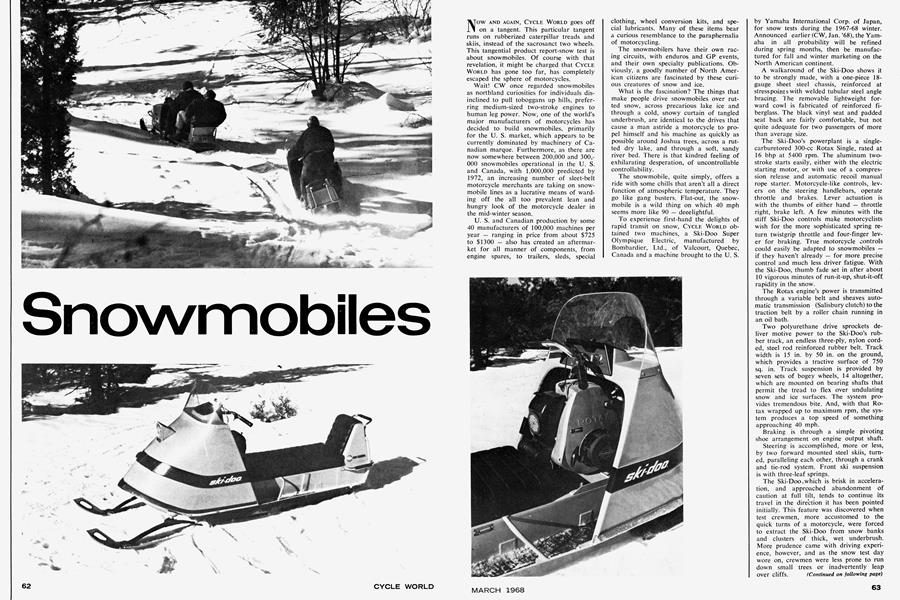
To experience first-hand the delights of rapid transit on snow, CYCLE WORLD obtained two machines, a Ski-Doo Super Olympique Electric, manufactured by Bombardier, Ltd., of Valcourt, Quebec, Canada and a machine brought to the U. S.
by Yamaha International Corp. of Japan, for snow tests during the 1967-68 winter. Announced earlier (CW, Jan. '68), the Yamaha in all probability will be refined during spring months, then be manufactured for fall and winter marketing on the North American continent.
A walkaround of the Ski-Doo shows it to be strongly made, with a one-piece 18gauge sheet steel chassis, reinforced at stress point s with welded tubular steel angle bracing. The removable lightweight forward cowl is fabricated of reinforced fiberglass. The black vinyl seat and padded seat back are fairly comfortable, but not quite adequate for two passengers of more than average size.
The Ski-Doo's powerplant is a singlecarburetored 300-cc Rotax Single, rated at 16 bhp at 5400 rpm. The aluminum twostroke starts easily, either with the electric starting motor, or with use of a compression release and automatic recoil manual rope starter. Motorcycle-like controls, levers on the steering handlebars, operate throttle and brakes. Lever actuation is with the thumbs of either hand — throttle right, brake left. A few minutes with the stiff Ski-Doo controls make motorcyclists wish for the more sophisticated spring return twistgrip throttle and four-finger lever for braking. True motorcycle controls could easily be adapted to snowmobiles — if they haven't already — for more precise control and much less driver fatigue. With the Ski-Doo, thumb fade set in after about 10 vigorous minutes of run-it-up, shut-it-off rapidity in the snow.
The Rotax engine's power is transmitted through a variable belt and sheaves automatic transmission (Salisbury clutch) to the traction belt by a roller chain running in an oil bath.
Two polyurethane drive sprockets deliver motive power to the Ski-Doo's rubber track, an endless three-ply, nylon corded, steel rod reinforced rubber belt. Track width is 15 in. by 50 in. on the ground, which provides a tractive surface of 750 sq. in. Track suspension is provided by seven sets of bogey wheels, 14 altogether, which are mounted on bearing shafts that permit the tread to flex over undulating snow and ice surfaces. The system provides tremendous bite. And, with that Rotax wrapped up to maximum rpm, the system produces a top speed of something approaching 40 mph.
Braking is through a simple pivoting shoe arrangement on engine output shaft.
Steering is accomplished, more or less, by two forward mounted steel skiis, turned, paralleling each other, through a crank and tie-rod system. Front ski suspension is with three-leaf springs.
The Ski-Doo,which is brisk in acceleration, and approached abandonment of caution at full tilt, tends to continue its travel in the direction it has been pointed initially. This feature was discovered when test crewmen, more accustomed to the quick turns of a motorcycle, were forced to extract the Ski-Doo from snow banks and clusters of thick, wet underbrush. More prudence came with driving experience, however, and as the snow test day wore on, crewmen were less prone to run down small trees or inadvertently leap over cliffs. (Continued on following page)
The test Ski-Doo was supplied by Chuck Mills, genial proprietor of Skyline Trails Outfitters in San Bernardino, Calif. He also provided invaluable information on machinery and snowmobile riding technique.
The Yamaha, which hasn't yet been given a nickname or numerical identification, was powered by the familiar-to-motorcyclists twin-carburetored two-stroke twin of 350 cc piston displacement. The engine is said to deliver 22 bhp at 5500 rpm. The Yamaha is not provided with an electric start mechanism, but a fire is easily lighted with a pull of the manual recoil starter, and use of full choke for the first few minutes of warm-up operation.
Control position and function are identical to those of the Ski-Doo. Though the Yamaha's throttle return spring tension was less than the Ski-Doo's, riders' thumbs were subject to undue wear.
The Yamaha twin's primary output is through V-belts to an automatic clutch/
transmission unit. The final drive is through duplex roller chain, running in oil in a neatly cast case, with an inspection window for checking lubricant level. The final drive chain delivers power to a massive sprocket, a clever combination of shock-absorbing rubber teeth, bonded to an alloy hub. The teeth engage matching rectangular slots in the center of the driving tread, which runs on four sets of rubber-tired bogey wheels. Belt dimensions are identical to the Ski-Doo's.
The Yamaha's brake also is on the clutch shaft assembly, but is a caliper disc unit which delivers incredibly quick stops — with 750 sq. in. of locked-up tread dragging on the snow.
Where the Ski-Doo's forté is all-out velocity, Yamaha's characteristic is handling.
The two-cylinder engine offered flexibility in that the machine could be directed through a bend with on/off/on/off/on/off technique that is reminiscent of a racing
sidecar outfit. A turn initiated with the steering skis can be tightened with a release of the throttle and a quick thumbing of the engine brake.
In finish, detailing and general manufacture, the Yamaha meets the standard established by the Japanese motorcycle industry. Paint, upholstery, machining and assembly are obviously of the first order.
The machine certainly is a contender for the market now dominated by Ski-Doo, and shared by 39 or so other builders.
The motorcycle people would be well advised to look into the ski/tread sports machines as a means to pleasure and profit. Looking at it the other way around, the snowmobile people might find the twowheelers fun to ride and fast sellers in the summer months. A snowmobile shop for every motorcycle dealer, a motorcycle dealership for every snowmobile agency; a chicken in every pot, and two cars in every garage. How's that for a tangent? ■