Racing Review
RACING REVIEW
READING 12-MILE NATIONAL
Everyone came to the party. There were the good guys riding the Triumphs with their cool chicks perched on the back, the bad guys with their mammas slopped over the choppers, the Motormaids, the townspeople, the visitors. All 6,500 of them, according to the local paper, were assembling for the third running of the 12-Mile National, the first to be held in Reading, Pa.
The race was going to be between national point leader Gary Nixon and current National Champion Bart Markel. That's what they said, anyway. Markel had won both previous 12-mile events, formerly held at Hagerstown, Md., and six features at Reading's "Home of Champions." Nixon had one Reading win to his credit. He also had 101 points from his Daytona ride. Markel had none.
In the pits at the Triumph end, Nixon was relaxing. His number 9 was alongside Dick Hammer's identical number 16. Hammer was out, though, with a broken foot, received the night before at a Maryland short track event. Down at the Harley end, Markel's two emerald green KRs were being checked over and George Roeder was working as usual on his machines. Ronnie Rail's, Roger Reiman's and Babe DeMay's bikes sat together, and Markel had yet to be seen.
In the parking lot the glitter of all the bikes made it look like the world's biggest motorcycle showroom.
The scene was set for Reading. While the spectators were picking the winners and depositing their guesses in boxes "conveniently located in the paddock area," Nixon and Markel were pouring the pressure on in practice. Markel was riding hard. Nixon was fast. Mert Lawwill was having engine trouble, and Dick Mann's Gold Star sounded overgeared.
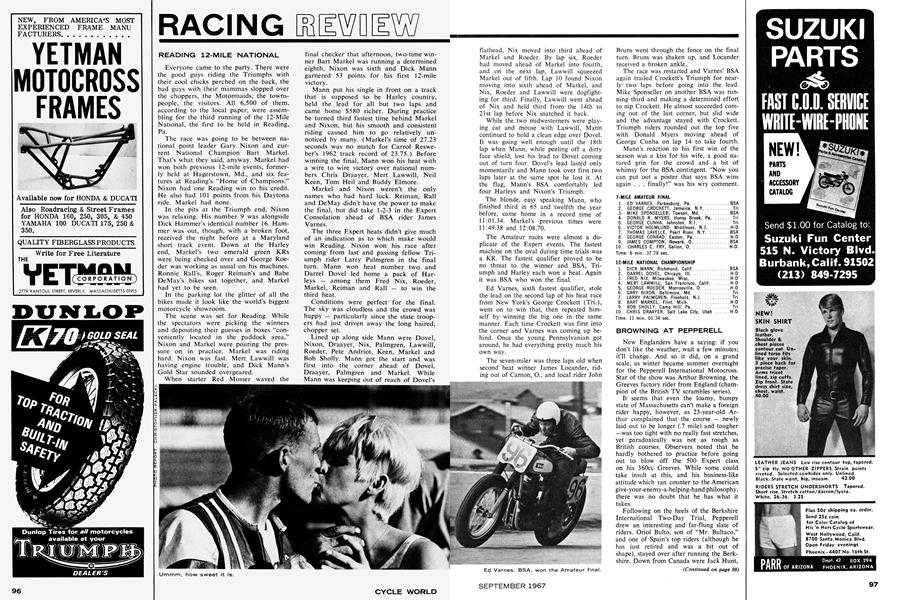
When starter Red Mosser waved the final checker that afternoon, two-time winner Bart Markel was running a determined eighth, Nixon was sixth and Dick Mann garnered 53 points for his first 12-mile victory.
Mann put his single in front on a track that is supposed to be Harley country, held the lead for all but two laps and came home $580 richer. During practice he turned third fastest time behind Markel and Nixon, but his smooth and consistent riding caused him to go relatively unnoticed by many. (Markel's time of 27.23 seconds was no match for Carrol Resweber's 1962 track record of 23.75.) Before winning the final, Mann won his heat with a wire to wire victory over national numbers Chris Draayer, Mert Lawwill, Neil Keen, Tom Heil and Buddy Elmore.
Markel and Nixon weren't the only names who had hard luck. Reiman, Rail and DeMay didn't have the power to make the final, but did take 1-2-3 in the Expert Consolation ahead of BSA rider James Varnes.
The three Expert heats didn't give much of an indication as to which make would win Reading. Nixon won his race after coming from last and passing fellow Triumph rider Larry Palmgren in the final turn. Mann won heat number two and Darrel Dovel led home a pack of Harleys — among them Fred Nix, Roeder, Markel, Reiman and Rail — to win the third heat.
Conditions were perfect' for the final. The sky was cloudless and the crowd was happy — particularly since the state troopers had just driven away the long haired, chopper set.
Lined up along side Mann were Dovel, Nixon, Draayer, Nix, Palmgren, Lawwill, Roeder, Pete Andriot, Keen, Markel and Bob Sholly. Mann got the start and was first into the corner ahead of Dovel, Draayer, Palmgren and Markel. While Mann was keeping out of reach of Dovel's flathead, Nix moved into third ahead of Markel and Roeder. By lap six, Roeder had moved ahead of Markel into fourth, and on the next lap, Lawwill squeezed Markel out of fifth. Lap 10 found Nixon moving into sixth ahead of Markel, and Nix, Roeder and Lawwill were dogfighting for third. Finally, Lawwill went ahead of Nix and held third from the 14th to 21st lap before Nix snatched it back.
While the two midwesterners were playing cat and mouse with Lawwill, Mann continued to hold a clean edge over Dovel. It was going well enough until the 18th lap when Mann, while peeling off a dirty face shield, lost his lead to Dovel coming out of turn four. Dovel's lead lasted only momentarily and Mann took over first two laps later at the same spot he lost it. At the flag, Mann's BSA comfortably led four Harleys and Nixon's Triumph.
The blonde, easy speaking Mann, who finished third in 65 and twelfth the year before, came home in a record time of 11:01.34. Markel's previous times were 11:49.38 and 12:08.70.
The Amateur races were almost a duplicate of the Expert events. The fastest machine on the oval during time trials was a KR. The fastest qualifier proved to be no threat to the winner and BSA, Triumph and Harley each won a heat. Again it was BSA who won the final.
Ed Varnes, sixth fastest qualifier, stole the lead on the second lap of his heat race from New York's George Crockett (Tri.), went on to win that, then repeated himself by winning the big one in the same manner. Each time Crockett was first into the corner and Varnes was coming up behind. Once the young Pennsylvanian got around, he had everything pretty much his own way.
The seven-miler was three laps old when second heat winner James Locander, riding out of Canton, O., and local rider John Bruns went through the fence on the final turn. Bruns was shaken up, and Locander received a broken ankle.
The race was restarted and Varnes' BSA again trailed Crockett's Triumph for nearly two laps before going into the lead. Mike Sponseller on another BSA was running third and making a determined effort to nip Crockett. He almost succeeded coming out of the last corner, but slid wide and the advantage stayed with Crockett. Triumph riders rounded out the top five with Donald Myers moving ahead of George Cunha on lap 14 to take fourth.
Mann's reaction to his first win of the season was a kiss for his wife, a good natured grin for the crowd and a bit of whimsy for the BSA contingent. "Now you can put out a poster that says BSA wins again . . . finally!" was his wry comment.
BROWNING AT PEPPERELL
New Englanders have a saying: if you don't like the weather, wait a few minutes; it'll change. And so it did, on a grand scale, as winter became summer overnight for the Pepperell International Motocross. Star of the show was Arthur Browning, the Greeves factory rider from England (champion of the British TV scrambles series).
It seems that even the loamy, bumpy state of Massachusetts can't make a foreign rider happy, however, as 23-year-old Arthur complained that the course — newly laid out to be longer (.7 mile) and tougher —was too tight with no really fast stretches, yet paradoxically was not as rough as British courses. Observers noted that he hardly bothered to practice before going out to blow off the 500 Expert class on his 360cc Greeves. While some could take insult at this, and his business-like attitude which ran counter to the American give-your-enemy-a-helping-hand philosophy, there was no doubt that he has what it takes.
Following on the heels of the Berkshire International Two-Day Trial, Pepperell drew an interesting and far-flung slate of riders. Oriol Bulto, son of "Mr. Bultaco," and one of Spain's top riders (although he has just retired and was a bit out of shape), stayed over after running the Berkshire. Down from Canada were Jack Hunt, (Continued on page 98) the Sehl boys and Lloyd West. Yankee Motor Corp. was represented by Dick Mann and Jim Corpe. Such stars as Timer Simonds from Alabama and Barry Higgins of New Jersey completed the field, not to mention the local talent.
In the 250 Expert races, Connecticut star Glen Vincent, Bultaco Pursang, was top gun. In the first heat, he led from the start, followed by Bruce Maguire and Sr. Bulto. Bulto passed into second place and Maguire dropped out shortly thereafter with engine trouble. The second heat proved more interesting as Maguire took charge off the line, followed by Bulto and Vincent. More passing and Bulto and Vincent got by; then Vincent took over to finish first. Overall scoring placed Vincent first, Bulto second, and Rhode Islander Alan Niles third, ahead of Maguire, who had failed to finish that first race.
The first 500cc Expert heat provided some heavy breathing as Terry Barber and Mel Gancsos, a top BSA rider who has been plagued with troubles of late, both charged into the first turn as one. Arthur Browning, after a conservative start, forced his way to the front after 1-1/2 laps, followed by Barber, Ron Jeckel, Dick Mann, and Gancsos, who soon relinquished even this place to BSA rider Barry Higgins. And so on.
The second 500 Expert was all Browning's. Canadian Hunt held second and then started dropping back, first allowing Barry Higgins by and then Ron Jeckel, who started after Higgins, only to be passed by Higgins' Ghost-sponsored teammate, Terry Barber.
So, overall, the 500 class went to Arthur Browning, followed by Barry Higgins, Jack Hunt, Dick Mann, Ron Jeckel, Terry Barber and Doug Sehl.
The Open Expert races (why can't these guys borrow 500s on a day like this?) proved to be the Charlie Vincent show, after Don Gore blew his lead by missing a shift and thus having to retire. New Hampshireman Red Bannister ran second overall, followed by Pete Koehler of Bolton, Conn.
Then a manufacturer's team event was run as a "Grand Prix," which is rather pretentious for a six-lap race. Indeed, Glen Vincent thought so too, and was heard trying to convince the referee that it should be 50 laps. All to no avail, as Greeves, Bultaco, and BSA put their stalwarts on the line.
Bruce Maguire, Bultaco, led from the start, followed by Greevesters Browning and Jeckel. Then Maguire was passed by Browning. Bultacomen Glen Vincent and Oriol Bulto, scrapping among themselves, zapped Jeckel in the process. Maguire faded badly, and Vincent was soon counting the hairs on the back of Browning's neck as they entered the last lap. But Browning finished first, then Vincent, and after a gap, Bulto, Jeckel et al. Bultaco (all of them the new Pursangs) won the team prize by a hair, which says a lot for Glen Vincent's ability.
FESTIVAL ROAD RACE
The Sacramento Motorcycle Festival and Safety Fair was a rather unfortunate affair financially, but its featured event, an AFM grand prix, provided some fine racing.
The circuit was laid out on the roads which meander about the California State Fairgrounds, including a long sweeper which follows the outside of the big mile track where the 20-mile national is traditionally held.
The course's size (about 1-1/2 miles) made it a "short circuit," but it was actually very much like an Irish or Continental course, complete with slippery manholes, bumpy pavement, and trees and buildings lining the track.
The course looked quite dangerous, and, in fact, there were several spills. Only one rider was seriously injured, suffering a broken arm and possibly a broken leg.
Sunday's day of racing started on a rather glum note as the word spread that Saturday's cycle show and street-rider competitions (slow races, etc.) had been pretty dismal.
Promoter Jim Keller, fronting for a group of Sacramento businessmen, said ruefully, "They stayed away in droves." However, he vowed the group would try again next year.
Man of the day was Art Baumann, who won the 250cc GP after a tremendous race-long dice with Ron Grant and then took the 350-500-0pen event. Baumann trailed Grant for most of the 250 race, with both riders on identical Al Fergodasponsored Yamahas. On about lap six he shot into the lead right in front of the crowd at the start-finish line and stayed ahead to win.
In the final event, Baumann was aboard the Precision Machining Honda 450, which seems to get more powerful every race. Art blew everyone into the weeds, stretch ing out a huge lead, and won easily.
Grant, chasing him on a 650 Triumph, got off in a big way when his machine threw a primary chain, locking the rear wheel as Grant was coming out of the sweeper at about 90 mph. Except for scuffed leathers, Grant was unhurt.
Fresno State College Professor Byron Black, who raced extensively in Europe last year and took fourth in the Japanese Grand Prix, competed in the production event on a Kawasaki 350, then entered it in the Grand Prix class and won his class there, too. Class winners were: 50cc, Cohn Jones, Honda, South Pasadena 100cc, Ron Grant, Yamaha, San Mateo 125cc, Rick Schell, Honda, Walnut Creek 175cc, Fred Muhlberg, Honda, San Fran. 250cc, Art Baumann, Yamaha, San Fran. 350cc, Byron Black, Kawasaki, Fresno 500cc, Art Baumann, Honda, San Fran. Open, Bill Lyons, Triumph, San Fran.
(Continued on page 100)
CAROLINA ROAD RACING
George Rockett, the big gun for Berliner and Yamaha in the AAMRR, nabbed the two feature events at a maiden run meet on a new road racing circuit at Rockingham, North Carolina. The $1,500 purse race was a cooperative effort of the Association of American Motorcycle Road Racers (AAMRR) and the Carolina-Tennessee area Racing Association for Motorcycling (RAM).
As the AAMRR is a group oriented to the foot-up, low bar, classical European style of road racing, and the RAM group is flattrack oriented, the contrast in riding technique, to understate things, was quite interesting. As the course was laid out within a 1-mile oval, 5,000 spectators had ample opportunity to see RAM's riders, most using dirt bars and universal tires, dropping their feet and broad sliding on the pavement amidst the tucked-in AAMRR men.
Rockett won the combined 350cc and 500cc class with his Berliner Motor Corp. tuned 500cc Norton twin, which was fitted with a Thalhammer six-speed gearbox. He ran away from all but Stan Fridus, also on a Norton twin. RAM rider Fred Lutz, Triumph, was the third 500 home. Fastest 350, and the second fastest man overall, was Frank Camillieri on a Desmo valve 350cc Ducati, beating Jim Noughton, Ducati, and Bill Thompson, Yamaha.
The 250cc Senior event was won by Rockett on a Yamaha. Camillieri placed second in this race on his Yamaha, after Ducati rider Jimmy Hayes left the circuit while trying to pass Rockett. Gary Koup was third on a Bultaco.
The big bore race was mostly a footdown party for RAM riders. Gary Hunter, BSA, emerged the winner, followed by J. Jones, Triumph, and Fred Lutz, BSA.
NIX NIXES NIXON
Fred Nix, the transplanted Oklahoman now living in Milwaukee, Wisconsin, thrilled the 16,000 fans crowding the Ohio State fairgrounds for the AMA 10-Mile National by beating Gary Nixon in a beautiful wire-to-wire final.
It was a chilly day, but Neil Keen warmed it up a bit by lowering the track record of 26.71 set by Carroll Resweber in 1961 to 26.67. Keen's record only stood for 13 minutes, however, as George Roeder lowered it to 26.63.
This set George on the pole for the first heat with Bart Markel beside him. But that rising star from Salt Lake City, Chris Draayer, won the heat with a 10lap time of 4:43.50. Neil Keen won the second heat with 4:44.80 and Dick Mann the third with 4:45.15. Nix placed second in the third heat.
When the 12 fastest Experts went to the line for the final, the track had developed a tight groove, offering little traction on the outside lines.
H-D rider Nix, placed sixth from the pole, took the lead immediately. Close at hand was Nixon's Triumph and together they started to leave the pack behind by the end of the first lap.
Bart Markel had third momentarily, but slipped off the groove and was picked off by Roeder. Up front, Nixon snatched the lead on the back straight, only to lose it back to Nix two laps later.
Markel attempted to regain third spot, but his high groove habit did him in again as he lost traction and let Dick Mann sneak by. Chris Draayer, meanwhile, dropped out with engine problems and Neil Keen lost ground after dropping an exhaust pipe.
At the finish, Nix led narrowly, followed by Nixon, Roeder, Mann, Markel, Babe Demay, Keen, Dick Hammer, and Mert Lawwill. ■