Metisse Road Racer
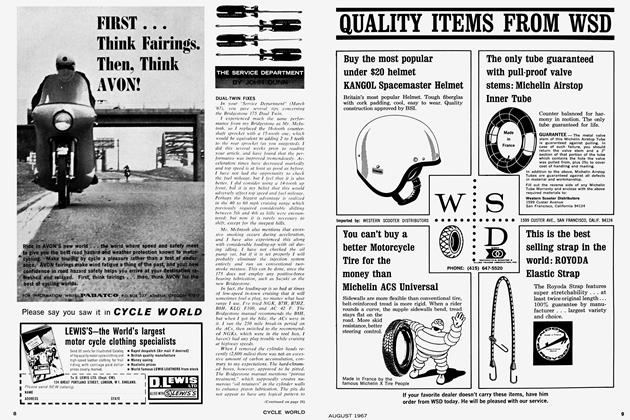
THE ORIGINAL INTENT behind building up a Rickman road racer was to see firsthand just how much has changed in frame design during the past five years. It is exactly that time span, to the month since the last of the famous Manx Nortons, AJSs and Matchlesses were built for sale. Many people, especially in England, have kept the old "bangers" alive, because of lack of machinery to replace them, and handling, too, is still superior to that found on any of the modern racing iron.
When Norton produced the full double cradle design, almost 17 years ago, it quickly became known as the "featherbed." Not only was the motorcycle comfortable to ride but more important, it permitted a rider to lap faster than his less fortunate rivals, even though they often had considerably more horsepower. There were English machines before the Featherbed, which set extremely high standards in road holding; most notable being the pre World War II Velocettes, and despite low power output, these machines were still world championship contenders in the 350 class, until Norton employed a similar frame but with telescopic front forks. From that point, Norton ruled the roost. The Italian multis often had 15 or 20 more horsepower, but if the circuit happened to be twisty or bumpy, the British singles could still pull off a win.
The main factor contributing to English superiority in frame design and construction has to be the Isle of Man. For no other circuit in the world offers the challenge to chassis and suspension that is encountered on a lap of the fabulous TT course. Twice each year, during the TT in June, and the Manx GP in September, British manufacturers have their chance to improve upon the previous year's performances.
Riders who were good at the Island were able to quickly evaluate handling. The technically inclined riders such as Duke, Surtees and Maclntyre were competent advisors to their firms, and helped speed up the evolution. Realizing this fact, the Italian manufacturers and later the Japanese paid very large sums of money for the services of riders with this special ability and broad Isle of Man experience, to help produce a winning machine. Most, of the riders had been teethed on Featherbeds, so it was not surprising that all of the serious factories taking part in racing were using frames patterned after the old Manx. This fact is still true, regardless of what configuration is used in the beginning.
The most important single requirement of a competition frame is that the steering head and rear wheel axle maintain their original relationship under any circumstances. The surest way to eliminate flexure between these two points is to build a structure that does not rely on anything other than itself for strength. Early in development, a manufacturer is likely to use the engine as a frame member; however, the engine is a variable thing that expands and contracts with temperature changes. And if the layout relies on the engine for alignment, there can be enormous handling problems.
Under road racing conditions the alignment situation becomes extremely critical for two reasons. Providing the tires are doing their job, there will be very little traction loss, and therefore greater stress on the frame, which encourages bending. Also, the speeds are so high that there is precious little time to correct for changes in navigation caused by frame flexing.
But, even in dirt competition, where absolute alignment is not quite as critical, there are benefits if the rider is unusually skillful and trying to maintain a "line." Among the first to apply this theory to production scrambles machines were Don and Derek Rickman, a pair of English brothers who built scrambler frames for their own use and, after some very impressive wins, decided to go into business building frames for the general public. The brothers dubbed their creation "Métissé," which is the French word for mongrel, because they had no intention of building engines or complete motorcycles.
In international scrambles competition, the Metisse has became almost a legend among private owners. In fact, it is safe to say that the Metisse holds the same place in scrambling as the Manx does in road racing. Both can be considered a yardstick by which all others may be judged.
The Rickman brothers had already achieved success in the scrambles world when the English factories ceased production of road racing equipment. So it was quite logical then, in a country with some fifteen-hundred riders wanting to road race, that they would turn their talents to the production of a chassis for the hard stuff.
METISSE ROAD RACER
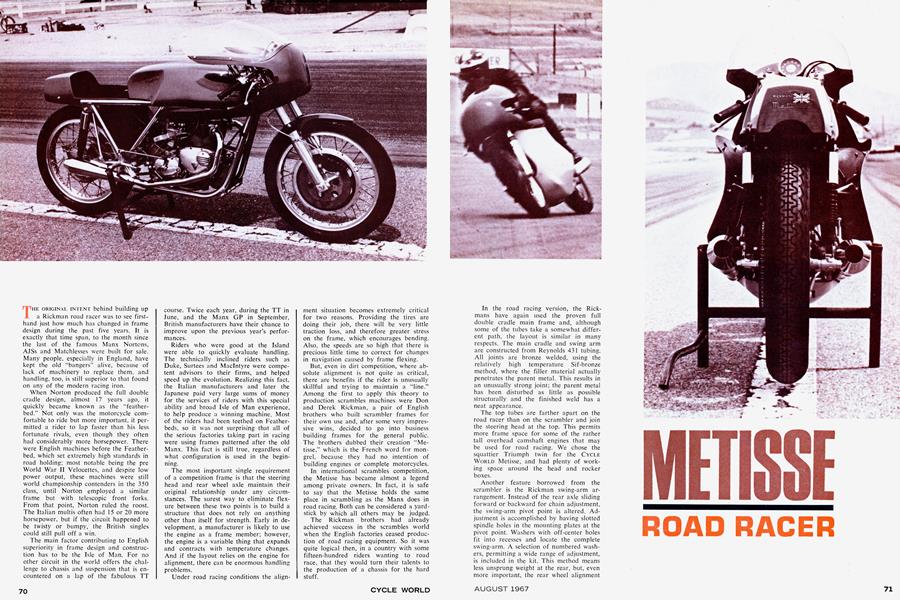
In the road racing version, the Rickmans have again used the proven full double cradle main frame and, although some of the tubes take a somewhat different path, the layout is similar in many respects. The main cradle and swing arm are constructed from Reynolds 431 tubing. All joints are bronze welded, using the relatively high temperature Sif-bronze method, where the filler material actually penetrates the parent metal. This results in an unusually strong joint; the parent metal has been disturbed as little as possible structurally and the finished weld has a neat appearance.
The top tubes are farther apart on the road racer than on the scrambler and join the steering head at the top. This permits more frame space for some of the rather tall overhead camshaft engines that may be used for road racing. We chose the squattier Triumph twin for the CYCLE WORLD Metisse, and had plenty of working space around the head and rocker boxes.
Another feature borrowed from the scrambler is the Rickman swing-arm arrangement. Instead of the rear axle sliding forward or backward for chain adjustment, the swing-arm pivot point is altered. Adjustment is accomplished by having slotted spindle holes in the mounting plates at the pivot point. Washers with off-center holes fit into recesses and locate the complete swing-arm. A selection of numbered washers, permitting a wide range of adjustment, is included in the kit. This method means less unsprung weight at the rear, but, even more important, the rear wheel alignment is always correct.
Since we wanted to try the most Rickman of the road racing kits available, we chose to have their own forks fitted. The forks are unusual in that the stanchions are quite large in diameter. This has been done to accommodate a small self-contained Girling damper unit, which is built primarily for automobile use. The bottom of the damper is fixed to the fork sliders, or lower legs. Rickman adds an extension to the actuating rod, which screws into the top fork nut. A large washer centers the damper in the leg and also serves as a base for the fork spring.
Fork bushings have been eliminated in the Rickman design. Instead, the slider operates directly on the stanchion. This offers the advantage of distributing loads over a much larger area, since whatever portion of the stanchion is inside the slider is bearing surface, thus permitting greater rigidity than with a bushed fork design.
For similar reasons we chose the Rickman-Lockheed disc front brake, although the Fontana four-shoe brake is available. Another adaptation of an automotive component, it was specially developed by Lockheed for the Rickmans. In external appearance the brake is very similar to the ones built by Al Gunter several years ago in this country.
The right fork leg has, as part of the casting, a fixed caliper mount. This eliminates the possibility of the slider being distorted, either from clamping, or welding, a mount to the leg after it has been machined. All of the brake components are very factory-like; rods and levers are used throughout, eliminating cables. Because the pads are self compensating in use there is an absence of adjusters for the rider to fiddle with during a race: On the rear, where the requirements are much less, we selected the Fontana two-leading shoe drum type brake.
Originally, the Rickmans used the main frame as the oil tank, which is a good idea; since the frame can be a rather effective radiator, it eliminates a separate tank. There is a problem, however, in that if an engine part fails and sheds metal particles into the oil supply, there is no way known to man as to how the frame can be cleaned. The insurmountable barrier came to light on one of the initial prototypes, which lost a big end bearing for one reason or another, and from then on, the frame was an engine wrecker. When a tank is fitted, it can be removed and thoroughly washed out in a few minutes.
Obviously, the rear brake cable was designed for the non-oil tank model, because it is not long enough to loop over the tank, when it is routed underneath the cable binds. Rather than make a new cable we looped a piece of inner tube (that just happened to come in the shipping box?) around the pedal, thus counteracting the binding cable.
Not so important to the serious racer, but of utmost importance to the not-soserious racer, is the finish. The frame, in Rickman tradition, is nickel plated, and can only be described as beautiful. The fiberglass components are Avon, built by the Mitchenall brothers, and are constructed by "blowing" random glass fibers into female moulds, rather than the hand lay-up method. While this system requires a slightly thicker section than if woven cloth is used, it does produce an excellent finished part. Nowhere is there a ripple or flaw on any of the fiberglass parts.
As we said, the Triumph kit was selected because of engine availability, but we soon found that unit-construction Triumph engines, without the rest of the motorcycle, can be rather hard to come by. Fortunately, our old friend and AMA expert Ken Clark, volunteered to install his engine in exchange for a ride on the finished bike. When two weeks passed, and the machine was not returned, we became a little worried. But Ken confessed that for the first 12 days he could only sit and drool over the thing, and that actually, everything fitted together properly without filing or fiddling.
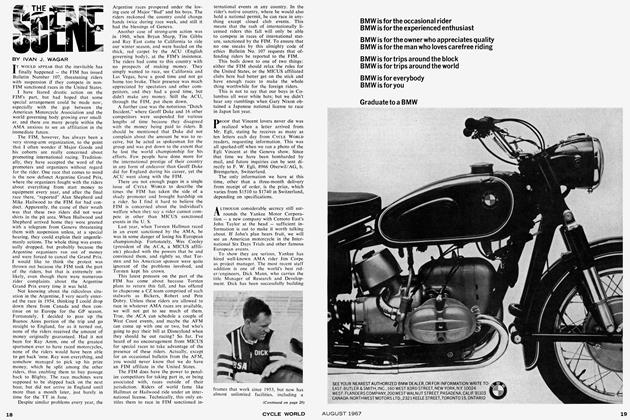
To give the Métissé a real gallop, we selected Riverside Raceway for the first outing. Fortunately, the editor held the 350cc lap record at Riverside for more than three years on a 7R AJS racer, and has completed several hours on the course with Manxes and Matchless G50s. The publisher also has a few hours to his credit on all three racers at Riverside. This was Ken's first exposure to the famous circuit, although he has been road racing regularly for the past year, including Daytona.
Because the engine has been modified to approximately the same specifications as last year's Daytona winner, we were able to get up a fair head of steam on the "short course," which is the standard road race circuit. Even on our initial warmup laps, it became obvious why Hailwood selected the Lockheed disc for his hack 350 Honda four, although there is very little difference in actual stopping power between the Lockheed and the Fontana four shoe we tested last month. On the first application, while the disc is cool, the brake has a tendency to grab slightly, but after the first turn, it remains consistent for the remainder of the riding period. Many riders do not like discs, claiming they tend to be unpredictable. However, this is certainly not the case with the Lockheed unit. In fact, predictability and lack of sponginess are on par with the excellent stopping capabilities.
Handling, which is the reason we started all of this in the first place, would be very hard to beat; it is certainly up to Manx standards. The Metisse is lighter than a Manx and requires a little less muscle to toss it about. The suspension is perfectly matched to the weight of the motorcycle with a 160-pound rider aboard.
Although there is a mount for a hydraulic steering damper, we did not find one in the parts, and ran the machine without it. Despite the lack of a steering damper of any sort, there was no sign of front end waggle, even in the severe bumps on turn one. The Rickmans have mounted everything high enough that it is impossible to ground the pegs or exhaust pipes, regardless of the cornering technique employed by the rider.
After two hours of riding the Metisse, we all agreed that the Rickmans are chassis builders of the highest caliber. Whether a frame is used for scrambling or road racing, if it is strong and the measurements are correct, it will handle. The purists may not like the idea of a mongrel bettering the old favorites — but that's progress.