Evel Knievel
EVEL KNIEVEL
HE TELLS US ABOUT A JOB WITH LONG HOURS, LOTS OF TRAVEL, AND NO FRINGE BENEFITS - SAVE BUILT-IN BUTTERFLIES. ANY TAKERS?
YOU'RE SITTING AT THE BAR of your favorite beverage house, sipping a single Beefeater marty on your way home from some late hours at the office, when the fellow sitting next to you leans over, blisters the lacquer around your glass with his breath and confides that he is going to jump the Grand Canvon on a motorcycle. So, what do you do? You nod to Bruce the bartender and he rings the Yellow Cab hotline for an assist for your neighbor.
Or maybe you're sitting on a park bench on a Saturday morning, merelv rejoicing at no-work-today and quietly digging other happy faces, when a flushed-face towhead runs un and shrills, "I'm gonna jump the Grand Canyon on a motorcvcle!" What do you do? You grin, and you feel sort of warm inside for the kids now who have a lot more imagination than you did at that age when you thought that beinc a fireman was a pretty wild bag.
Or maybe it's midweek at four and you find vourself sharing a sad embarrassment with your fellow workers as. on the heels of the departing 1RS auditors, the whitecoats drag Marvin, the chief accountant out — but not before he raves that he is going to jump the Grand Canyon on a motorcycle!
Or then it could just be a plain old Wednesday morning, and you're in the publishing business, and there's nothing big about the day. The first segment of the neu issue goes to the printer tomorrow, and the art department looks like it had been arranged with a hand grenade — just the regular pressure, the kind you tell the wife you thrive on — when in walks a good-looking young man with a confident smile, sober, mature and apparently sane, and he says directly, quietly. "I'm going to jump the Grand Canyon on a motorcycle."
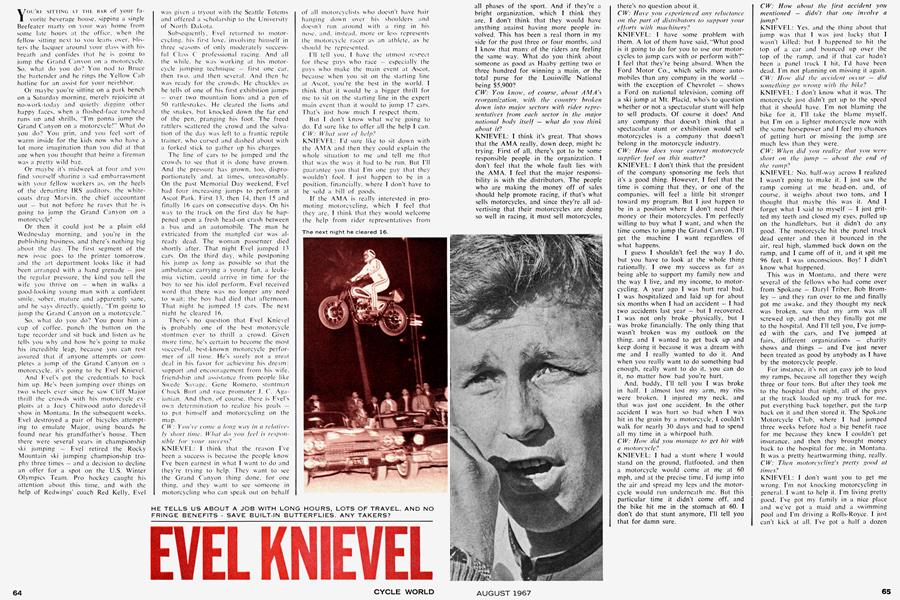
So. what do you do? You pour him a cup of coffee, punch the button on the tape recorder and sit back and listen as he tells you why and how he's going to make his incredible leap, because you can rest assured that if anyone attempts or completes a jump of the Grand Canyon on a motorcycle, it's going to be Evel Knievel.
And Kvel's got the credentials to back him up. He's been jumping over things on two wheels ever since he saw Cliff Major thrill the crowds with his motorcycle exploits at a Joey Chitwood auto daredevil show in Montana. In the subsequent weeks. Hvel destroyed a pair of bicycles attempting to emulate Major, using boards he found near his grandfather's house. Then there were several years in championship ski jumping — F.vel retired the Rocky Mountain ski jumping championship trophy three times — and a decision to decline an offer for a spot on the U.S. Winter Olympics Team. Pro hockey caught his attention about this time, and with the help of Redwings' coach Red Kelly, Evel was given a tryout with the Seattle Totems and offered a scholarship to the University of North Dakota.
Subsequently, Evel returned to motorcycling. his first love, involving himself in three seasons of only moderately successful Class C professional racing. And all the while, he was working at his motorcycle jumping technique — first one car. then two. and then several. And then he was ready for the crowds. He chuckles as he tells of one of his first exhibition jumps — over two mountain lions and a pen of 50 rattlesnakes. He cleared the lions and the snakes, but knocked down the far end of the pen, pranging his foot. The freed rattlers scattered the crowd and the salvation of the day was left to a frantic reptile trainer, who cursed and dashed about with a forked stick to gather up his charges.
The line of cars to be jumped and the crowds to see that it is done have grown. And the pressure has grown, too, disproportionately and, at times, unreasonably. On the past Memorial Day weekend, Evel had four increasing jumps to perform at Ascot Park. First 13. then 14, then 15 and finally 16 cars on consecutive days. On his way to the track on the first day he happened upon a fresh head-on crash between a bus and an automobile. The man he extricated from the mangled car was already dead. The woman passenger died shortly after. That night Evel jumped 13 cars. On the third day. while postponing his jump as long as possible so that the ambulance carrying a young fan, a leukemia victim, could arrive in time for the boy to see his idol perform, Evel received word that there was no longer any need to wait: the boy had died that afternoon. That night he jumped 15 cars. The next niiiht he cleared 16.
There's no question that Evel Knievel is probably one of the best motorcycle stuntmen ever to thrill a crowd. Given more time, he's certain to become the most successful, best-known motorcycle performer of all time. He's surely pot a creat deal in his favor for achieving his dream: support and encouragement from his wife, friendship and assistance from people like Swede Savage. Gene Romero, stuntman Chuck Burt and race promoter J. C. Agaianian. And then, of course, there is Evel's own determination to realize his goals — to put himself and motorcycling on the map.
CW: You've conic a long way in a relatively short time. What do yon feci is responsible for your success?
KNIEVEL: I think that the reason I've been a success is because the people know I've been earnest in what I want to do and they're trying to help. They want to see the Grand Canyon thing done, for one thing, and they want to see someone in motorcycling who can speak out on behalf of all motorcyclists who doesn't have hair hanging down over his shoulders and doesn't run around with a ring in his nose, and, instead, more or less represents the motorcycle racer as an athlete, as he should be represented.
I'll tell you, I have the utmost respect for these guys who race — especially the guys who make the main event at Ascot, because when you sit on the starting line at Ascot, you're the best in the world. I think that it would be a bigger thrill for me to sit on the starting line in the expert main event than it would to jump 17 cars. That's just how much I respect them.
But I don't know what we're going to do. I'd sure like to offer all the help I can. CW: What sort of help?
KNIEVEL: I'd sure like to sit down with the AMA and then they could explain the whole situation to nie and tell me that that was the way it had to be run. But I'll guarantee you that I'm one guy that they wouldn't fool. I just happen to be in a position, financially, where I don't have to be sold a bill of goods.
If the AMA is really interested in promoting motorcycling, which I feel that they are, I think that they would welcome the help from rider representatives from all phases of the sport. And if they're a bright organization, which I think they are, Ï don't think that they would have anything against having more people involved. This has been a real thorn in my side for the past three or four months, and I know that many of the riders are feeling the same way. What do you think about someone as good as Haaby getting two or three hundred for winning a main, or the total purse for the Louisville National being $5,900?
CW: You know, of course, about AM A's reorganization, with the country broken down into major sectors with rider representatives from each sector in the major national body itself — what do you think about it?
KNIEVEL: I think it's great. That shows that the AMA really, down deep, might be trying. First of all. there's got to be some responsible people in the organization. T don't feel that the whole fault lies with the AMA. I feel that the major responsibility is with the distributors. The people who are making the money off of sales should help promote racing, if that's what sells motorcycles, and since they're all advertising that their motorcycles are doing so well in racing, it must sell motorcycles, there's no question about it.
CW: Have you experienced any reluctance on the part of distributors to support your efforts with machinery?
KNIF.VEL: I have some problem with them. A lot of them have said, "What good is it going to do for you to use our motorcycles to jump cars with or perform with?" I feel that they're being absurd. When the Ford Motor Co., which sells more automobiles than any company in the world — with the exception of Chevrolet — shows a Ford on national television, coming off a ski jump at Mt. Placid, who's to question whether or not a spectacular stunt will help to sell products. Of course it does! And any company that doesn't think that a spectacular stunt or exhibition would sell motorcycles is a company that doesn't belong in the motorcycle industry. CW: How does your current motorcycle supplier feel on this matter?
KNIF.VEL: I don't think that the president of the company sponsoring me feels that it's a good thing. However, I feel that the time is coming that they, or one of the companies, will feel a little bit stronger toward my program. But I just happen to be in a position where I don't need their money or their motorcycles. I'm perfectly willing to buy what I want, and when the time comes to jump the Grand Canyon, Ell get the machine I want regardless of what happens.
I guess T shouldn't feel the way I do, but you have to look at the whole thing rationally. I owe my success as far as being able to support my family now and the way I live, and my income, to motorcycling. A year ago I was hurt real bad. I was hospitalized and laid up for about six months when I had an accident — I had two accidents last year — but I recovered. I was not only broke physically, but I was broke financially. The only thing that wasn't broken was my outlook on the thing, and I wanted to get back up and keep doing it because it was a dream with me and I really wanted to do it. And when you really want to do something bad enough, really want to do it, you can do it, no matter how bad you're hurt.
And, buddy, I'll tell you I was broke in half. I almost lost my arm, my ribs were broken. I injured my neck, and that was just one accident. In the other accident I was hurt so bad when I was hit in the groin by a motorcycle, I couldn't walk for nearly 30 days and had to spend all my time in a whirpool bath.
CW: How did you manage to get hit with a motorcycle?
KNIEVEL: I had a stunt where I would stand on the ground, flatfooted. and then a motorcycle would come at me at 60 mph, and at the precise time. I'd jump into the air and spread my legs and the motorcycle would run underneath me. But this particular time it didn't come off, and the bike hit me in the stomach at 60. I don't do that stunt anymore, I'll tell you that for damn sure.
CW: How about the first accident you mentioned — didn't that one involve a jump?
KNIEVEL: Yes. and the thing about that jump was that I was just lucky that I wasn't killed: but I happened to hit the top of a car and bounced up over the top of the ramp, and if that car hadn't been a panel truck I hit, I'd have been dead. I'm not planning on missing it again. CW: How did the accident occur — did something go wrong with the bike? KNIEVEL: I don't know what it was. The motorcycle just didn't get up to the speed that it should have. I'm not blaming the bike for it. I'll take the blame myself, but I'm on a lighter motorcycle now with the same horsepower and I feel my chances of getting hurt or missing the jump are much less than they were.
CW: When did you realize that you were short on the jump — about the end of the ramp?
KNIEVEL: No. half-way across I realized I wasn't going to make it. I just saw the ramp coming at me head-on. and, of course, it weighs about two tons, and I thought that maybe this was it. And I forget what I said to myself — I just gritted my teeth and closed my eyes, pulled up on the handlebars, but it didn't do any good. The motorcycle hit the panel truck dead center and then it bounced in the air. real high, slammed back down on the ramp, and I came off of it, and it spit me 96 feet. I was unconscious. Boy! I didn't know what happened.
This was in Montana, and there were several of the fellows who had come over from Spokane — Daryl Triber. Bob Bromley — and they ran over to me and finally got me awake, and they thought my neck was broken, saw that my arm was all screwed up. and then they finally got me to the hospital. And I'll tell you, I've jumped with the cars, and I've jumped at fairs, different organizations — charity shows and things — and I've just never been treated as good by anybody as I have by the motorcycle people.
For instance, it's not an easy job to load my ramps, because all together they weigh three or four tons. But after they took me to the hospital that night, all of the guys at the track loaded up my truck for me. put everything back together, put the tarp back on it and then stored it. The Spokane Motorcycle Club, where I had jumped three weeks before had a big benefit race for me because they knew I couldn't get insurance, and then they brought money back to the hospital for me, in Montana. It was a pretty heartwarming thing, really. CW: Then motorcycling's pretty good at times?
KNIEVEL: I don't want you to get me wrong. I'm not knocking motorcycling in general. I want to help it. I'm living pretty good, I've got my family in a nice place and we've got a maid and a swimming pool and I'm driving a Rolls-Royce. I just can't kick at all. I've got a half a dozen motorcycles and a pretty good bank account. Motorcycling's been good to me. boy. And I hope that someday it'll be good to everyone who is in it from a professional standpoint. And anything I can do to help it. if it's not going to cost me a lot of money. I'll do it at my own expense. All the AMA needs to do is call me on the phone and say, "Well, you opened your mouth and we'd like to explain it to you so get back here."
Well, buddy, I'll go, because I'm not pulling anybody's leg.
CW: What's your chief concern about y outown business at this point?
KNIEVEL: The thing that's bothering me right now is getting over the jumps that I have to make in the next year safely. And I'm looking forward to this Grand Canyon thing.
CW: Do you have quite a bit of help with the project itself?
KNIEVEL: Alex Tremulis is working with me, and as you know, he's the guy who designed the Gyronaut. And he's building a windscreen for me for the front of my machine. Turbonique, in Orlando, Florida, is supplying me with the rocket system, and Paranetics is providing the parachutes and the altimeter and gauges.
The bike, at this time, as you know, is a Triumph. I'm working with Mr. Summers of Gyro-Transport in Northridge (Calif.) — and Alex Tremulis is also connected with them. I feel that these guys know what they're doing, because if they can get John Glenn around the world, they can sure get me across the Grand Canyon. That's the way I look at it.
CW: What's the nature of the system from Turbonique? Is it a bi-propellant rocket? KNIEVEL: Yes, it's a liquid fuel rocket that runs on thermalene and oxygen. The motorcycle will run right now from zero to 158 miles an hour in three point seven one seconds. Now, if I run the motorcycle under its own power to 120, and then throw those jets on, I'm going to have tremendous speed. The only thing is, can I hang onto it. and that's where the windscreen comes in — to deflect wind around me. We just definitely feel that it can be done. I feel that the machine can very well have a top speed of 280 miles an hour.
CW: It would seem that you would encounter a lot of skepticism regarding the Grand Canyon Jump.
KNIEVEL: Well, there are some experts who have appeared on television who say that I will only make it half-way across, and then there are other experts, connected with some of the biggest jet and missile engineering firms in the country who say that I might be one of the smartest fellows to come along in some time. Everybody laughed at Lindbergh when he said that he was going to fly over the Atlantic. Seven men had been killed trying it before him, and they said that even if he did do it, what difference would it make. The public is funny — they're skeptical until something is done — most of them. But there are enough people with whom I'm associated now who have put enough faith in it and are working hard at it, and I'm talking about Government-backed companies that are helping me on an experimental basis.
CW: How is the project progressing at this time? It would seem that there would he a great deal more involved than just the bike itself.
KNIEVEL: Right now we're in the final stages of completing negotiations with the Navaho Indians. We went to the Grand Canyon just two or three days ago and met with the chairman of the tribal council and their attorney. They are enthused about the program. I'm trying to arrange now to have Navaho people employed for a great deal of the work at the site.
I'm getting an access road built, a parking area, and we're going to start work on the takeoff ramp, which is going to be 200 feet high and 700 feet long. It's going to be built of dirt.
Then we have the problem deciding on whether to jump on the Fourth of July. There have been suggestions made by both my engineers and the Navahos that it is awfully hot in that area in July and I might have a better chance, because of turbulence, later on, on Labor Day weekend, because it's not so hot then.
Of course, we're going to look at every aspect of it. The United States Government has contacted me — Under-secretary Carver — and the wording of his letter was that after reading of my plans they did not share the positive feeling that I have — that I could make it across — but that I had their best wishes for success in my undertaking. In other words, I have written permission from the government to land the motorcycle on the Federal side of the canyon.
CW: Do you feel that the Grand Canyon jump is going to take the edge off your act and reduce the appeal of your jumps after that?
KNIEVEL: No. It'll help them. Most people realize that jumping the Grand Canyon is quite an undertaking, but, at the same time, jumping a half a block on a standard motorcycle isn't any easy deal either. As I said before, when I had my accident jumping, that ramp doesn't give, so I'd just as soon jump the Grand Canyon as 16 cars.
CW: You seem to feel pretty strongly about the lot of the motorcycle racer. KNIEVEL: I'm not trying to be a crusader for the motorcycle riders and racers; I've got my own self to worry about. But I sure feel that the riders ought to form a good union of some kind.
CW: They have a riders' union at Ascot — Motorcycle Racers, Inc.
KNIEVEL: They ought to form a good union for the entire country and should be allowed to sit on the board of the AMA, and if the AMA is really interested in promoting good motorcycling, they certainly shouldn't have anything against it, because it's just good relations between what might be classified as labor and industry. CW: The MRI has been instrumental in getting the riders about 40 percent of the gate for non-national races, and that surely indicates that a union can work. KNIEVEL: I believe that they're only getting 30 percent now, because the AMA is taking 10 percent for insurance. So now I'm wondering where that annual $22 license fee that each rider sends to the AMA goes to.
Now, I hope that the money is being put to good use, but if it isn't, then why send it to the AMA? Why not form a riders' union and let the promoter have 50 percent of the gate, instead of the percentage that he gets, and let the riders have 50 percent instead of racing for 30 and let them furnish their own insurance. They're an independent contractor. Let them be liable for their own insurance. I'm sure they'd all be willing to take $20 out of their pocket and lay it on the line for insurance and they could all do it as a group and then they could race for 50 percent. And then if the crowds are bad, they've got nobody to blame, and if they're good,they get 50 percent of the take. CW: Are your fees in any way tied up with the amount of prize money a promoter is willing to pay?
KNIEVEL: I don't make my living on their purses. I'd just like to see those guys make more than $300 for winning a main event. When I received that bulletin from the AMA concerning the Louisville National, and they said that the deal was going to be $5,900 total prize money, it just made me sick. They're going to pay all those guys with $5,900 for a national! I know it's wrong! It's gotta be wrong when they're acting as business managers and as consultants for guys who are racing motorcycles, supposedly representing them — all the competition riders in the country — and all they can get for them is $5,900 for a national. My business manager, and my men, can make me $10,000 in two weeks at Ascot. That's what they made me — ten grand. I made five thousand smackers at Ascot last week! I've probably made more money at Ascot than any guy's made there.
CW: That's more than Tanner can make there in an entire season, even when he's really on the bubble.
KNIEVEL: That's right! I think that these fellows that are out risking their lives had better get some business managers or get together and say. "Look, we're drawing some people and we'd like to get some more money for it."
I think it was Mark Twain who said, "Thank the Lord for the fools in this world, because if it weren't for the fools, I couldn't make a living." And I just hate to think that every guy who gets on a motorcycle is a fool for the people who want to make a living off of him. T just can't comprehend it.
I can't say that the motorcycle industry hasn't been good to me, but that's not because of the organization itself, it's because of the people in it who are trying so hard to make it so good.