Indian History
CAPTAIN T. A. HODGDON, JR.
There are writers and there are writers — but few can boast of the achievements of Capt. T. A. Hodgdon, Jr., USAF. Capt. Hodgdon is presently a/c Commander on the C-130 Hercules (16,000 H.P. Transport). He spent four years flying in Viet Nam and was decorated with the Air Medal, as well as a citation for “certain” Viet Nam flying. Since then he has received five more citations and five Oak Leaf Clusters.
The author learned to ride a 125 BSA when he was 12 years of age and was flying the family “T-Craft” at the age of 14. And what does he do for excitement when he’s at home? Ride a motorcycle, of course. - Ed.
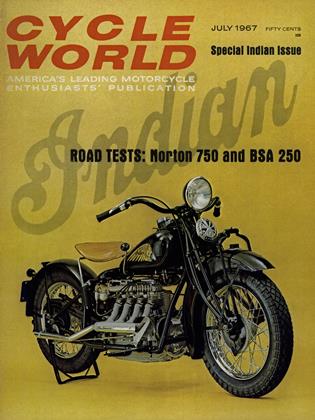
To COMPRESS into a few pages the 52year-history of one of America’s greatest pioneer motorcycle manufacturers — maker of some of the most glamorous and exciting motorcycles the world ever saw in the first half of this century, is, indeed, a difficult task. There is so much to write about this Yankee motorcycle, which first saw the light of day in Springfield, Massachusetts, at the turn of the century, then rose to great heights of achievement and popularity throughout the world. The name of this motorcycle was INDIAN, and it enjoyed a high-wide-and-handsome life span of over half a century, during which it became one of the most popular motorcycles all over the United States, was exported to almost every civilized country in the world, was the winner of major motorcycle races and speed records not only here at home but in England, Europe, Australia, New Zealand, South Africa, and many other countries as well.
What do we mean by “exciting motorcycles”? Well — take, for instance, the famous Tourist Trophy Races held in the Isle of Man — an event that is now recognized as the most famous of all road races. Indian was the first foreign brand to ever win this event, which it did in 1911 — snatching first, second and third places, beating a most challenging array of the finest racing machines the world then had to offer. In doing so, Indian was the only American motorcycle to ever win this world-renowned event.
When it came to setting new speed records, coast to coast records, winning races, endurance runs, or hillclimbs, the Indian could be counted on to be right in there, giving hard fought competition to the other two most famous of American motorcycles of those days, the Harley-Davidson and the Chicago built Excelsior.
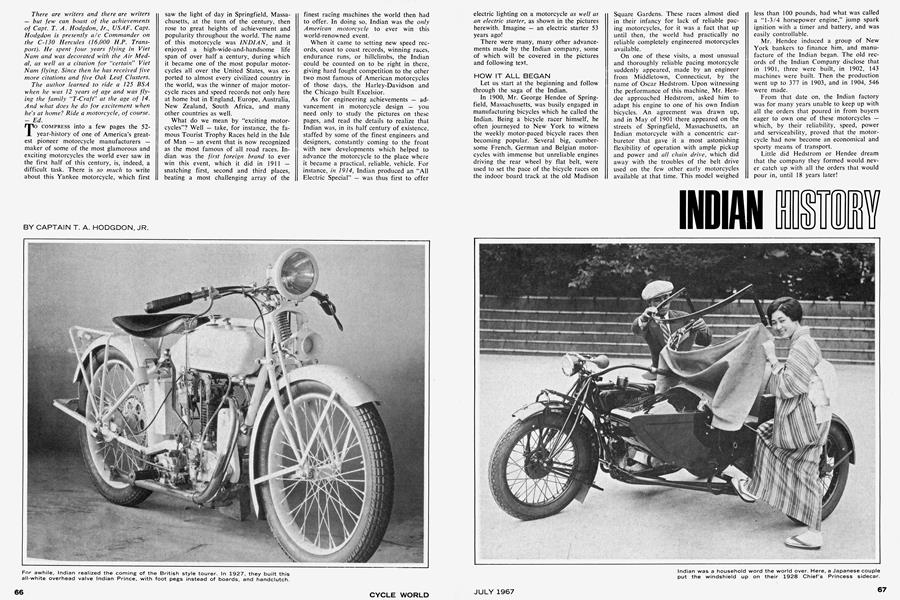
As for engineering achievements — advancement in motorcycle design — you need only to study the pictures on these pages, and read the details to realize that Indian was, in its half century of existence, staffed by some of the finest engineers and designers, constantly coming to the front with new developments which helped to advance the motorcycle to the place where it became a practical, reliable, vehicle. For instance, in 1914, Indian produced an “All Electric Special” — was thus first to offer electric lighting on a motorcycle as well as an electric starter, as shown in the pictures herewith. Imagine — an electric starter 53 years ago!
INDIAN HISTORY
There were many, many other advancements made by the Indian company, some of which will be covered in the pictures and following text.
HOW IT ALL BEGAN
Let us start at the beginning and follow through the saga of the Indian.
In 1900, Mr. George Hendee of Springfield, Massachusetts, was busily engaged in manufacturing bicycles which he called the Indian. Being a bicycle racer himself, he often journeyed to New York to witness the weekly motor-paced bicycle races then becoming popular. Several big, cumbersome French, German and Belgian motorcycles with immense but unreliable engines driving the rear wheel by flat belt, were used to set the pace of the bicycle races on the indoor board track at the old Madison Square Gardens. These races almost died in their infancy for lack of reliable pacing motorcycles, for it was a fact that up until then, the world had practically no reliable completely engineered motorcycles available.
On one of these visits, a most unusual and thoroughly reliable pacing motorcycle suddenly appeared, made by an engineer from Middletown, Connecticut, by the name of Oscar Hedstrom. Upon witnessing the performance of this machine, Mr. Hendee approached Hedstrom, asked him to adapt his engine to one of his own Indian bicycles. An agreement was drawn up, and in May of 1901 there appeared on the streets of Springfield, Massachusetts, an Indian motorcycle with a concentric carburetor that gave it a most astonishing flexibility of operation with ample pickup and power and all chain drive, which did away with the troubles of the belt drive used on the few other early motorcycles available at that time. This model weighed less than 100 pounds, had what was called a “1-3/4 horsepower engine,” jump spark ignition with a timer and battery, and was easily controllable.
Mr. Hendee induced a group of New York bankers to finance him, and manufacture of the Indian began. The old records of the Indian Company disclose that in 1901, three were built, in 1902, 143 machines were built. Then the production went up to 377 in 1903, and in 1904, 546 were made.
From that date on, the Indian factory was for many years unable to keep up with all the orders that poured in from buyers eager to own one of these motorcycles — which, by their reliability, speed, power and serviceability, proved that the motorcycle had now become an economical and sporty means of transport.
Little did Hedstrom or Hendee dream that the company they formed would never catch up with all the orders that would pour in, until 18 years later!
MECHANICAL IMPROVEMENTS YEAR BY YEAR.
With Mr. Hedstrom on the engineering and mechanical side, and Mr. Hendee on the financial and sales management side, the Springfield firm prospered and grew, with one factory enlargement after another taking place to keep up with the demand. Much of this growth was due to the Indian policy of constant, notable improvement in the mechanical features of the product, as well as precision workmanship.
For the first six years, Hedstrom (Indian) engines were manufactured by the Aurora Automatic Machinery Company of Aurora, Illinois, to Hedstrom’s specifications. (This is the same firm which today still manufactures Thor tools and appliances.) However, with the greatly increased demand, a substantial enlargement of the Springfield factory was made so that engines and carburetors could be manufactured right there under Oscar Hedstrom’s watchful eye.
In 1905, Indian offered its first twin-cylinder machine and a coil spring cushion front fork was added. In 1908, Indian was the first motorcycle to introduce magneto ignition to replace the troublesome battery and jump spark timer. In 1908, engine size was increased to 3-1/2 hp — double the horsepower of the original engine.
As we look at the list of Indian engineering improvements, we see that Indian was first with twist grip control, first with mechanical oil pump for lubrication, first with electric lighting, and first with an electric starter as illustrated herewith. In 1909, the “Camel Back” gasoline tank was removed from the rear mudguard and placed in the frame above the engine (as all motorcycles today are made).
By 1910, the Hendee Manufacturing Company, as it was then called, had a network of Indian dealers not only in the USA, but in foreign countries as well, numbering more than 1,000! In 1910, the Indian company manufactured a rotary aircraft engine of nine cylinders, and the record, as well as the actual engine itself in the Smithsonian Institution today, testify to the fact that this engine flew a Bleriot-type monoplane, piloted by Earl Ovington, to carry the first air mail in America on Long Island, New York, in 1911.
In that same year, Indian produced a two-speed gearbox! (Nearly all the world’s motorcycles up to then were single speed — with only a clutch to get moving off for a smooth start.) It was this twospeed gearbox (plus other control features) that enabled Indian to win the first three places in the 1911 Isle Of Man Tourist Trophy Race.
At this point, information should be given as to the color of these motorcycles. Up through 1909, all Indian motorcycles were painted a dark blue. However, for 1910, the color was changed to a brilliant red, with a large gold Indian script on the tank. From that year, up to end of the existence of this motorcycle, most were produced in brilliant Indian red. By 1913, Indian had more than 2,000 dealers, both at home, and in many foreign countries.
As the roads of early America were largely unpaved and rough, Indian, in 1913, appeared with a swinging arm rear fork — working against leaf springs. This is illustrated in the photo of the electric model herewith. By the year 1913 the Indian factory was producing at the rate of 35,000 motorcycles per year — a truly handsome figure for motorcycle production of 54 years ago! In this year Oscar Hedstrom, the mechanical genius who had fostered the engineering excellence and high quality of the Indian, decided to retire to his farm in Connecticut.
Buyers from foreign lands continued to take more and more of the red Indians, with England, France, Denmark, Sweden, Japan, Australia and New Zealand among the largest customers. Truly, this product from old New England was blazing a trail of success around the globe.
In 1915, the first three-speed Indian appeared — a husky big twin of 61 cubic inches (l,000cc) with a reliable kick-starter, easy shifting gearbox, and rugged heavy-duty clutch, as well as leaf spring front fork, and the same swinging arm rear spring suspension which first appeared on the 1913 models.
(Author’s note: My Dad had one of these machines, and still speaks with nostalgic enthusiasm of its snappy, instant acceleration and the easy riding of the spring frame.)
Oscar Hedstrom returned from his retirement in 1916, to the great joy of Indian fans the world over. That same year, George Hendee, the man of vision who had founded the company, retired. The year 1916 also saw the advent of the Indian “Power Plus,” a l,000cc engine greatly improved, with side valve cylinders, and with electric lighting, battery charging being accomplished by a Dixie combination magazine and generator.
Then, as the dark clouds of World War I finally settled over America, and April, 1917, saw us enter the conflict on the side of England and France, the old Indian went to war — with the entire output turned over to war production.
In the years 1917, 1918 and early 1919, the Springfield factory turned out an astonishing 41,000 olive drab Indian Power Plus models which served the Dispatch Riders of the American Expeditionary Forces around the globe.
A GREAT ENGINEER JOINS INDIAN
In the first year after the war ended — 1919 — one of the most outstanding motorcycle designers the world had ever seen joined the Indian company. Fie was no less than Charles B. Franklin, who in 1912, was the first man in the world to ride 300 miles in 300 minutes — which he did on an Indian at Brooklands Race Track in England. The ingenuity and sound engineering which Mr. Franklin put into Indian motorcycles from then, through the next ten years, was a great factor in Indian’s continued growth.
The Indian Scout of 596cc capacity, with complete unit power plant, including helical gear drive from the engine to the transmission, was one of the most durable motorcycles Indian ever built, was practically indestructible, and for its size, was a most remarkable performer. You need only ask any old timer who knew the Indian in those days, and he will agree that the Indian Scout was the best small motorcycle ever to appear in the world up until that time.
This splendid high-performance and durable small motorcycle swept into such a high state of popularity almost overnight, that the great factory in Springfield was obliged to put on a night shift and even then, could not keep up with the orders.
There followed the Indian Chief of l,000cc capacity, also with the complete unit power plant, and later the Indian 74, of l,250cc capacity, which soon became one of the major police motorcycles of America. New York City alone had a fleet of 765 of these machines; the state of Pennsylvania purchased them in quantity of 535; the state of Massachusetts, the city of St. Louis, Philadelphia, Washington, D.C., Atlanta, and many other major American cities made the Indian the standard police motorcycle of that day. All this contributed to the further success of Indian dealers, and to the prestige of the Indian.
Later, Mr. Franklin designed the 101 Scout, still beloved by those who knew this motorcycle in the year 1928, when it was first introduced, and on up to 1932. This was later redesigned into the Sport Scout, which the records of the AMA disclose as a race winner and a most phenominal performer on the dirt tracks and road courses of the nation.
The Sport Scout won Daytona, Laconia, Langhorne, Springfield, and many many other National Championships, setting records, many of which were not broken until several years later.
INDIAN RACING MOTORCYCLES AND SUCCESSES.
In the history of many great industrial enterprises, there appear several outstanding moves, which often accounted for great growth and success. In going over some of the reasons for Indian’s resounding progress and growth, we automatically come across one outstanding fact — namely, the policy which the founders employed right from the start, and continued with steadfast application through the years — of developing and racing outstanding motorcycles, year by year, thus keeping the Indian name in the limelight. Space prohibits even a partial listing of Indian victories, and I can do no better than to quote from the 30th anniversary issue of Indian News, the company publication (which incidentally, my father edited when Indian was in its hey day).
1902: FIRST MOTORCYCLE RACE IN AMERICA. George M. Holden, on Indian, won this 10-mile event on the Brooklyn, N.Y., Cycle Path. His time was 14 minutes 57-1/2 seconds., 1908: BRITISH SIX DAY TRIALS. T. K. Hastings duplicated his feat of 1907. He scored 992 points out of a possible 1,000 — a remarkable tribute to the efficiency of early Indian models. 1912: 300 MILES IN 300 MINUTES. For the first time in history, 300 miles has been covered in as many minutes. C. B. Franklin, riding a 7 hp Indian twin, made this phenomenal ride at Brooklands Speedway, England. 1919: THREE-FLAG RECORD BROKEN. “Cannonball” Baker, carrying a passenger, rode an Indian sidecar outfit from Canada to Mexico in two days, 17 hours and 53 minutes, July, 1919. 1923: Paul Remaley on his sturdy 596cc Indian Scout broke the transcontinental record set by a machine much larger, from San Francisco to New York. 1923: THE BELGIAN GRAND PRIX was won by Fred Dixon on an Indian 500cc single. 1923: THE CHAMPIONSHIP OF ITALY in both the l,000cc and the 750cc classes won by Indian. 1923: ARGENTIN A. The Argentine Tourist Trophy was won by Antonio Gerli riding an Indian Super Chief. 1924: INDIAN SCOUT WINS SOUTH AFRICAN TOURIST TROPHY RACE, 200 miles over rough roads, finishing 12 minutes ahead of 650cc machines. (The Scout had only 596cc.) 1924: INDIAN SCOUT WINS
WEST AUSTRALIA 3-DAY RELIABILITY TRIAL with full score against large field of larger machines. 1924: NEW ZEALAND. George Lambert won the flying mile championship for l,000cc class. 1925: INDIAN WON THE AUSTRALIA SOLO AND SIDECAR CHAMPIONSHIPS, the Victoria Junior TT Race, the Australia Heavyweight Championship, the Tasmanian Sidecar Championship, and the Adelaide to Melbourne Solo Record. 1925: 125 MILES PER HOUR. At Sellick’s Beach, South Australia, Paul Anderson set a new record of 125 miles per hour. Anderson made a sidecar speed record of 100 miles per hour. 1926: 132 MILES PER HOUR AT DAYTONA BEACH. Johnny Seymour, riding an Indian twin, established a new world’s motorcycle speed record of 132 mph at Daytona Beach, Florida. He also set a record for single-cylinder motorcycles of 112.63 mph.
Above are just samples indicating the performance of Indian in various parts of the world in the first quarter century of its existence.
INDIAN SPECIAL RACING MACHINES.
From the very beginning, there was an Indian racing department with a staff of draftsmen and machinists continually turning out special racing motorcycles in order that Indian could win in any corner of the globe against almost any competition. Among the most famous of these motorcycles was the eight valve, l,000cc racing machine (four valves per cylinder) and the four valve 500cc single. These motorcycles hung up an enviable string of records, did so well that the Harley-Davidson and Excelsior factories followed suit with special racing motorcycles.
In 1925, Indian produced the first overhead camshaft single racing machine, the Indian Prince Special. This was patterned somewhat after the famous Velocette KSS model. Exactly 12 of these machines were built and sent to various parts of the world.
From 1926 to 1930, Indian built a series of 350cc overhead valve dirt track racers, which were so successful that Indian won every national championship in the years 1928 and 1929 in the face of stiff competition. One of these overhead valve racers, in road racing trim for overseas use, is pictured herewith.
(Continued on page 91)
In 1928, Indian built a number of l,000cc special racing machines with a carburetor for each cylinder. On one of these, Curly Fredricks set a new world speedway championship record of 120.3 mph on the board track at Rockingham, N.H. in the Fall of 1928.
THE DAYS OF THE GREAT INDIAN FOURS.
Today, in America, there is a club called “The Indian Four Club,” composed of enthusiasts who have found and restored fine examples of the four-cylinder machines manufactured for many years by Indian. Indian’s entry into the four-cylinder motorcycle field was heralded in the year 1927 when, at the Madison Square Gardens National Motorcycle Exhibition, a new motorcycle appeared in the Indian exhibit — the Indian Ace.
Only a week before the show, Indian had purchased the complete assets of the Michigan Motors Corporation, successor to the Ace Motor Corporation of Philadelphia and it was their intention to market the famous Ace, which had earned a fine name for itself in the motorcycle field, and gradually absorb it into the Indian line.
An engineer named Arthur Lemon came with the acquisition of the Ace, as he had been a close associate of William G. Henderson, who had originally designed the Ace in 1919. Mr. Lemon remained with Indian for many years, and continued to perfect the four-cylinder machine which was readily accepted by police departments across the nation, and by enthusiasts who wanted the best in smooth, fast motoring.
The Four was improved in the years from 1927 through to the entry of America into World War II — at which time the beautiful Indian Four came to an untimely end. During and following the war, the Indian Engineering Department did design two more four-cylinder Indians, but they never went beyond the experimental state. Neither of them was put into production, but fortunately, both of the original models are still preserved today and are owned by enthusiasts in this country.
Thus, with the entry of America into World War II, when Indian production was turned over to the War Department, the Indian Four vanished forever. Whenever an enthusiast asks me why Indian stopped making such a wonderful machine, I can only quote from the records of the old Indian company . . . “Production costs are too high, and the volume is not sufficient for us to continue the production of this high-priced machine. To continue producing it would mean additional losses to the company.”
THE GREAT WESTERN INDIAN EMPIRE.
In the year 1930, Hap Alzina of Oakland, California, was given the distributorship for Indian for the entire West Coast, and in the following 20 years, Mr. Alzina became the largest single customer of the factory for motorcycles and spare parts. He built an empire of Indian enthusiasts west of the Rocky Mountains which caused Indian to rise to great heights of popularity, due to the drive, personality and enthusiasm of Alzina and his ability to surround himself with enthusiastic, capable associates. His accomplishments in building this Western Indian empire served as a great stimulus for the red Indian brand, and for many years Mr. Alzina held the title of “Mr. Motorcycle — West of the Rockies.” Today Hap is in well earned retirement, with a host of friends in many parts of the world.
WHAT WAS THE ULTIMATE DESTINY OF INDIAN?
From all of the above, the great worldwide success of Indian is clear. Why, then, the reader may ask, is there no Indian today? What happened to Indian to cause it to go out of business? The answer is that starting in 1927, when President Frank J. Weschler retired, the company passed into the hands of people who were not motorcycle enthusiasts and did not understand the business. No less than six new presidents came and went — six times the old Indian suffered the upheaval of new products, new staff, new modern ideas, and ventures into products foreign to motorcycle manufacture.
One great revival did come in 1930, when E. Paul Dupont of Wilmington, Delaware, acquired the Indian, and from then until World War II, the old Indian got back to the job of making motorcycles — red ones and good ones. As World War II came along, the entire facilities of the plant were turned over to the War Production Board, and the factory turned out thousands upon thousands of olive drab Indians for use by the armies of England and France. At the close of the war, new financial interests acquired the Indian, and a project was immediately started to import numerous brands of British motorcycles, rather than to perfect the existing Indian models. A venture was tried in the lightweight field, which proved unsuccessful.
Gone were all but a few of the fine engineers and management people who had made Indian at one time the greatest motorcycle producer in the world. In 1953, the last Indians came down the production line. The Indian name was acquired by a British firm, but success was not forthcoming and eventually the old Indian dropped out of the picture, never to be revived.
Is the Indian name forgotten around the world? I think, as the author of this article, that I can answer that. As a pilot and officer in the U. S. Air Force, my flying has taken me into 40 different countries. Being a motorcycle enthusiast, I have often been asked by people in foreign lands, “What ever happened to the famous and wonderful red Indian?”
So you see, although it has all but vanished from the world’s highways and byways — the Indian is still remembered in many parts of the world, as one of the great products from America in the first half of this century! ®