A Pair of Desert Sleds
A PAIR OF DESERT SLEDS
Something for the Mojave Bailiwick
THE WORD, “SLED,” as applied to a motorcycle, means desert racer and probably has origin in the delightful scraping sensation one feels as the skid plate hits ground. But the connotation goes even farther in that the term brings to mind, more often than not, a throbbing big twin from Coventry decked out in appropriate accoutrement.
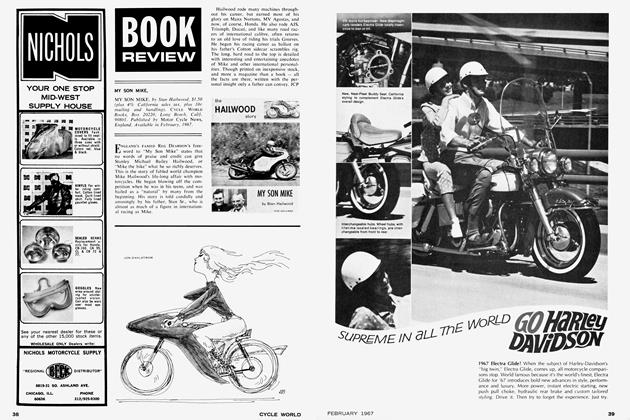
As the riding gets faster each year and the demands on machinery become more grueling, a desert-ready bike is now a far cry from most machines on the showroom floor. Thus, one old pro, Ted Lapidakis of the Checkers M/C, decided to bring the two closer together. The result is that the reader may, without lifting a wrench, buy a brand-new 500cc or 650cc Triumph desert sled ready to race (after a few break-in miles, naturally).
The price tag is a bit more($1564 for the 650, $1430 for the 500), but riders who bought a new Triumph and tried to duplicate the work done would receive a rude fiscal shock, unless they were lucky enough to get discounts on the parts and free labor.
Modifications to both bikes are the same with one exception: while the 650’s fork angle remains standard, the 500’s frame has been jacked out slightly for greater rake.
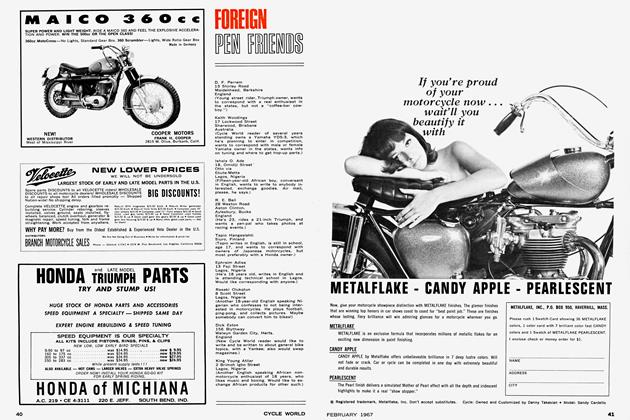
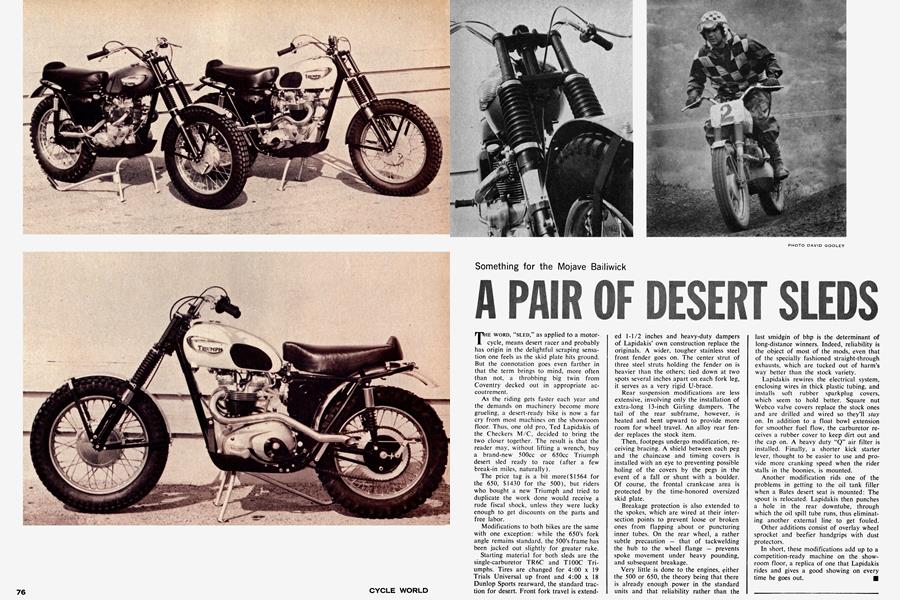
Starting material for both sleds are the single-carburetor TR6C and T100C Triumphs. Tires are changed for 4:00 x 19 Trials Universal up front and 4:00 x 18 Dunlop Sports rearward, the standard traction for desert. Front fork travel is extended 1-1/2 inches and heavy-duty dampers of Lapidakis’ own construction replace the originals. A wider, tougher stainless steel front fender goes on. The center strut of three steel struts holding the fender on is heavier than the others; tied down at two spots several inches apart on each fork leg, it serves as a very rigid U-brace.
Rear suspension modifications are less extensive, involving only the installation of extra-long 13-inch Girling dampers. The tail of the rear subframe, however, is heated and bent upward to provide more room for wheel travel. An alloy rear fender replaces the stock item.
Then, footpegs undergo modification, receiving bracing. A shield between each peg and the chaincase and timing covers is installed with an eye to preventing possible holing of the covers by the pegs in the event of a fall or shunt with a boulder. Of course, the frontal crankcase area is protected by the time-honored oversized skid plate.
Breakage protection is also extended to the spokes, which are wired at their intersection points to prevent loose or broken ones from flapping about or puncturing inner tubes. On the rear wheel, a rather subtle precaution — that of tackwelding the hub to the wheel flange — prevents spoke movement under heavy pounding, and subsequent breakage.
Very little is done to the engines, either the 500 or 650, the theory being that there is already enough power in the standard units and that reliability rather than the last smidgin of bhp is the determinant of long-distance winners. Indeed, reliability is the object of most of the mods, even that of the specially fashioned straight-through exhausts, which are tucked out of harm’s way better than the stock variety.
Lapidakis rewires the electrical system, enclosing wires in thick plastic tubing, and installs soft rubber sparkplug covers, which seem to hold better. Square nut Webco valve covers replace the stock ones and are drilled and wired so they’ll stay on. In addition to a float bowl extension for smoother fuel flow, the carburetor receives a rubber cover to keep dirt out and the cap on. A heavy duty “Q” air filter is installed. Finally, a shorter kick starter lever, thought to be easier to use and provide more cranking speed when the rider stalls in the boonies, is mounted.
Another modification rids one of the problems in getting to the oil tank filler when a Bates desert seat is mounted: The spout is relocated. Lapidakis then punches a hole in the rear downtube, through which the oil spill tube runs, thus eliminating another external line to get fouled.
Other additions consist of overlay wheel sprocket and beefier handgrips with dust protectors.
In short, these modifications add up to a competition-ready machine on the showroom floor, a replica of one that Lapidakis rides and gives a good showing on every time he goes out. ■