Bridgestone 90 Sport
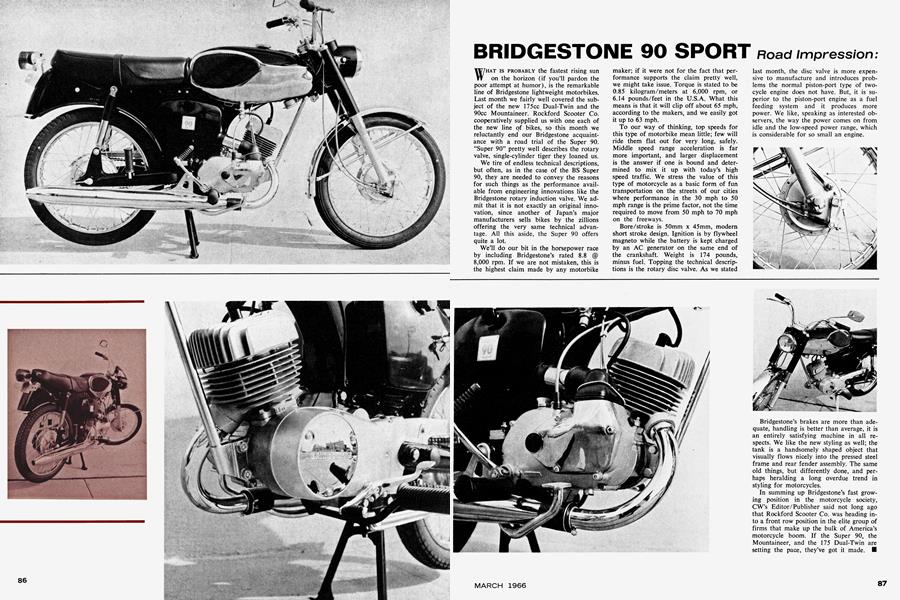
BRIDGESTONE 90 SPORT
Road Impression:
WHAT IS PROBABLY the fastest rising sun on the horizon (if you'll pardon the poor attempt at humor), is the remarkable line of Bridgestone lightweight motorbikes. Last month we fairly well covered the subject of the new 175cc Dual-Twin and the 90cc Mountaineer. Rockford Scooter Co. cooperatively supplied us with one each of the new line of bikes, so this month we reluctantly end our Bridgestone acquaintance with a road trial of the Super 90. “Super 90” pretty well describes the rotary valve, single-cylinder tiger they loaned us.
We tire of endless technical descriptions, but often, as in the case of the BS Super 90, they are needed to convey the reasons for such things as the performance available from engineering innovations like the Bridgestone rotary induction valve. We admit that it is not exactly an original innovation, since another of Japan’s major manufacturers sells bikes by the zillions offering the very same technical advantage. All this aside, the Super 90 offers quite a lot.
We’ll do our bit in the horsepower race by including Bridgestone’s rated 8.8 @ 8,000 rpm. If we are not mistaken, this is the highest claim made by any motorbike
maker; if it were not for the fact that performance supports the claim pretty well, we might take issue. Torque is stated to be 0.85 kilogram/meters at 6,000 rpm, or 6.14 pounds/feet in the U.S.A. What this means is that it will clip off about 65 mph, according to the makers, and we easily got it up to 63 mph.
To our way of thinking, top speeds for this type of motorbike mean little; few will ride them flat out for very long, safely. Middle speed range acceleration is far more important, and larger displacement is the answer if one is bound and determined to mix it up with today’s high speed traffic. We stress the value of this type of motorcycle as a basic form of fun transportation on the streets of our cities where performance in the 30 mph to 50 mph range is the prime factor, not the time required to move from 50 mph to 70 mph on the freeways.
Bore/stroke is 50mm x 45mm, modern short stroke design. Ignition is by flywheel magneto while the battery is kept charged by an AC generator on the same end of the crankshaft. Weight is 174 pounds, minus fuel. Topping the technical descriptions is the rotary disc valve. As we stated
last month, the disc valve is more expensive to manufacture and introduces problems the normal piston-port type of twocycle engine does not have. But, it is superior to the piston-port engine as a fuel feeding system and it produces more power. We like, speaking as interested observers, the way the power comes on from idle and the low-speed power range, which is considerable for so small an engine.
Bridgestone’s brakes are more than adequate, handling is better than average, it is an entirely satisfying machine in all respects. We like the new styling as well; the tank is a handsomely shaped object that visually flows nicely into the pressed steel frame and rear fender assembly. The same old things, but differently done, and perhaps heralding a long overdue trend in styling for motorcycles.
In summing up Bridgestone’s fast growing position in the motorcycle society, CW’s Editor/Publisher said not long ago that Rockford Scooter Co. was heading into a front row position in the elite group of firms that make up the bulk of America’s motorcycle boom. If the Super 90, the Mountaineer, and the 175 Dual-Twin are setting the pace, they’ve got it made. ■