A 250 Ducati For Racing, Part Two
A 250 DUCATI FOR RACING, Part Two
250 DUCATI
WE HAVE REMARKED UPON the Ducati 250's racing potential; previously (before this Ducati racing project), we have not explained why the potential is there. Taken on its design features, the Ducati engine impresses one as being just the thing for racing. The radically "over-square" bore/stroke ratio (1.277:1) would seem to insure large valve sizes and low piston speeds at high revs; the valves are operated from an overhead camshaft; and all of the engine castings are of aluminum alloy. Just as important as these theoretical considerations is the fact that in service, the Ducati 250 has proven to be nearly unbreakable.
Unfortunately, for what we had in mind the standard of reliability established by normal (or even slightly abnormal) service was of limited value. It is axiomatic that maximum power will ultimately come from maximum revs, and our first task was to determine what order of crank speeds the Ducati was likely to withstand. Piston speed is one index of this; a better one is piston acceleration. This is calculated from stroke, connecting rod length, and engine speed. There is no fixed limit for piston acceleration, but considering that the Ducati has a good, forged piston, we tentatively placed our target limit at 125,000 ft/sec2. That limit is reached at just under 10,000 rpm, but because it is a somewhat elastic limit, the "red-line" our efforts would be directed toward was set at 10,000 rpm. The validity of this pencil-predicted limit is substantiated by the experiences of Frank Scurria, who has raced Ducatis with some success and who found a 10,000 rpm red-line to give reasonable reliability.
Once the upper limit was set, it then became a simple matter to determine the engine speed-range; this being calculated from the ratios provided in the standard Ducati 5-speed transmission. To make the rather large jump from 1st to 2nd gear without dropping below the power band, power is required from 6500 rpm. However, on most race courses, one would not use anything under 2nd gear except on the start, so the real power band could be between 8000 and 10,000 rpm — that would cover almost any course and overall gearing conditions we would be likely to encounter.
Knowing how "peaky" power curves become in highly modified engines, we could estimate that with everything tuned for running in a 8000-10,000 rpm range the point of maximum output would be at about 9500 rpm. From that point, it was all fairly easy slide-rule work to arrive at an inlet valve and port size, and a diameter for the carburetor throat.
First to come in for consideration was the intake port diameter. This should be large enough to avoid throttling; yet, small enough to provide the gas velocity needed for good cylinder charging over a fairly wide engine-speed range. Experimental work has shown that gas-flow speeds in the order of 400 feet per second give good results, and a couple of racing engines have used even higher gas speeds. However, some degree of throttling occurs as the flow nears 400 ft/sec, and as we were dealing with a 5-speed transmission, it was not necessary to spread the power band very far. Therefore, we could settle for a narrower range and gain slightly in maximum power. Calculations showed that a port diameter of 1 3/16" would give us a maximum mean gas speed of 380 ft/sec at 10,000 rpm, with a minimum of 307 ft/sec down at 8000 rpm. The lower figure is still high enough to dampen the powerband narrowing effects of a moderately radical racing cam.
At the carburetor, there is no need for having more gas velocity than is necessary for proper air/fuel mixing. In fact, to maintain the high port-area gas velocities out through the carburetor is to incur entirely unnecessary flow losses due to friction. Our ultimate choice of carburetors, an Amal GP5 with 1 3/8" throat, gives a maximum flow velocity of 283 ft/sec; just high enough at 10,000 rpm to create some friction losses. More to the point, the flow at 8000 rpm is 226 ft/sec, which is low enough to make flow restriction minimal and high enough to give completely clean carburetion. Down at the 6500 rpm minimum, gas speed through the carburetor is only 184 ft/sec, and rather borderline for clean running, but acceptable.
Valve size was determined by the interaction of many factors. Contrary to some opinion, biggest is not necessarily best. Insofar as gas-flow is concerned, there is a point of rapidly diminishing returns with increases in valve size, and large valves are a positive embarrassment when dealing with long-overlap valve timing. Moreover, the big valves, which are always added mass in the valve gear, lower the point at which valve-float occurs. Finally, increased valve sizes mean bigger clearance pockets in the piston crown, and make it difficult to get a sufficiently high compression ratio.
By juggling all of these factors around, we settled on an intake valve of 1 5/8" diameter, and a Matchless "twin" intake valve was selected to replace the Ducati valve. As a matter of fact, the latest Ducati 250s have an intake valve only a few "thou"' smaller than 1 5/8" and the Ducati valve is made of excellent steel. Unfortunately, the Ducati valve is horribly heavy. The Matchless valve, with its smalldiameter stem and deeply tuliped head, is light and has a shape well suited to the port we were planning.
Ah, yes. The intake port. Here was where all the sliderule work came to a grinding halt and we embarked on a long and frustrating exercise in what is sometimes called "the art of the possible." In other words, making the best of a bad situation. Indeed, we did not fully realize how sticky the situation was until we sawed a cylinder head apart — cutting along the ports. The exhaust port is fine, but the intake port is, according to our Technical Editor, dreadful. While no doubt very easy to cast, being perfectly straight, it directs the gas flow across the valve head, and our tests indicate that only half of the valve circumference is effective to any worthwhile extent. An entirely new port shape would have to be carved into the cylinder head.
In the end, the job was done by milling a new port at 6-degrees downdraft (measured from the plane of the lower cylinder head face), to replace the original 9-degree port. The new port's upper edge starts at the upper edge of the original, out at the port mouth, but because it is slightly larger in diameter, the cut overlaps the bottom of the port. As the cutter moves in, it begins to remove material from the port roof, raising it about .250" above the valve. Hand-finishing (with rotary-files) created a pocket above the valve head to direct flow downward at the point, rather than diagonally across the valve.
All this lifting of the port roof improves flow, but it also brings problems. These originate from the scanty amount of material between the port and the valve-spring/rockerarm cavity. The port we have described breaks through into this cavity, and the break must be welded. Also, it leaves what may eventually prove to be too little metal around the valve guide, and this is rather poorly supported after the porting work is completed. Frankly, we fear that after some hours of running, the intake guide in our modified cylinder head may come adrift. If it does not, we will have gained a wonderfully smooth port. Should the worst happen, a boss to support the guide will have to be welded into the port.
It has become standard practice, when building a "hot" Ducati engine, to replace the stock hairpin springs with coils. Whatever inclination we might have had toward this was removed by the port shape used. To get room for coil springs, it is necessary to cut a relief in the spring-cavity floor at almost precisely the point where we had to weld on aluminum to close a breakthrough in the port roof. Thus, to get a good port shape, one must be prepared to use hairpin springs. As we have found, this is not the handicap it might seem. If the valve gear is light enough, the hairpin springs will do the job, and we had reduced the weight of our intake valve to only 53.9 grams — substantially lighter than a stock Ducati intake valve. (As a matter of interest, we used the original intake valve for an oversize exhaust valve, trimming it to 1 3/8" diameter. It is made of the same steel as Ducati's exhaust valves and was thereby suitable for its change of jobs.)
Machine-shop work, apart from the milling of the intake port, included making special valve-clearance caps, as the Ducati caps do not come in a size thick enough to work with the cam we used, and one had to be made to fit the smaller intake valve stem in any case. The camshaft is a Ducati part, and opens the intake valve 65-degrees before top center; closing it 75-degrees after bottom center. The exhaust valve opens 75-degrees before bottom center and closes 50-degrees after top center. Lift is .380" for the intake valve, and .360" for the exhaust. The valveclearance problem arises because the extra lift has been obtained by going to a smaller base circle on the cam.
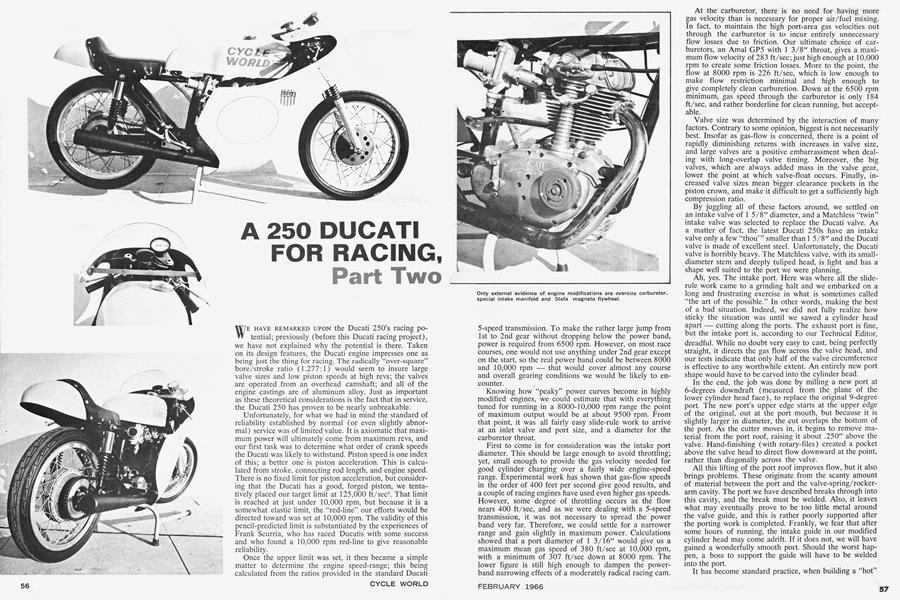
We also machined an intake manifold. This part was machined from the solid, with a flange at one end to bolt against the head, and the other end flanged to match the carburetor. Length is 3" from face to face, as this spacing gave us the correct overall tuned-length for the intake tract. The manifold's bore is tapered from 1 3/8" to 1 3/16" between carburetor and port.
With the valve lifts and diameters we had, the pistoncrown clearance pockets were deep enough, but had to be made slightly larger. More depth might have been required, but we used the stock valve seats, and in cutting these for the bigger valves, we also moved the valves deeper into the head. Incidentally, the intake valve seat area was re-cut to give a large radius, or rolled effect, to improve flow when the valve is just off its seat. We might add here, too, that if you attempt to use larger valves than we have recommended, the piston's valve clearance pockets may become so large that there will be too little metal left above the upper ring groove.
Little work is required down below the cylinder head joint. The stock piston was used, as it is a high-quality aluminum-alloy forging, and we did not feel that any of the alternatives offered any particular advantage. A higher piston crown would have been appreciated, as we lost some of the original 10.0:1 compression ratio by sinking the valves in the head, and cutting larger pockets in the piston crown. With those changes, the compression ratio drops to about 9.5:1 and we would prefer 10.5:1. In the future, we may machine the cylinder slightly shorter to move the piston farther into the head and boost the compression ratio up to the desired 10.5:1. A higher compression ratio would yield little gain in power, and with good breathing 10.5:1 will bring the engine near the point of detonation in any case.
One major modification we made that is not, in the strictest sense, entirely necessary, was to install a Swedishmade Stefa magneto. This unit is a standard fitting on the Greeves Challenger, and consists of a small rotor/generating coil/breaker-point assembly that feeds a low-tension output to a separate spark coil. Although primarily intended for two-strokes, it has been used on 4-stroke engines, and its performance in both types of engines has been outstanding.
To install this magneto, we machined a new shaft to replace the one that normally drives the point-breaker cam in the Ducati. The new shaft extends out past the timing case, and the magneto rotor is fixed to a taper at the shaft's end. The magneto's point plate fits into the recess provided for the stock point plate — after the recess is machined to a slightly larger diameter. We added a sleeve just behind the recess, and it holds a ball bearing that supports the shaft. With the added load imposed by the magneto rotor, we did not think that the original brass bushing would be up to the job. The bearing chosen is one with a seal on one side of the races, and this keeps the oil inside the timing case. The most difficult part of this whole conversion was in designing and machining a breaker cam right on the rotor shaft. There is not room to graft-in a breaker cam borrowed from something else.
Two reasons dictated this change. First, we could not use the Ducati magneto because its generating coil does not move with its points, and the points must be set to match the moment of maximum flux in that coil, rather than to whatever moment the engine might prefer for ignition. Thus, it is not possible (or at least not conveniently) to experiment much with spark-lead settings. Most "tuners' work around this by using a constant-loss battery/coil ignition, removing the Ducati generating coils and magnetic flywheel entirely. This works well, but at the expense of carrying a heavy battery — which is also a potential troublespot; battery plates sometimes disintegrate due to vibration. Also, a battery/coil system does not match the high-revs performance of the Stefa magneto, nor does it match the magneto's high rate of voltage rise, which makes for great resistance to plug fouling.
The only other modification made below the cylinder head was in the transmission shifter-mechanism. We installed a Sturtevant ratchet-fork, as the older Ducati forks will bend sometimes if the rider attempts to hurry shifts.
Before starting this project, we had the Ducati engine dynamometer-tested, and the results were a bit surprising. With megaphone in place, and after setting the spark and changing jets, to get maximum output, we found ourselves with an honest 22.2 bhp at 8500 rpm. There must be something very special in the air around the Ducati factory's dyno room, for they claim 28 bhp, net, at 8000 rpm (at those revs, our engine delivered 21.3 bhp.) It becomes even more curious when one considers that the Ducati Diana is one of the fastest stock 250s, and virtually all of Ducati's competitors claim much more than 22 bhp. Is it possible that somebody, or several somebodies, has been playing fast and loose with the truth?
There is, at present, no way for us to know how much power we have obtained. The dynamometer facility originally used is currently being renovated, and we do not feel that it would be fair to use other facilities—where we are not certain of accuracy. But, on the basis of such comparative tests as we have made (measuring the CYCLE WoRLD-Ducati's performance against the Technical Editor's Yamaha TD-1B), it would appear that we have that 30 bhp and perhaps a bit more. And, we have that wide spread of power. The engine is strong from 6500 rpm right to 10,000 rpm and beyond. It will go all the way to 11,000 rpm without separating, and without a trace of valve float. However, we do not expect that 11,000 rpm could be used very much without suffering a very nasty engine explosion.
Something we did not expect, but are delighted to have, is phenomenally easy starting. Most of our local races are held under FIM rules, with push starts, and if the Ducati does nothing else, it will be first at the first turn. When warm, you take three steps, hit the saddle and drop in the clutch. Invariably, this is followed by an explosion of exhaust noise and a rapidly disappearing motorcycle and rider.
Handling is good, though not outstanding, but the brakes work to perfection. Little pressure at the controls is needed to scrub off speed at a tremendous rate. With this, and the good low-speed pulling qualities of the engine, we expect that our Ducati will be quite a good short-course motorcycle. To make it effective on fast circuits, more sheer horsepower will be required, and we cannot, frankly, afford time for the prolonged development work needed to get that power. The amount of power needed would be in the order of 35-37 bhp, and to get that it will be necessary to direct efforts toward a power peak at probably 10,500 rpm, with the red-line up at 11,000. Reliability at that crank speed will not be good enough using a completely standard crank, rod and piston assembly. It can be done, however, by someone who can afford the time to find ways to keep the engine together while using 11,000 for long periods, and to develop a camshaft to give the horsepower.
At present, we have about 200 man-hours of time invested in the Ducati, and at retail prices (we won't try to kid you; we get a discount on most of this stuff) the CYCLE WoRLD-Ducati road racing motorcycle would represent an expenditure of slightly more than $1700. Before the bike reaches winning form (fast enough to compete on an equal basis with the Yamaha TD-IB, HarleyDavidson Sprint CR, or the new 250cc Bultaco TSS) we can envision that price being doubled. Presumably, the Ducati factory could afford this development cost; CYCLE WORLD magazine most definitely cannot afford the sheer number of hours involved — even though some individual enthusiasts can, and probably will.
What we hope we have done is to lay the groundwork for the above-mentioned enthusiasts. All modifications have been purposely held to things the individual can do, and we have given what we consider to be a good basis for further development. With this machine, we have demonstrated that a 1 3/8" GP carburetor works fine; that the stock valve springs do likewise; that you can get a good port carved into the head; and that the engine is quite safe up to 10,000 rpm without bearing, piston or valve-gear problems. From here on, it is every man for himself. It should be mentioned that the wet weight of the bike, complete with fairing, is 233-pounds, or 10-pounds less than the Yamaha TD-IB and probably 40-pounds less than a Sprint CR. Moreover, with a special frame (now possible under the AMA's rules) the Ducati's weight could probably be trimmed another 15-pounds and the handling improved. There is hope, Ducati Lovers; stay with it. ■