Triton-Vee Four
TRITON-VEE FOUR
BY CHRIS LAVERY
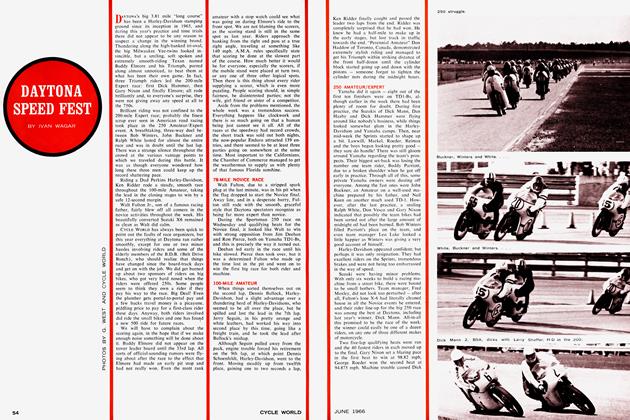
THE SIGHT OF TWO TRIUMPH ENGINES coupled in a single frame is nothing new. You see it on the drag strips repeatedly. But just look at this Norton-Triumph; the crankcases are welded together!
Sorry you can't see this monster in action, but right now it's in the window of Bob Foster's emporium in Parkstone, Dorset, England. For those who don't know, Bob was world's 350cc road-race champion in 1950 on an overhead-cam Velocette.
This 61-cubic-inch Norton-Triumph vee four is not Foster's, however. It belongs to Arthur Harris, an English scrambler who bought it in Napier, New Zealand, from Bill Plummer, the man who built it.
Some time back, Plummer was NZ side car racing champion, and he dreamed up this unusual method of joining two Tri umph engines, because it was the only way he could squeeze them into a Manx Norton frame without too much alteration.
The scheme worked out remarkably well. Framewise, all Bill had to do was weld in some extra-wide down tubes to clear the front cylinder head, then find a new loca tion for the oil tank.
Of course, the rear cylinder block and head had to be reversed to make room for the carburetor. Forward-facing carbs, as a means of free supercharging, are a myth. At somewhere around 80 mph, the air pressure over the jet builds up to the same level as that in the float chamber (14.7 lb.sq.in.), and so the gas stops flow ing.
But the rear carb on this plot is probably well enough shielded from a direct air blast to continue to work normally. Spe cial manifolds were made to offset the air intakes relative to one another.
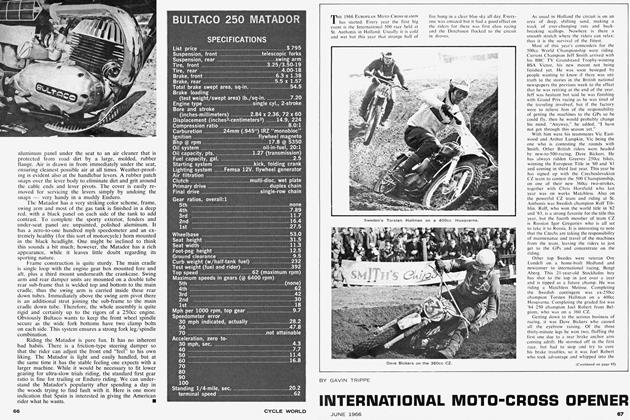
Before welding, the crankcases were cut away at an angle just clear of the flywheel rims. The cases are joined in such a way that the included angle between banks is about 60 degrees.
However, the crankshafts are coupled so that each pair of pistons is at top cen ter, while the others are at bottom center. Thus, the firing intervals are evenly spaced, and an ordinary four-cylinder distributor is used on the front crankcase.
Although the two crank chambers are in communication with one another, separate oiling systems are used,1 fed from a com mon tank. To join the shafts there is a train of gears in a case outboard of the rear engine sprocket. From there the drive goes to an AJS 7R gear box.
What use is a machine like this for European scrambling? None at all. Then why did Arthur Harris buy it? Because, after begging a ride on it during a visit to New Zealand, he just couldn't resist it.
Although it should be good for 160 mph, it is probably too short for dragging. But with its 75 or 80 bhp, it should be capable of creating a stir in sidecar racing.