Intelligent Motorcycling Part Vii
INTELLIGENT MOTORCYCLING PART VII
Safety on the Race Tracli
BILL KAYSING
"A man who is not afraid of the sea will soon be drowned for he will be going out on a day he shouldn’t. But we who are afraid of the sea — we are only drowned now and again."
J. M. SYNGE, The Aran Islands
SEVERAL YEARS AGO there was a young, well-liked motorcycle competition rider whose special talent was defying the trackless Western desert in the rough and ready sport of Hare and Hound racing. Most regrettably and ironically, after years of trophy-winning charges across the sandy wastes, he lost his life in an ordinary automobile accident. His passing seemed to add validity to the belief of many motorcycle riders that the most dangerous part of racing on two wheels is the trip by car to the track.
No attempt will be made in this review of safety on the track to claim that motorcycle racing is as safe as sitting at home watching retreaded monsters on TV. However, there are many active sports that are more hazardous, have less supervision and aren’t nearly as much fun. What follows should not be interpreted as an endorsement or recommendation of racing for every young rider who has just latched onto a 1/1 Oth liter two-stroke. On the other hand, it is believed that if a rider has made up his mind to race, he should have every advantage. To race safely he needs a wellengineered motorcycle, the best protective equipment available and most important, as much advance knowledge about the subject as can be acquired. This knowledge can dispel the trepidation of both the rider and his family since, as the saying goes, “Nothing is to be feared, it is only to be understood.”
CHOOSE YOUR RACE EVENT INTELLIGENTLY
Anyone wishing to give the race bit a go, has art astounding selection from which to choose. There are scrambles, TT, road racing, hilfclimbing, flattrack, trials, enduros and hare and hound events to mention a few. Which one is most suitable for a novice rider is a matter of personal preference. Many riders start out with scrambles racing since it is an event that is popular throughout the world. It is an easy event to stage and does not require elaborate preparation. In addition, it is almost too much fun for competitor and spectator alike. Because it is typical of motorcycle racing both here and abroad, the scrambles event is selected for a discussion of race safety. It incorporates elements of each type of race.
SCRAMBLES: FUN AT A REASONABLE INVESTMENT
In its broadest definition, scrambles racing involves a course which is partly improved and partly natural terrain. It may contain some stretches of smooth dirt road, sharp rights and lefts, ups and downs, water crossings, moderate cliffs and a jump or two to add spectator interest and rider thrills. Scrambles courses have infinite variety and range from the famous grass scrambles of England to the rough courses preferred in the Eastern United States and on out to the high speed TT scrambles tracks currently in vogue in the West.
THE MACHINES
Most scrambles-trim motorcycles are strongly built to withstand the steady and severe punishment of rough terrain and all-out demands on the power plant and transmission. Most riders prefer the largest tires (both front and rear) that the frame will permit. This allows maximum traction since traction is, as with any type of racing, the basic ingredient necessary to stay with the machine. Engines are now being designed with the objective of combining lightness and durability along with plenty of torque at both ends of the rpm spectrum. Both twoand four-stroke engines are used, each type having the backing of a loyal group of supporters.
Most scrambler machines are geared low — 20 or 30 miles per hour under normal top speed since speeds attained on a track average 40 or 50 mph and often less. Suspension is most important on a scrambler since keeping the machine on the ground where it can get a good “bite” is fundamental to forward progress. A few of the newest styles in front wneel suspension, sucn as leading nnks and double acting shocks, make it possioie for today’s amateur riaer to handle a machine as w’ell as an expert of a decade ago. Altogether, modern suspension has become what might be termed “forgiving” of riders’ errors.
Light metal or plastic fenders, a threequarter seat, bars that are fairly high, upswept pipes and back-folding pegs are the major items completing the typical scrambler in use today.
SAFETY YOU CAN WEAR
Fortunately, for all motorcycle competition riders, a good supply of new and improved safety equipment has appeared on the market since WW II. Research performed in the last decade or two has provided manufacturers with the necessary data to create designs which offer more effective protection. This is particularly true for helmets, an item virtually mandatory. For example, early helmet design was based on the erroneous belief that the helmet itself should withstand almost any shock and not be allowed to “give.” Today, all approved helmets incorporate the principle of permitting the helmet to collapse under load thus absorbing the shock of high speed contact. There is no question that this research will continue in the future and that motorcycle riders as well as other users of helmets will benefit greatly both in injury protection and simple “peace of mind.”
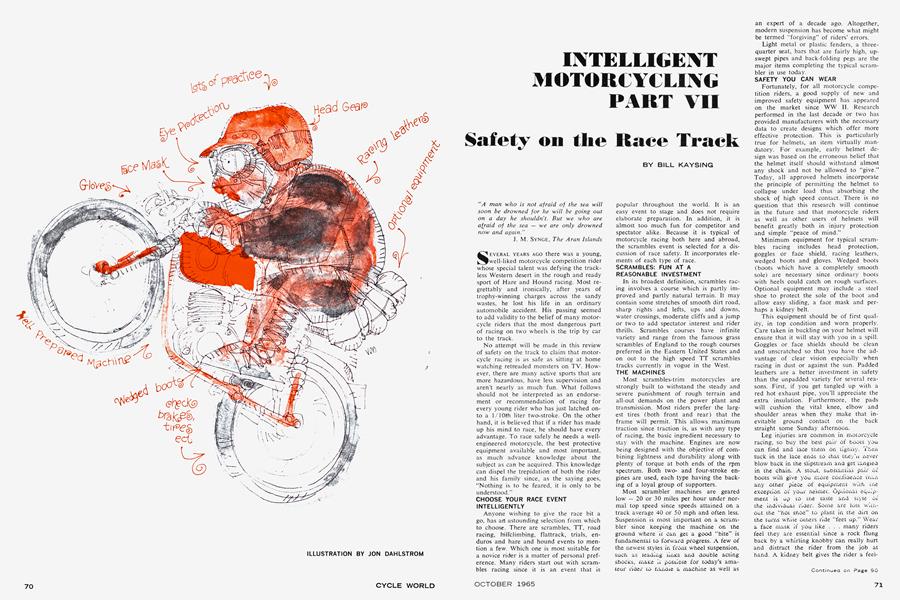
Minimum equipment for typical scrambles racing includes head protection, goggles or face shield, racing leathers, wedged boots and gloves. Wedged boots (boots which have a completely smooth sole) are necessary since ordinary boots with heels could catch on rough surfaces. Optional equipment may include a steel shoe to protect the sole of the boot and allow easy sliding, a face mask and perhaps a kidney belt.
This equipment should be of first quality, in top condition and worn properly. Care taken in buckling on your helmet will ensure that it will stay with you in a spill. Goggles or face shields should be clean and unscratched so that you have the advantage of clear vision especially when racing in dust or against the sun. Padded leathers are a better investment in safety than the unpadded variety for several reasons. First, if you get tangled up with a red hot exhaust pipe, you’ll appreciate the extra insulation. Furthermore, the pads will cushion the vital knee, elbow and shoulder areas when they make that inevitable ground contact on the back straight some Sunday afternoon.
Leg injuries are common in motorcycle racing, so buy the best pair of boots you can find and lace mem on tightly. Then tuck in the lace ends so mat mey’ji never blow back in the slipstream ana get tangiea in the cham. A stout, suosiantial pair or boots will give you more conti aenee man any other piece of equipment with me exception or your helmet. Optional equ.pment is up to toe taste and style or the individual naer. Nome are lost witnout the “not snoe” to plant in the airt on the turns while otners ride “feet up.” Wear a face mask if you like . . . many riders feel they are essential since a rock flung back by a whirling knobby can really hurt and distract the rider from the job at hand. A kidney belt gives the rider a feeiing of being well-bolted together - a welcome sensation where rough scrambles are encountered.
Continuea on Page 90
continued
Well-designed equipment of good quality and worn properly by a competition rider will go a long way toward contributing a feeling of safety and confidence. Wearing a suit of modern armor will foster a sensation of exhileration instead of “queasies” when you and the pack go roaring down that first long hill ... the one with the big lumps in it.
SOME PRELIMINARIES
Before beginning any kind of racing career, it is essential to study the rules in your local, national or international rule book. Learn what the various signal flags mean, what authority is vested in the officials and what to expect in the way of licenses, fees, points to be earned; in short, the academic side of racing.
In addition, it would be advantageous if all riders were well-versed in the subject of first aid. Injuries are inevitable in a sport this fast and dynamic. Most tracks are many miles from hospitals and doctors, and even a modest amount of intelligent care can help greatly. In recent years, it has become more common to see an ambulance and attendants present at race meets. However, a contestant should feel an obligation to look out for his fellow riders in the same manner as he would expect them to care for him.
If no regular medical aid is available and you are nearest to an injured rider, run your bike off the track and stop it. If necessary, you can act as flagman and slow traffic; then attend to the downed rider. First aid procedures can take place right on the track. However, it is usually best to wait until the race is over or stopped before moving the rider.
In summary, if you expect to be around the race scene for some time, prepare yourself to diminish the seriousness of injuries. This capability can be a real lifesaver on or off the track. Besides, knowing that your fellow riders are also prepared to render aid will make racing a more relaxed and enjoyable sport for you.
PRACTICE MAKES PERFECT (SAFETY)
Everyone who has been to watch a day of motorcycle racing has noticed the startling difference between the novice riders and the experts. Uncontrolled “wheelies” on the starting line followed by pile-ups in the first turn and speed wobbles down the straights are the marks of the unpracticed riders. Conversely, the experts really put on a show of craftsmanship on two wheels. From their flat, dragster starts to skillfully controlled brake and power slides to long, confident jumps, they uniformly exhibit the result of what is needed by every rider . . . practice and more practice. Due to the absence of qualifying time trials for most scrambles events, it becomes the responsibility of each rider to qualify himself before he ventures into competition.
Even before attempting race practice, a rider who intends to race should take plenty of time to become a better-thanaverage, off-the-road rider. Then, with protective equipment in place, he can enjoy some long afternoons of simulated starts, turns, jumps, and other race maneuvers on the terrain that will be encountered during an actual scrambles event. Of course, it would be ideal to practice on the race course itself and in some cases this is possible. However, regardless of where you practice, get in as much as you need, to allow a feeling of competence and confidence in your first heat race. Probably the most difficult task in the world would be to teach someone to ride skillfully exclusively through the printed word despite the fact that there are many books and articles on the subject. While it’s true that many generalities could be explained, no amount of prose could ever communicate just how a motorcycle feels as it crosses that dividing line between sticking in the groove and sliding out. This is something that must be experienced first-hand since it is similar situation to what early fliers called “seat of the pants” flying. As with most skills, motorcycle racing depends on automatic “conditioned” responses and these may only be attained through long hours of diligent practice. Read all the books on racing you wish but more important, practice, practice, practice. The more control you have over your machine, the safer you will be and so will your competitors.
The intelligent rider will seek to learn all about the limits of adhesion between his tires and the track while he is alone on the practice loop. He will take as many spills as are necessary to learn where this limit is at various speeds and under different surface conditions. With no one behind to crash into him, the practice rider can spill in virtual safety.
GETTING OFF
It is the author’s belief that the major cause of serious injury and death on the track is collision between a bike and a downed rider. Of course, this does not take place by intent on anyone’s part. Quite the contrary, riders will “lay it down” themselves to avoid hitting a fallen rider. However, when a rider spills at say, 40 mph, and the pack is only a few feet behind, there is no time for them to change direction.
If you race consistently, you are a candidate for a spill, so what’s the answer? Well, first of all there are techniques for getting off without injury. These techniques are practiced by tumblers, parachutists, circus performers and rodeo riders among others. In essence they involve the principle of rolling with your forward motion rather than attempting to stop prematurely by thrusting out hands and feet. Every motorcycle rider can benefit by studying these principles so that their use becomes a reflex.
Secondly, if you find yourself sprawled on the track with the pack coming on fast, your best defense is to simply stay where you are. Here’s why. The riders behind you are fully aware that you’ve unloaded and all of their efforts will be directed towards avoiding you in your present location. If you try to get up and run off the track, you will make it extremely difficult for pursuing riders to take the necessary corrective action. Instead of the simple task of avoiding a single stationary object, they will now have to avoid both a spilled bike and a human target moving at random. This creates the kind of uncertainty and confusion that could have all of your followers crashing into each other in one fantastic Keystone Kops tangle. Of course, if your fellow competitors are way back, then make haste off the track or at least get behind your machine which will afford some protection while also reducing the clutter.
When positions are reversed and a rider falls in front of you, it is expected that you will make every conceivable effort to avoid hitting him. Stop, run off the track, lay it down or run over the motorcycle . . . any expedient is worthwhile as long as you can avoid colliding with a downed rider. It is apparent at this point of the discussion why it is important for a rider to be at least moderately skillful ... it means more protection for the rider os well as his racing buddies.
A CONSIDERATION OF OTHER HAZARDS
Next to being run over after a spill, there is always the hazard of unloading and being hit by your own machine. The laws of physics tell us that there is more kinetic energy in a 250-pound scrambles machine than there is in a 160-pound rider. Thus, in a typical spill, the bike will travel further and faster than the rider. This is fine unless you are somehow ahead of the bike. Let’s take an example. In a TT scrambles event, a rider with a burning desire to improve his jumping record made a spectacular and lengthy leap. Regrettably, the machine flew so far that its front wheel dipped and touched first at a steep angle. The forks bent like knees and the rider was catapulted directly onto the track followed by his somersaulting machine. Luckily, only a broken bone or two resulted. Similar accidents have resulted in far more serious injury. There are definite limits as to how far a motorcycle will “fly” and the learning rider will seek to learn these limits from the safe side. After all, there are few things in life that you get to do once . . . there are few (if any) second tries with unopened parachutes, head-on collisions at 70 per, or end-overenders on a motorcycle where you become the machine’s landing platform.
In a scrambles event of three or four laps, it is most important that you make a good start and that you come out of the first turn leading or with the leaders. However, on occasion there are as many as twelve motorcycles with an average width of 30 inches to go through a space considerably less than 12 times 30 inches or 30 feet! Obviously some of the riders are going to have to shut down and form into rows. Fortunately, by the time the first turn is reached, superior power or ability has created a wedge-shaped grouping. The fastest machines and alert starters are in front, the bulk of the riders in the middle and a handful of late starters and inept riders bringing up the rear. It is advisable for the novice rider to hang back a little on his first few starts since, if he does fall, there are fewer riders to make like swift steamrollers.
Like life itself, most scrambles have a few hills which add both interest and hazard. As any rider knows, going uphill feels easier and safer than going down despite all the early newsreels showing hillclimbers flipping over backwards. Usually the rider is going slower uphill and if he should lose control, he can step away from the machine. However, when speeding downhill in a scrambles, the wise competitor leaves a little margin for the unpredictables. There are always the little wheel-catching holes, the off-camber turns, and the steep drop-offs that can cause palpitating endovers. Here again, the machine can act like a catapult and project the rider ahead of itself and then turn into a fair facsimile of a drophammer. In addition, due to the downward slant of a bike on a hill, the front brake becomes more potent . . . use it with extreme care.
Many falls occur in turns. This is the place where most care should be exercised both from the standpoint of hitting and being hit. Many novice riders misjudge the radius of a turn and come in much too fast. This can cause them to swing too wide and run off the course or, while braking hard, to lose it in a slide-out or high-sider. Whether you are a rail rider or are partial to the wall, prepare for the turn while you are still in the straight. Keep a sharp eye on the surface characteristics of every curve. For example, a fast scrambler friend of mine once miscalculated the degree of dampness of a curve just after the passage of the water truck. Result — a high-side and a broken wrist. Also, after several heat races, a bank of earth will build up. This “groove” is fine if you stay in it but it also makes a fine tripping device for your front wheel should you hit it at the wrong angle at low' speed. Another element to consider where turns are concerned are the hidden chuck holes filled with loose earth. These are created by spinning knobbies and then filled by the grader. While it may look like solid track, it’s really only a concealed w'heel catcher. Normally, your machine would bound right through one without hesitation. However, at the reduced speeds traveled in turns, these holes can behave like bear traps on your wheels.
As for straights, this is a part of the scrambles track where brute horsepower counts most and riding skill becomes secondary. How'ever, there is a leveling influence since too much speed in a straight can cause the rider to overshoot the turn. Although speeds are higher, the average rider is probably safer in the straight than anywhere else on the track. This is because of the law of physics w'hich states that the greater the speed of a motorcycle, the greater its stability. Jumps and holes become like a smooth highway to a scrambler at speed. Here is the opportunity for the novice rider to make up for ineptness in the turns. However, don’t ever forget that turn coming up . . . this is one instance where it’s sooner than you think.
SUMMARY
Ahvays race to win whether you win or not. Give it your best within the limits of your inherent ability and practiced skill. Don’t jeopardize your own life and the lives of your fellow' competitors because you failed to train yourself properly. Practice the art of motorcycle racing until you have the confidence that is derived from experience. Then you can go out on the track and be recognized as a capable, intelligent and safety-conscious rider . . . the type of rider that you yourself would want to ride with in the main event. •