The Incredible Speedy Babbs
THE INCREDIBLE SPEEDY BABBS
JAMES T. CROW
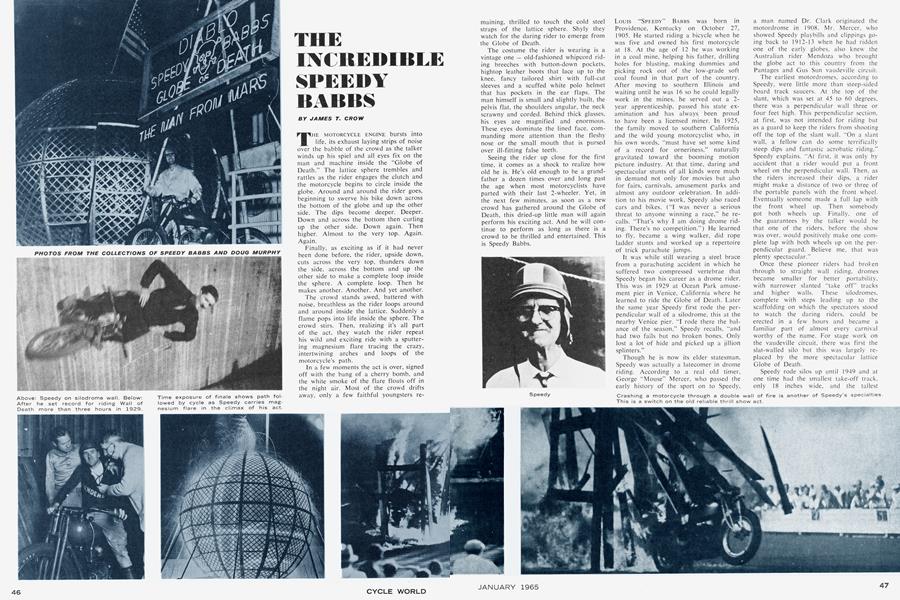
THE MOTORCYCLE ENGINE bursts into life, its exhaust laying strips of noise over the babble of the crowd as the talker winds up his spiel and all eyes fix on the man and machine inside the “Globe of Death.” The lattice sphere trembles and rattles as the rider engages the clutch and the motorcycle begins to circle inside the globe. Around and around the rider goes, beginning to swerve his bike down across the bottom of the globe and up the other side. The dips become deeper. Deeper. Down and across the bottom then curling up the other side. Down again. Then higher. Almost to the very top. Again. Again.
Finally, as exciting as if it had never been done before, the rider, upside down, cuts across the very top, thunders down the side, across the bottom and up the other side to make a complete loop inside the sphere. A complete loop. Then he makes another. Another. And yet another.
The crowd stands awed, battered with noise, breathless as the rider loops around and around inside the lattice. Suddenly a flame pops into life inside the sphere. The crowd stirs. Then, realizing it’s all part of the act, they watch the rider repeat his wild and exciting ride with a sputtering magnesium flare tracing the crazy, intertwining arches and loops of the motorcycle’s path.
In a few moments the act is over, signed off with the bang of a cherry bomb, and the white smoke of the flare floats off in the night air. Most of the crowd drifts away, only a few faithful youngsters remaining, thrilled to touch the cold steel straps of the lattice sphere. Shyly they watch for the daring rider to emerge from the Globe of Death.
The costume the rider is wearing is a vintage one — old-fashioned whipcord riding breeches with button-down pockets, hightop leather boots that lace up to the knee, fancy tailored shirt with full-cut sleeves and a scuffed white polo helmet that has pockets in the ear flaps. The man himself is small and slightly built, the pelvis flat, the shoulders angular, the neck scrawny and corded. Behind thick glasses, his eyes are magnified and enormous. These eyes dominate the lined face, commanding more attention than the fleshy nose or the small mouth that is pursed over ill-fitting false teeth.
Seeing the rider up close for the first time, it comes as a shock to realize how old he is. He’s old enough to be a grandfather a dozen times over and long past the age when most motorcyclists have parted with their last 2-wheeler. Yet, in the next few minutes, as soon as a new crowd has gathered around the Globe of Death, this dried-up little man will again perform his exciting act. And he will continue to perform as long as there is a crowd to be thrilled and entertained. This is Speedy Babbs.
Louis “SPEEDY” BABBS was born in Providence, Kentucky on October 27, 1905. He started riding a bicycle when he was five and owned his first motorcycle at 18. At the age of 12 he was working in a coal mine, helping his father, drilling holes for blasting, making dummies and picking rock out of the low-grade soft coal found in that part of the country. After moving to southern Illinois and waiting until he was 16 so he could legally work in the mines, he served out a 2year apprenticeship, passed his state examination and has always been proud to have been a licensed miner. In 1925, the family moved to southern California and the wild young motorcyclist who, in his own words, “must have set some kind of a record for orneriness,” naturally gravitated toward the booming motion picture industry. At that time, daring and spectacular stunts of all kinds were much in demand not only for movies but also for fairs, carnivals, amusement parks and almost any outdoor celebration. In addition to his movie work, Speedy also raced cars and bikes. (“I was never a serious threat to anyone winning a race,” he recalls. "That’s why I am doing drome riding. There's no competition.”) He learned to fly, became a wing walker, did rope ladder stunts and worked up a repertoire of trick parachute jumps.
It was while still wearing a steel brace from a parachuting accident in which he suffered two compressed vertebrae that Speedy began his career as a drome rider. This was in 1929 at Ocean Park amusement pier in Venice, California where he learned to ride the Globe of Death. Later the same year Speedy first rode the perpendicular wall of a silodrome, this at the nearby Venice pier. “I rode there the balance of the season.” Speedy recalls, “and had two falls but no broken bones. Only lost a lot of hide and picked up a jillion splinters.”
Though he is now its elder statesman. Speedy was actually a latecomer in drome riding. According to a real old timer, George “Mouse” Mercer, who passed the early history of the sport on to Speedy,
a man named Dr. Clark originated the motordrome in 1908. Mr. Mercer, who showed Speedy playbills and clippings going back to 1912-13 when he had ridden one of the early globes, also knew the Australian rider Mendoza who brought the globe act to this country from the Pantages and Gus Sun vaudeville circuit.
The earliest motordromes, according to Speedy, were little more than steep-sided board track saucers. At the top of the slant, which was set at 45 to 60 degrees, there was a perpendicular wall three or four feet high. This perpendicular section, at first, was not intended for riding but as a guard to keep the riders from shooting off the top of the slant wall. “On a slant wall, a fellow can do some terrifically steep dips and fantastic acrobatic riding,” Speedy explains. “At first, it was only by accident that a rider would put a front wheel on the perpendicular wall. Then, as the riders increased their dips, a rider might make a distance of two or three of the portable panels with the front wheel. Eventually someone made a full lap with the front wheel up. Then somebody got both wheels up. Finally, one of the guarantees by the talker would be that one of the riders, before the show was over, would positively make one complete lap with both wheels up on the perpendicular guard. Believe me, that was plenty spectacular.”
Once these pioneer riders had broken through to straight wall riding, dromes became smaller for better portability, with narrower slanted “take off” tracks and higher walls. These silodromes. complete with steps leading up to the scaffolding on which the spectators stood to watch the daring riders, could be erected in a few hours and became a familiar part of almost every carnival worthy of the name. For stage work on the vaudeville circuit, there was first the slat-walled silo but this was largely replaced by the more spectacular lattice Globe of Death.
Speedy rode silos up until 1949 and at one time had the smallest take-off track, only 18 inches wide, and the tallest =straight wall of any drome. 16 feet. “This is actual,” Speedy says, “Not the hokedup measurements the front man tells about — 90 miles an hour and 25 feet high.”
During Speedy’s 35-year career as a drome rider he has performed all over the western hemisphere, including several of the Caribbean islands. He has performed indoors and outdoors, he has given sensational performances with his globe hanging free in the air and has been in innumerable movies and television shows. Recently his act was featured in “The Greatest Show on Earth,” his motorcycle looping around and around inside the lattice work of his Globe of Death.
The bike that Speedy rides in his act is an ancient Indian Arrow, probably one of the last of these famous machines still in regular use. Speedy has been an Indian rider for many years and, like most Indian riders, has nothing but scorn for the riders of Harley-Davidsons. “When somebody comes up and tells me what a hot shot he is and how he used to ride the 'tub,' you can be sure he’s a Big Harley Rider and usually his cycle is so fast he has to keep it in second gear riding around town.”
IN I HI YEARS that Speedy has been a trick rider and stunt man, he has had his full share of accidents and injuries. He has had a total of 54 bones broken (including two ribs last season) and on one occasion was almost burned to death while making a parachute jump. This happened over Ocean Park pier one Fourth of July when Speedy was supposed to light and toss out fireworks while floating to the ground. "The first bomb I lit dropped sparks inside the large fruit-picking sack containing my fireworks.” Speedy recalls with a shake of his head. "And all hell cut loose. The only way I could unload — because I'd sewed the sack to my clothes so the load couldn't drop accidentally — was to reach inside and throw them out. That is one time I had more fireworks than I wanted to shoot at one time."
He was picked up about two miles off shore with first, second and third degree burns and the next day a Los Angeles paper announced, "Stunt man not expected to live!"
Not all his accidents have been so grim. In 1933. Speedy signed on with an illfated carnival that went to Mexico. Speedy had many adventures on that trip, fighting a bull from the back of a motorcycle, making a parachute jump to attract attention to the carnival, and riding a small 16-ft half slant, half wall drome in a staged race with a rhesus monkey that was “driving” an outboard-powered midget car. “I’d trick ride on the straight wall and play around on the slant, racing Mr. Chongo. It was a brand new drome and the walls were slick and I skidded and there was a crash. Motorcycle, myself, midget car and Mr. Chongo ended up in a tangle on the bottom. This monkey was mean as hell at best and when he got untangled he blamed me for the wreck and commenced to chew on my leg. Scars I still have from that encounter,” he says.
THE HOME OF Speedy Babbs is a converted bus, rather battered now, with “Here Comes Speedy Babbs” across the front and appropriate advertisements emblazoned along the sides. The Globe of Death breaks down into sections and these are carried on top. along with a spare tire. Inside are Speedy’s living quarters, completely outfitted for his pleasure and including a shortwave radio, hi fi, tape recorder, Citizen's Band ham radio (KKP 2829) air conditioner, color television and even an electric typewriter.
In his bus he moves from engagement to engagement, wintering in Florida, traveling north with the spring and returning in the fall. A seasoned traveler, Speedy makes himself at home wherever he goes. “Usually a conniving wisenheimer like myself can find a hot outlet somewhere to cut in on so I can have all the comforts of home while en route. I have even cut in on roadside electric signs, had TV and all the works, way to hell and gone from nowhere.”
Speedy has been married twice, once to a woman who had no legs as the result of an accident in childhood. This wife, called Miss Alverna, starred with him in their “Dare Devil Circus,” riding a motorcycle on rollers and doing acrobatic stunts as the bike roared along on the treadmill. Both of Speedy's marriages ended in divorce and he now lives a solitary existence in his bus. He denies being lonely, however, pointing to his wide circle of friends and acquaintances all over the country. “I have yet to go anywhere and not meet someone that knows me. I firmly believe that if I was to walk down a dusty street in Timbuctoo, I’d meet someone that knew me.”
LIKE MOST MEN who have made their career in a spectacular and dangerous profession. Speedy plays down his own courage, turning to his own special brand of humor, but he never minimizes the skill that is required to perform his stunts. About drome riding, he says, “Believe me, this is an art. Anybody that tries to ride a globe or a wall has guts but that is not what it takes. It is just as much an art as playing a violin. A violin has only four strings and the trick is to draw the bow across a certain string at a certain time. It’s as simple as that but still there are fiddlers and there are concert violinists.”
The unforgivable sin to Speedy and to men like him, is for an unqualified person to claim to be a member of his select profession. “There is positively no way a towner can pass himself off as a drome rider,” Speedy asserts. “And when one tries to make out to be one of us, he is either told off in no uncertain terms or we lead him along and let him flounder in his own lies.”
Although there was a time 35-40 years ago when there were dozens, perhaps hundreds, of experienced drome riders, there are at present less than a dozen performers in the U.S. that Speedy would classify as “real trick riders.” Those that are still active are a close-knit group, staying in touch with each other through correspondence and through the highly effective medium of carnival gossip. The fraternity of drome riders even extends to foreign countries and Speedy recently heard from an old friend, Doug Murphy, an Englishman who is making an extended tour through the Middle East with his silodrome act and doing a terrific business.
One of the hallmarks of Speedy's career as a stunt man is the great pride he takes in putting on a good show. Indicative of his dedication to his profession is a promise he makes to his audience whenever he tries out a new act on them. “This is going to be good,” he assures them, “if I can do it.” Then, with a quick grin, he adds, “And if I can't do it, it'll still be good.”
As to the future, Speedy’s plans are definite. He’s going to keep right on riding. “Many times I've been asked when I plan on retiring. I don't. I’m having too much fun riding motorcycles and traveling around the country. I've been around a long time and every once in a while I hear somebody telling what a great rider my Dad was and how they remember seeing him in such and such a place. It’s quite a let-down for them when they realize that it’s not the son carrying on the act but the old man that has never quit."
Then Speedy gives his quick little grin and says, "As I've said many times when the subject of my death comes up. if I can’t take my Greyhound bus and my motorcycles with me, I ain’t a-goin’ to go.”