Honda Cr-110
HONDA CR-110
Cycle World Track Impression
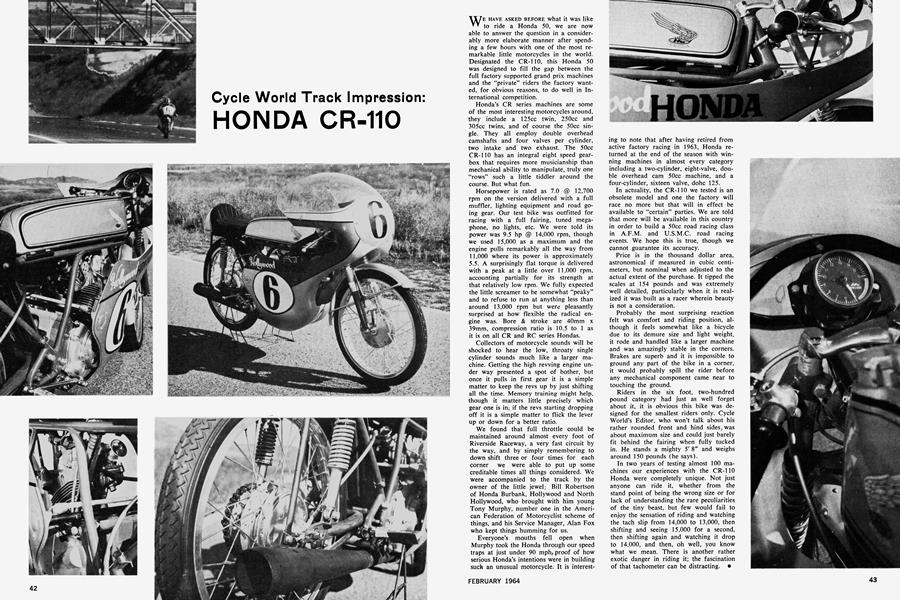
WE HAVE ASKED BEFORE what it Was like to ride a Honda 50, we are now able to answer the question in a considerably more elaborate manner after spending a few hours with one of the most remarkable little motorcycles in the world. Designated the CR-110, this Honda 50 was designed to fill the gap between the full factory supported grand prix machines and the "private" riders the factory wanted, for obvious reasons, to do well in International competition.
Honda's CR series machines are some of the most interesting motorcycles around, they include a 125cc twin, 250cc and 305cc twins, and of course the 50cc single. They all employ double overhead camshafts and four valves per cylinder, two intake and two exhaust. The 50cc CR-110 has an integral eight speed gearbox that requires more musicianship than mechanical ability to manipulate, truly one "rows" such a little tiddler around the course. But what fun.
Horsepower is rated as 7.0 @ 12,700 rpm on the version delivered with a full muffler, lighting equipment and road going gear. Our test bike was outfitted for racing with a full fairing, tuned megaphone, no lights, etc. We were told its power was 9.5 hp @ 14,000 rpm, though we used 15,000 as a maximum and the engine pulls remarkably all the way from 11,000 where its power is approximately 5.5. A surprisingly flat torque is delivered with a peak at a little over 11,000 rpm, accounting partially for its strength at that relatively low rpm. We fully expected the little screamer to be somewhat "peaky" and to refuse to run at anything less than around 13,000 rpm but were pleasantly surprised at how flexible the radical engine was. Bore & stroke are 40mm x 39mm, compression ratio is 10.5 to 1 as it is on all CR and RC series Hondas.
Collectors of motorcycle sounds will be shocked to hear the low, throaty single cylinder sounds much like a larger machine. Getting the high revving engine under way presented a spot of bother, but once it pulls in first gear it is a simple matter to keep the revs up by just shifting all the time. Memory training might help, though it matters little precisely which gear one is in; if the revs starting dropping off it is a simple matter to flick the lever up or down for a better ratio.
We found that full throttle could be maintained around almost every foot of Riverside Raceway, a very fast circuit by the way, and by simply remembering to down shift three or four times for each corner we were able to put up some creditable times all things considered. We were accompanied to the track by the owner of the little jewel; Bill Robertson of Honda Burbank, Hollywood and North Hollywood, who brought with him young Tony Murphy, number one in the American Federation of Motorcyclist scheme of things, and his Service Manager, Alan Fox who kept things humming for us.
Everyone's mouths fell open when Murphy took the Honda through our speed traps at just under 90 mph, proof of how serious Honda's intentions were in building such an unusual motorcycle. It is interesting to note that after having retired from active factory racing in 1963, Honda returned at the end of the season with winning machines in almost every category including a two-cylinder, eight-valve, double overhead cam 50cc machine, and a four-cylinder, sixteen valve, dohc 125.
In actuality, the CR-110 we tested is an obsolete model and one the factory will race no more but that will in effect be available to "certain" parties. We are told that more will be available in this country in order to build a 50cc road racing class in A.F.M. and U.S.M.C. road racing events. We hope this is true, though we cannot guarantee its accuracy.
Price is in the thousand dollar area, astronomical if measured in cubic centimeters, but nominal when adjusted to the actual extent of the purchase. It tipped the scales at 154 pounds and was extremely well detailed, particularly when it is realized it was built as a racer wherein beauty is not a consideration.
Probably the most surprising reaction felt was comfort and riding position, although it feels somewhat like a bicycle due to its demure size and light weight, it rode and handled like a larger machine and was amazingly stable in the corners. Brakes are superb and it is impossible to ground any part of the bike in a corner, it would probably spill the rider before any mechanical component came near to touching the ground.
Riders in the six foot, two-hundred pound category had just as well forget about it, it is obvious this bike was designed for the smallest riders only. Cycle World's Editor, who won't talk about his rather rounded front and hind sides, was about maximum size ánd could just barely fit behind the fairing when fully tucked in. He stands a mighty 5' 8" and weighs around 150 pounds (he says).
In two years of testing almost 100 machines our experiences with the CR-110 Honda were completely unique. Not just anyone can ride it, whether from the stand point of being the wrong size or for lack of understanding the rare peculiarities of the tiny beast, but few would fail to enjoy the sensation of riding and watching the tach slip from 14,000 to 13,000, then shifting and seeing 15,000 for a second, then shifting again and watching it drop to 14,000, and then, oh well, you know what we mean. There is another rather exotic danger in riding it; the fascination of that tachometer can be distracting.