Greeves Silverstone Revisited
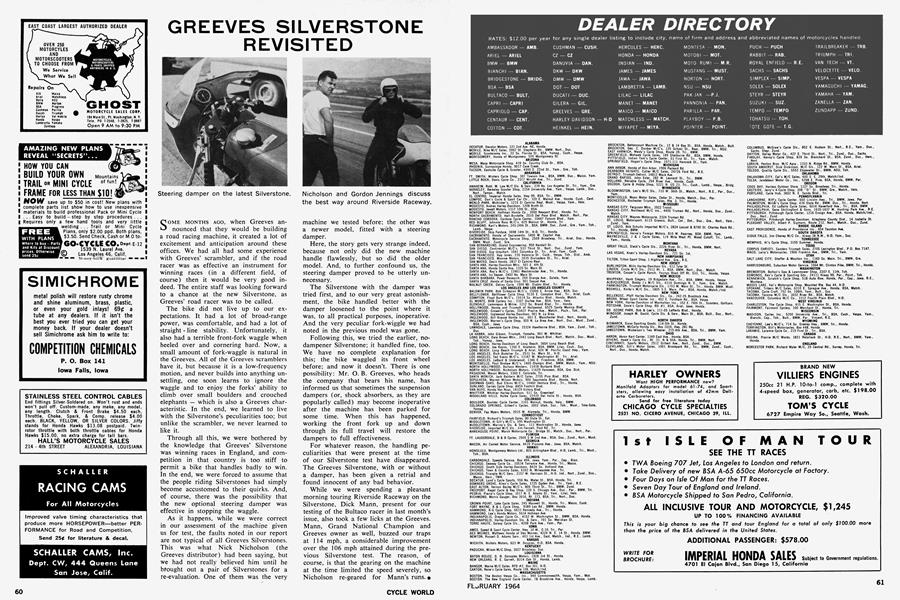
GREEVES SILVERSTONE REVISITED
SOME MONTHS AGO, when Greeves announced that they would be building a road racing machine, it created a lot of excitement and anticipation around these offices. We had all had some experience with Greeves' scrambler, and if the road racer was as effective an instrument for winning races (in a different field, of course) then it would be very good indeed. The entire staff was looking forward to a chance at the new Silverstone, as Greeves' road racer was to be called.
The bike did not live up to our expectations. It had a lot of broad-range power, was comfortable, and had a lot of straight - line stability. Unfortunately, it also had a terrible front-fork waggle when heeled over and cornering hard. Now, a small amount of fork-waggle is natural in the Greeves. All of the Greeves scramblers have it, but because it is a low-frequency motion, and never builds into anything unsettling, one soon learns to ignore the waggle and to enjoy the forks' ability to climb over small boulders and crouched elephants — which is also a Greeves characteristic. In the end, we learned to live with the Silverstone's peculiarities too; but unlike the scrambler, we never learned to like it.
Through all this, we were bothered by the knowledge that Greeves' Silverstone was winning races in England, and competition in that country is too stiff to permit a bike that handles badly to win. In the end, we were forced to assume that the people riding Silverstones had simply become accustomed to their quirks. And, of course, there was the possibility that the new optional steering damper was effective in stopping the waggle.
As it happens, while we were correct in our assessment of the machine given us for test, the faults noted in our report are not typical of all Greeves Silverstones. This was what Nick Nicholson (the Greeves distributor) had been saying, but we had not really believed him until he brought out a pair of Silverstones for a re-evaluation. One of them was the very
machine we tested before; the other was a newer model, fitted with a steering damper.
Here, the story gets very strange indeed, because not only did the new machine handle flawlessly, but so did the older model. And, to further confound us, the steering damper proved to be utterly unnecessary.
The Silverstone with the damper was tried first, and to our very great astonishment, the bike handled better with the damper loosened to the point where it was, to all practical purposes, inoperative. And the very peculiar fork-wiggle we had noted in the previous model was gone.
Following this, we tried the earlier, nodampener Silverstone; it handled fine, too. We have no complete explanation for this; the bike waggled its front wheel before; and now it doesn't. There is one possibility: Mr. O. B. Greeves, who heads the company that bears his name, has informed us that sometimes the suspension dampers (or, shock absorbers, as they are popularly called) may become inoperative after the machine has been parked for some time. When this has happened, working the front fork up and down through its full travel will restore the dampers to full effectiveness.
For whatever reason, the handling peculiarities that were present at the time of our Silverstone test have disappeared. The Greeves Silverstone, with or without a damper, has been given a retrial and found innocent of any bad behavior.
While we were spending a pleasant morning touring Riverside Raceway on the Silverstone, Dick Mann, present for our testing of the Bultaco racer in last month's issue, also took a few licks at the Greeves. Mann, Grand National Champion and Greeves owner as well, buzzed our traps at 114 mph, a considerable improvement over the 106 mph attained during the previous Silverstone test. The reason, of course, is that the gearing on the machine at the time limited the speed severely, so Nicholson re-geared for Mann's runs.